
Payment systems generate far more information than a simple approved-or-declined response. A single payment can move through authorization, capture, settlement, merchant funding, refund, dispute, and accounting processes, with different records created at each stage.
Payment API reporting gives businesses a programmatic way to retrieve, organize, validate, and analyze those records.
For developers and technical teams, reporting APIs provide structured transaction data that applications can query automatically. For finance and accounting teams, the same information can support reconciliation, settlement verification, fee analysis, refund tracking, and accounting integration.
Ecommerce teams, SaaS businesses, marketplaces, and multi-location operators can also use reporting data to understand payment status and operational activity across different systems.
The challenge is that payment reporting is not standardized across every integration. API endpoints, status terminology, available fields, historical retention, settlement details, fee breakdowns, pagination methods, and update timing can differ substantially.
A reporting integration therefore needs more than an endpoint that returns transactions; it needs controls for completeness, security, synchronization, exceptions, and changing data.
This guide explains the payment API reporting features that matter most, how payment information moves through reporting systems, and how businesses can build reporting workflows that remain useful as transaction volume and operational complexity grow.
What Is Payment API Reporting?
Payment API reporting is the process of retrieving payment-related information through application programming interfaces rather than relying entirely on a graphical dashboard or manually downloaded statement.
An authorized application might send a request to an API endpoint asking for transactions completed during a particular date range. The payment data API can return structured records containing transaction IDs, amounts, currencies, payment statuses, timestamps, settlement details, refund information, processing fees, dispute data, and related metadata.
A broader introduction to payment APIs explains how APIs can connect business applications with authorization, capture, refunds, recurring billing, reporting, and reconciliation workflows.
Payment API reporting differs from several related tools.
A dashboard is primarily designed for people. An employee signs in, applies filters, views totals, searches transactions, and may download reports. Dashboards are valuable for investigation and day-to-day operations but are harder to integrate into automated workflows.
A downloadable statement or report is usually a snapshot created for a defined reporting period. It may be useful for accounting or recordkeeping, but obtaining and importing it can involve manual work.
A reporting API allows software to request transaction information when needed. It can support automated synchronization with databases, accounting systems, internal dashboards, reconciliation engines, and business intelligence workflows.
A webhook, by contrast, sends an event notification to an application when something happens. A webhook might report that a payment was captured or a refund completed. It generally does not replace an API that can retrieve the complete current state or historical records.
These tools often work together. Webhooks can provide fast event awareness, reporting APIs can verify the latest state, dashboards can support investigations, and periodic statements can serve as finalized financial records when the payment arrangement provides them.
Why Payment Reporting APIs Matter
A payment reporting API creates a structured connection between payment activity and the systems that need to understand it. Without that connection, teams may have to compare order systems, transaction dashboards, settlement reports, bank deposits, refund records, and accounting entries manually.
Financial reconciliation is one of the most important applications. A payment reconciliation API can help match internal sales records to payment transactions and later connect those transactions to settlement batches and deposits. Unique identifiers make it possible to trace a payment through the process rather than comparing totals alone.
Reporting APIs can also support accounting automation. For example, an integration may retrieve gross captured payments, processing fees, refunds, chargebacks, and net settlement amounts so that the accounting workflow can post them to appropriate accounts or clearing ledgers.
Other practical uses include:
- Monitoring successful, pending, declined, and failed transactions.
- Helping customer support locate a payment and verify refund status.
- Tracking full and partial refunds.
- Identifying disputes requiring attention.
- Reviewing processing fees and adjustments.
- Verifying settlement activity against deposits.
- Separating activity by location, channel, merchant identifier, or business unit.
- Tracking subscription renewals and recurring payment failures.
- Building operational dashboards from API-based payment reporting.
- Measuring transaction activity without manually compiling reports.
The business value comes from consistency and traceability rather than simply having more data. A reporting system is most useful when each order, authorization, capture, refund, settlement, and accounting entry can be connected with reliable identifiers.
This also means reporting should be designed during the broader payment API integration process rather than added as an afterthought. Reporting requirements affect which identifiers should be stored, how timestamps should be normalized, which webhook events matter, and how financial exceptions should be handled.
Core Payment API Reporting Features

Modern payment processing API reporting generally needs several capabilities because a single transaction list rarely contains everything required for finance, operations, and technical monitoring.
Search and filtering are foundational. Applications should be able to locate individual payments using a transaction ID, order reference, customer reference, or another supported identifier. Date-range filters and status filters help prevent applications from retrieving large volumes of irrelevant information.
Pagination becomes critical when a query returns more records than an API permits in one response. Sorting helps create predictable retrieval sequences, while custom metadata allows businesses to preserve references such as an internal order number, subscription identifier, location code, or sales channel.
Settlement, fee, refund, and dispute reporting provide the financial context that transaction authorization data alone cannot supply. Export functionality may also be important where teams need CSV, JSON, spreadsheet, database, or accounting-system outputs.
Real-time or near-real-time information can be useful for operations, while historical reporting is essential for reconciliation and investigations. These should not automatically be treated as interchangeable because recent records may still change as payment processing continues.
Key Payment API Reporting Features
| Reporting feature | What it provides | Business use | Important consideration |
| Transaction reporting | Individual payment records and statuses | Order verification and support | Fields vary by implementation |
| Settlement reporting | Batches, settlement amounts and references | Deposit reconciliation | Settlement is separate from authorization |
| Fee reporting | Processing costs and adjustments | Cost analysis and accounting | Fee detail may be limited |
| Refund reporting | Full and partial refund activity | Customer service and reconciliation | Link refunds to original payments |
| Dispute reporting | Disputed payments and case status | Dispute management | Status can change over time |
| Filters | Date, status, currency, location and other criteria | Efficient queries | Supported filters vary |
| Pagination | Retrieval of large result sets | Historical synchronization | Every page must be processed |
| Exports | Structured data files or feeds | Accounting and analysis | Maintain schema consistency |
| Webhooks | Event-driven notifications | Fast operational updates | Events may require API verification |
| Reconciliation | Connections between payments, settlements and deposits | Financial control | Stable identifiers are essential |
Transaction-Level Reporting and Payment Status
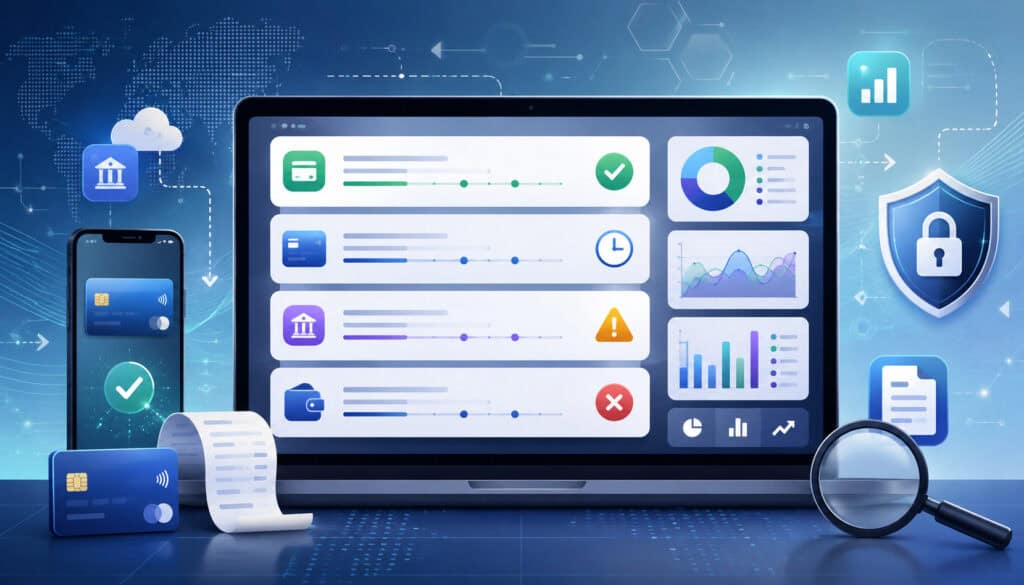
The payment transaction reporting API is usually the starting point for operational reporting. Each transaction record represents a payment or payment-related action and normally contains identifiers, monetary fields, timestamps, status information, and contextual data.
Common fields can include:
- Transaction ID
- Order ID
- Customer reference
- Amount
- Currency
- Payment method
- Authorization status
- Capture status
- Transaction date
- Refund status
- Settlement status
- Processing channel
- Location identifier
- Custom metadata
Exact fields vary by API. Some systems use one transaction object containing multiple lifecycle fields, while others create separate authorization, capture, refund, settlement, or adjustment objects.
Payment status terminology can vary just as much. Common concepts include created, pending, authorized, captured, declined, failed, cancelled, refunded, partially refunded, disputed, and settled.
Applications should never assume that identical words have identical meanings across APIs. One implementation might describe a successful payment as “captured,” another might use a different lifecycle state, and another might distinguish payment success from settlement status entirely.
Status transitions also matter. A pending payment can later succeed or fail. A captured payment can later receive a refund. A settled transaction can subsequently become associated with a dispute or adjustment.
Applications therefore benefit from storing both the provider-facing status and an internally normalized status. The original value preserves auditability, while the normalized value lets internal systems treat similar lifecycle states consistently.
Authorization and Capture Reporting
Authorization and capture represent different stages of many payment workflows, and reporting should preserve that distinction.
An authorization generally indicates that a payment request has been evaluated and approved for a specified amount. It does not necessarily mean that the transaction has been captured, settled, or deposited into the business’s account.
Capture moves an approved payment further into the processing lifecycle. Some businesses authorize and capture in one workflow, while others authorize first and capture later after inventory confirmation, shipment, service completion, or another operational event.
Reporting authorization and capture separately can reveal problems that a simple “successful payment” field would hide. For example, an order system may show that an authorization succeeded but the corresponding capture was never submitted. Another authorization may expire or otherwise become unusable before capture.
Useful reporting data may include the original authorization transaction ID, authorization amount, authorized timestamp, capture transaction ID, captured amount, capture timestamp, and current status. Partial capture information may also be important where supported.
A reconciliation process should not treat an authorization amount as settled revenue. Authorization, capture, settlement, and bank funding are distinct stages, even when an interface makes them appear close together.
Settlement, Funding, Fees, Refunds, and Disputes
A payment gateway reporting API becomes particularly useful when transaction data can be connected to the financial events that follow capture.
Settlement reporting may contain settlement dates, batch identifiers, gross transaction amounts, refunds, chargebacks, fees, adjustments, net settlement amounts, and deposit references. Depending on the implementation, settlement records may represent a batch, payout, funding event, or another grouping used by the payment system.
The important distinction is that authorization, capture, settlement, and merchant funding should not be treated as the same event. A captured payment may become part of a later settlement batch, and the corresponding bank deposit may reflect several transactions plus refunds, fees, disputes, or adjustments.
Fee reporting can be equally important. Available data may include interchange, network assessments, processing markup, per-transaction fees, gateway fees, refund fees, chargeback fees, cross-border charges, and miscellaneous adjustments.
The availability and level of fee detail vary, so finance teams should confirm whether charges are reported at transaction, settlement, or statement level.
Refund reporting should distinguish full refunds, partial refunds, multiple partial refunds, pending refunds, completed refunds, and refund transaction IDs. Each refund should retain a relationship to the original payment whenever the reporting model provides one.
Voids should also remain distinct from refunds. A void generally cancels an eligible transaction before it completes later processing, whereas a refund returns value associated with a captured payment.
Dispute reporting may include:
- Dispute ID
- Original transaction ID
- Disputed amount
- Reason
- Current status
- Response deadline
- Evidence status
- Reversal information
- Final outcome
A dispute record is a case-tracking record, not a prediction of the result. Neither reporting detail nor submitted evidence guarantees a favorable outcome.
Real-Time Reporting, Historical Data, and Webhooks
“Real-time reporting” should be interpreted carefully. A payment analytics API may make new transaction activity visible within seconds, but that does not necessarily mean every field is financially final.
A payment may initially appear as authorized, later become captured, and eventually receive settlement information. Refund and dispute records may likewise change after their initial creation. Operational applications should therefore distinguish fast visibility from finalized financial reporting.
Historical reporting has a different purpose. It lets an application reconstruct what happened over a longer period, retrieve records missed during outages, investigate prior transactions, or build accounting and analytical datasets.
Webhooks complement both capabilities. Instead of repeatedly querying an endpoint to ask whether anything changed, the payment system can push an event to a configured receiver. Events might indicate that a payment changed status, a refund completed, or a dispute was created.
However, webhook delivery and reporting retrieval solve different problems. Webhooks answer, “What event should I know about now?” A reporting API answers, “What is the current or historical record for this transaction or reporting period?”
Many robust integrations combine them:
- Receive a webhook event.
- Authenticate and validate it according to the integration requirements.
- Record the event identifier to help prevent duplicate processing.
- Retrieve the authoritative current record if needed.
- Update the internal payment state.
- Periodically run reconciliation queries to detect missing events or mismatches.
This design reduces constant polling without making webhook delivery the only source of financial truth.
Filters, Pagination, Dates, and Large Data Sets
Reporting APIs become difficult to operate efficiently as transaction history grows. Good filtering and pagination controls help applications request manageable slices of data.
Useful filters may include:
- Transaction date and time
- Payment status
- Payment method
- Currency
- Customer
- Location
- Sales channel
- Settlement batch
- Refund status
- Dispute status
- Transaction amount
Date-range filtering is particularly important for incremental synchronization. Rather than downloading the entire transaction history every day, an integration might request records created or updated since its last successful checkpoint.
Pagination controls what happens when a result contains more records than one response allows. Page-based pagination commonly asks for page one, page two, and so forth. Cursor-based pagination returns a token or cursor representing the continuation point; the application sends that value with the next request.
Cursor-based designs can reduce some problems caused by data changing while pages are being retrieved, although behavior depends on the API.
Regardless of pagination style, the application should continue until the API clearly indicates that no more records remain. Stopping after the first response can silently omit transactions.
Date handling requires equal care. Reporting systems may use UTC timestamps, local transaction times, settlement dates, posting dates, or reporting periods. Daylight-saving changes and settlement cutoff times can also affect which records appear in a reporting day.
A transaction performed late in the evening may belong to a different settlement period than expected if the business compares a local sales date with a UTC API timestamp.
Multi-Currency, Multi-Location, and Subscription Reporting
Payment reporting becomes more complex when several currencies, locations, payment channels, or recurring billing workflows share the same integration.
Multi-currency reporting may include transaction currency, presentment currency, settlement currency, exchange rates, converted amounts, currency-related fees, and refund amounts. These concepts should remain separate because the amount shown to a customer is not always the amount ultimately represented in settlement records.
Amounts from different currencies should never simply be summed as if they were one monetary unit. Reporting systems should group totals by currency or perform an explicitly documented conversion using an appropriate rate and conversion date.
The same discipline applies to organizational dimensions. Location IDs, merchant IDs, store IDs, ecommerce channels, mobile payments, virtual terminals, and subscription systems may generate different identifiers even when they belong to one business.
A reporting integration should preserve those dimensions so activity can be consolidated when needed while remaining traceable to its source.
Subscription reporting introduces another set of lifecycle events. Useful records can include active subscriptions, successful renewals, failed payments, retry attempts, plan upgrades, downgrades, cancellations, refunds, recurring revenue data, and indicators associated with involuntary churn.
Recurring payment reporting should not assume that a subscription state and a payment state are identical. A subscription can remain active while a payment retry is pending, or a payment can succeed shortly before a cancellation becomes effective.
For teams designing these workflows, the broader payment integration guidance can help connect reporting requirements with checkout, testing, security, and operational planning.
Payment Reconciliation
Payment reconciliation compares records from multiple systems to determine whether sales, payments, fees, refunds, disputes, settlements, deposits, and accounting entries agree.
The process usually starts with internal orders. Each completed order should connect to the corresponding payment transaction using a transaction ID, order ID, or another stable reference. The integration then determines whether the payment was authorized and captured correctly.
Refunds and voids are incorporated next because they change the relationship between gross sales and expected settlement value. Chargebacks and other adjustments must also be included rather than treated as unexplained deposit differences.
Processing fees can then be mapped to individual transactions or settlement batches depending on the available reporting data.
Settlement reports provide the bridge between payment activity and actual funding. A settlement ID or batch identifier can associate many captured transactions, refunds, fees, and adjustments with a net settlement amount.
Finally, bank deposits and accounting records are compared with that expected settlement value.
Payment API Data for Reconciliation
| Data field | What it represents | What to match it against | Common reconciliation issue |
| Transaction ID | Unique payment reference | Internal payment record | ID not stored internally |
| Order ID | Business order reference | Ecommerce or order system | Duplicate or reused order references |
| Capture amount | Amount moved toward settlement | Sales record | Authorization confused with capture |
| Refund ID | Separate refund reference | Return or credit record | Refund not linked to original payment |
| Settlement ID | Settlement or batch reference | Settlement report | Missing batch association |
| Fee amount | Processing cost | Expense or clearing account | Fee detail reported separately |
| Net settlement | Expected funded amount | Deposit record | Adjustments omitted |
| Currency | Monetary denomination | Order and accounting currency | Different currencies combined |
| Location ID | Source location or channel | Store or business unit | Incorrect location mapping |
| Deposit reference | Funding identifier | Bank deposit | Deposit timing differs from sales date |
A practical reconciliation sequence is:
- Compare internal orders with API transaction records.
- Confirm authorizations and captures.
- Apply refunds and voids.
- Include chargebacks and disputes affecting funds.
- Add processing fees and adjustments.
- Group records by settlement ID or batch.
- Compare settlement totals with deposits.
- Post or verify accounting entries.
- Place unmatched items into an exception queue.
Matching records individually is more reliable than simply deciding that two daily totals appear close.
Automated Reconciliation, Accounting Integration, and Data Export
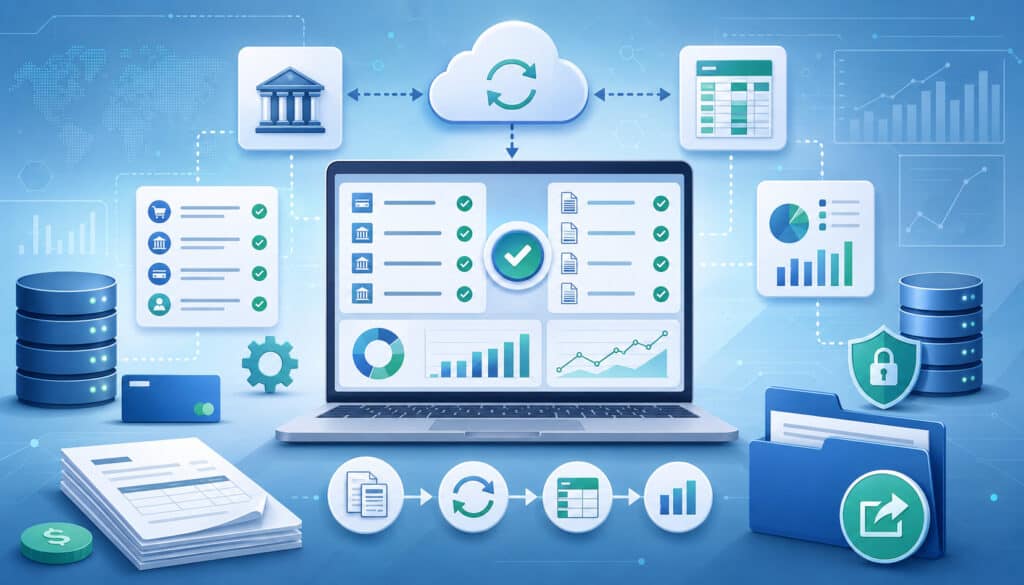
Automation can reduce repetitive reconciliation work when transaction records contain dependable identifiers.
An automated payment reconciliation API workflow can match records using transaction IDs, order IDs, settlement IDs, amounts, dates, location identifiers, or custom metadata. The strongest match normally uses a unique identifier plus supporting information rather than relying only on amount and date.
Not every record will match automatically. A refund may appear after the accounting period closes, a deposit can combine several batches, or an internal order reference may be missing. Those records should enter an exception queue for investigation instead of being silently discarded.
Accounting integration typically maps payment activity into financial categories such as:
- Gross sales
- Processing fees
- Refunds
- Chargebacks
- Net deposits
- Accounts receivable
- Payment clearing accounts
A clearing account can help represent money that has been captured but has not yet been reconciled to a deposit. The exact accounting design should be determined by qualified accounting personnel based on the business’s circumstances.
Data export remains useful even in API-driven environments. Common formats include CSV, JSON, spreadsheets, database records, and structured accounting-system imports.
Export processes should preserve consistent field names, data types, character encoding, timestamp rules, currencies, and identifier formats. Import routines should also prevent duplicate entries, especially when a reporting period is processed more than once.
Reporting API Authentication, Authorization, and Data Protection
Reporting endpoints can expose commercially and financially sensitive information, so read-only access should still be treated as security-sensitive.
Common authentication mechanisms include API keys, access tokens, and OAuth-based authorization where supported. An overview of API authentication methods for payments provides additional context on controlling access to payment integrations.
Credentials should be stored securely rather than embedded in public source code, browser scripts, shared documents, or logs. Rotation procedures should make it possible to replace credentials without breaking the reporting workflow.
Authorization determines what an authenticated identity is actually allowed to do. The least-privilege principle means granting only the permissions necessary for the assigned task. A standards-oriented definition describes least privilege as restricting access to the minimum needed to accomplish assigned work.
A reporting credential that only needs to retrieve transactions and settlements should not automatically have permission to create charges, issue refunds, modify bank information, or change account settings.
Role-based access can further separate developer, finance, support, and administrative responsibilities.
Sensitive reporting data can include customer information, transaction identifiers, metadata, bank information, and API credentials. Appropriate protections may include encryption in transit and at rest, access controls, secure secret storage, data minimization, and documented retention rules.
Payment security obligations depend on the payment environment and data handled. Relevant industry security standards provide technical and operational requirements intended to protect payment data.
For implementation planning, this payment gateway security guidance provides additional security considerations without replacing the requirements applicable to a specific payment environment.
Secure Logging and Audit Trails
Reporting integrations need logging because missing, failed, duplicated, or unauthorized requests can affect financial records. Logging, however, should capture operational evidence without unnecessarily exposing sensitive information.
An audit trail might record:
- Report access
- API user or service identity
- Request timestamp
- Endpoint requested
- Filters used
- Synchronization job identifier
- Export action
- Permission changes
- Request result
- Error category
Logs should make it possible to answer questions such as: Who accessed the report? Which date range was requested? Did every pagination request finish? When did a synchronization fail? Which records were exported?
Sensitive credentials should not appear in those logs. Access tokens, API keys, authentication secrets, raw payment credentials, and other high-risk values should be excluded or appropriately masked.
Application security guidance specifically recommends thoughtful application logging while recognizing that logged information can itself become sensitive. Secure logging guidance can help technical teams design useful logs without turning log storage into another unnecessary source of exposure.
Audit records should also be protected against inappropriate access or alteration. If a compromised account can erase every record of its own reporting activity, the audit trail has limited investigative value.
API Rate Limits, Incremental Synchronization, and Error Handling
Reporting workloads can generate substantial API traffic, especially when an application repeatedly retrieves historical transactions. APIs therefore commonly impose rate limits or other request constraints.
When a service returns an HTTP 429 Too Many Requests response, it indicates that the client has exceeded an applicable request rate. The HTTP specification for that status also allows a response to communicate how long the client should wait before retrying.
Reporting applications should respect documented API rate limits and any retry instructions. Useful techniques include pagination, incremental synchronization, caching suitable non-sensitive information, scheduled imports, and exponential backoff for retryable failures.
Incremental synchronization means retrieving only records that are new or have changed since the last successful synchronization. The implementation may use an updated timestamp, continuation cursor, change token, sequence value, or another mechanism supported by the API.
Checkpoints should only advance after the necessary records have been safely processed. Advancing a checkpoint before a failed database write, for example, can create a permanent reporting gap.
Error handling should distinguish among:
- Authentication errors
- Permission failures
- Invalid filters
- Invalid date ranges
- Rate-limit responses
- Network timeouts
- Server errors
- Missing records
- Incomplete responses
Retries should not be indiscriminate. Authentication failures may require credential correction, while invalid filters require fixing the request. Temporary network or server problems may be suitable for controlled retry logic.
Most importantly, failed reporting requests should never silently disappear. A financial reporting integration should surface incomplete synchronization and prevent downstream users from assuming the dataset is complete.
Data Completeness, Testing, and Monitoring
Receiving an HTTP success response does not automatically prove that the entire intended dataset was retrieved.
A reporting integration should validate expected record counts when possible, pagination completion, duplicate records, missing transactions, currencies, totals, settlement references, and refund relationships. Reconciliation totals can provide another important control because unexpectedly large differences may reveal incomplete imports or mapping problems.
Testing should include much more than one successful request.
Before launch, teams should test:
- Successful report requests
- Empty result sets
- Large date ranges
- Multiple pages
- Invalid credentials
- Insufficient permissions
- Invalid filters
- Rate limits
- Network timeouts
- Partial failures
- Duplicate records
- Multi-currency records
- Full and partial refunds
- Disputes
- Settlement reports
Testing should also confirm what happens if the application stops halfway through a multi-page synchronization. It should be able to resume safely without creating duplicate records or skipping data.
Production monitoring should track API availability, synchronization failures, authentication failures, rate-limit responses, missing records, delayed settlement data, export failures, and reconciliation exceptions.
A useful monitoring system distinguishes operational success from financial completeness. A job that executed without throwing an application error may still be defective if it imported only the first page of records.
Alerting should therefore consider both technical indicators and business-data checks.
Reporting Performance, Versioning, and Data Retention
Reporting performance improves when applications request only the information they need. Narrow date ranges, selective filters, incremental synchronization, efficient pagination, and appropriate caching can reduce unnecessary API calls and database processing.
Applications should avoid repeatedly downloading years of historical information simply to identify a small number of new transactions. Query patterns that work at low volume can become inefficient as transaction history grows.
Payment reporting integration also needs a strategy for API versioning and schema changes.
A seemingly minor API change can affect:
- Field names
- Data types
- Required or optional fields
- Status values
- Pagination behavior
- Timestamp formats
- Endpoint paths
- Nested objects
- Error responses
Applications should avoid assuming that a known list of statuses or fields can never expand. Strict parsers that crash when an unfamiliar status appears can create reporting outages even when the API change is otherwise backward compatible.
Version changes should be tested in a controlled environment with representative transaction, refund, dispute, settlement, multi-currency, and pagination data before production migration.
Data retention requires a separate policy. Reporting systems should determine what information genuinely needs to be retained for operational, accounting, security, contractual, and applicable regulatory purposes.
Keeping every available field indefinitely can increase security exposure without providing corresponding operational value. Deleting information too aggressively can make reconciliation, audit, dispute, or accounting work difficult.
Retention decisions should therefore balance business need with data minimization and applicable professional requirements. This discussion is educational and should not substitute for accounting, legal, tax, banking, cybersecurity, or compliance advice specific to an organization.
Reporting for Fraud, Risk, and Operational Analytics
Payment API analytics can support risk monitoring by revealing patterns that deserve investigation. Reporting alone does not establish that activity is fraudulent, and it cannot detect or prevent every form of fraud.
Potential review signals include unusual refund activity, elevated decline patterns, repeated transaction attempts, sudden transaction spikes, location anomalies, unusual chargeback activity, and unexpected manual-entry patterns.
Context matters. A transaction spike may reflect a legitimate promotion. Increased declines may result from a technical integration problem. High refund activity in one location may indicate operational errors rather than intentional abuse.
Reporting is therefore most useful as an investigative and monitoring input rather than an automatic conclusion.
Operational teams can also use a payment analytics API to calculate useful metrics, including:
- Transaction volume
- Transaction count
- Approval rate
- Decline rate
- Average transaction value
- Refund rate
- Chargeback activity
- Payment failure rate
- Processing costs
- Net settlement amount
- Payment-method mix
- Settlement discrepancies
- Recurring payment success
No single benchmark is appropriate for every business. Payment methods, transaction sizes, billing models, customer behavior, industry characteristics, and risk controls can all affect these measurements.
Metrics should also have explicit definitions. For example, an “approval rate” calculated from authorization attempts may differ from a “payment success rate” based on completed captures. Mixing definitions can make dashboards look consistent while teams are actually discussing different parts of the payment lifecycle.
Common Payment API Reporting Mistakes
Many reporting failures come from small implementation assumptions rather than complicated technical problems.
One of the most serious mistakes is treating authorization as settlement. An approved authorization does not necessarily mean the payment was captured, settled, or funded.
Ignoring pagination is another frequent source of incomplete data. An application can receive a successful response yet import only the first portion of a large result set.
Other mistakes include:
- Combining amounts from different currencies.
- Converting timestamps without considering UTC, local time, or settlement cutoffs.
- Failing to store unique transaction IDs.
- Ignoring refunds when calculating net payment activity.
- Missing chargebacks and financial adjustments.
- Processing both webhook and API records as independent transactions.
- Giving reporting credentials unnecessary write permissions.
- Recording access tokens or sensitive payment information in logs.
- Ignoring API rate limits.
- Comparing sales totals with deposits without settlement reconciliation.
- Assuming fields and status values will never change.
- Relying only on a dashboard when automated systems need structured data.
- Failing to monitor data synchronization jobs.
Double-counting webhook and API information deserves particular attention. A webhook event and an API transaction record may describe the same payment state change. They should normally be connected by event or transaction identifiers rather than treated as two separate payments.
Another mistake is forcing automatic matches when evidence is ambiguous. An exception queue is safer than incorrectly pairing two unrelated transactions because their values happen to match.
Good reporting architecture expects exceptions. It makes unusual records visible, traceable, and reviewable instead of hiding them behind a successful synchronization status.
Payment API Reporting Checklist
A structured implementation checklist helps technical and financial teams agree on what a payment reporting integration must accomplish before it becomes a production dependency.
- Define reporting requirements. Identify who needs transaction, settlement, fee, refund, dispute, subscription, and operational data.
- Identify required API endpoints. Confirm how each required record type can be retrieved.
- Protect reporting credentials. Keep keys and tokens out of client-side code, public repositories, and inappropriate logs.
- Use least-privilege access. Reporting identities should receive only the permissions necessary for reporting tasks.
- Store unique transaction identifiers. Preserve both payment-system IDs and internal references.
- Handle pagination correctly. Process every page or cursor until completion.
- Normalize timestamps. Preserve original timestamps while creating consistent internal time handling.
- Separate currencies. Never combine amounts across currencies without deliberate conversion.
- Track refunds and disputes. Preserve relationships to the original transactions.
- Reconcile settlement data. Connect captured transactions, fees, adjustments, and deposits.
- Implement incremental synchronization. Retrieve new or changed data rather than repeatedly downloading full history.
- Handle rate limits. Respect documented limits, backoff rules, and retry instructions.
- Validate data completeness. Check pages, totals, duplicates, relationships, and settlement references.
- Monitor synchronization failures. Do not allow reporting gaps to remain silent.
- Test API-version changes. Validate schemas, statuses, pagination, and error handling before migration.
- Protect and retain data appropriately. Keep only the reporting information justified by operational and professional requirements.
Frequently Asked Questions
What is payment API reporting?
Payment API reporting is the use of API endpoints to retrieve payment and financial activity programmatically. Instead of requiring a person to sign into a dashboard and download reports, authorized software can request transaction records and integrate them with internal systems.
Depending on the implementation, the API may provide payment status, transaction IDs, authorization and capture information, settlement details, refunds, disputes, processing fees, subscription payments, and other records.
Payment API reporting is particularly useful when a business needs automated reconciliation, accounting integration, transaction monitoring, customer support tools, or internal dashboards. It also allows applications to retrieve updated information after the original payment request has finished.
The exact reporting model varies. Some APIs provide specialized endpoints for transactions, settlements, refunds, disputes, and payouts, while others expose those records through related resources. Teams should review the available schema and understand which fields are preliminary and which represent later financial stages.
What information can a payment reporting API provide?
A payment reporting API may provide transaction identifiers, order references, amounts, currencies, payment methods, authorization results, capture states, refund information, settlement records, fees, disputes, metadata, timestamps, and location or channel identifiers.
Some APIs provide extensive settlement and fee detail, while others provide only basic payment records. Historical availability can also vary.
Teams should begin with actual business requirements rather than assuming that every API exposes every desirable field. Finance may require settlement IDs, gross amounts, fees, chargebacks, and net deposits, while customer support may primarily need transaction ID, payment status, order reference, and refund state.
Developers should document field definitions and data types during implementation. A field called “date,” for example, may refer to transaction creation, authorization, settlement, or posting depending on the data model. Understanding that distinction is essential for accurate analysis.
How is a reporting API different from a payment dashboard?
A payment dashboard is designed primarily for interactive human use. Users can often search transactions, inspect payment details, apply filters, view summaries, and download reports through a graphical interface.
A payment reporting API is designed for software-to-software communication. Applications can automatically request records, store them in databases, perform reconciliation, populate internal dashboards, or send structured data to accounting workflows.
Neither approach necessarily replaces the other. A finance employee may use a dashboard to investigate an individual exception while an automated process synchronizes thousands of transactions through a reporting API.
Downloadable reports can also remain useful when a finalized statement is required. The important difference is automation and integration. Dashboards support direct human investigation, whereas a transaction reporting API enables payment information to become part of repeatable technical and financial workflows.
Can payment APIs report processing fees?
Some payment APIs can report processing fees, but the level of detail varies. A system may provide one aggregated fee for a settlement, transaction-level fees, or individual components such as interchange, assessments, processor markup, per-transaction charges, gateway charges, refund fees, chargeback fees, cross-border charges, or adjustments.
Developers should not assume that a transaction endpoint contains the final fee amount. Fee records may appear later or may be associated with settlement rather than the original authorization. Finance teams should establish whether reported fees are preliminary or finalized and determine how they map into accounting records.
When detailed fee data is unavailable through the API, other reporting or statement sources may need to supplement the payment reporting integration. Reconciliation should therefore confirm which system is authoritative for each fee category rather than creating an estimated fee and treating it as finalized financial data.
How are refunds and chargebacks reported?
Refunds should generally be represented as payment-related records with their own identifier and a reference to the original transaction. Useful fields include refund amount, currency, creation time, current status, original payment reference, and completion information.
Partial refunds require particular care because one payment may have several refund records. Reporting software should calculate refunded totals from the underlying records rather than assuming one refund per transaction.
Chargebacks or disputes may have a separate dispute ID, original transaction reference, disputed amount, reason, status, response deadline, evidence status, and final outcome.
Both refunds and disputes can change after the initial record is created. Incremental synchronization should therefore account for updated records rather than importing each object once and assuming it will never change.
Reporting and evidence management can help teams manage disputes, but neither provides a guaranteed outcome.
What is settlement reporting?
Settlement reporting explains how captured payment activity is grouped and moved toward merchant funding.
A settlement report may contain a settlement ID or batch reference, transaction amounts, refunds, chargebacks, fees, adjustments, net settlement amount, settlement date, and deposit reference. The exact fields depend on the payment arrangement.
Settlement reporting is important because the amount deposited into an account may not equal gross sales for the same transaction date. A deposit may reflect multiple captured payments minus refunds, disputes, fees, or adjustments.
Settlement records provide the bridge between transaction-level reporting and deposit reconciliation.
Applications should preserve settlement identifiers and avoid treating authorization or capture timestamps as bank deposit dates. These stages describe different parts of the payment lifecycle, and confusing them can generate recurring reconciliation discrepancies.
How do webhooks differ from reporting APIs?
Webhooks push event notifications to an application when relevant activity occurs. A payment system might send a webhook when a transaction succeeds, a refund completes, a dispute opens, or a recurring payment changes state.
Reporting APIs work in the opposite direction: the application requests information when it needs it. Webhooks can provide fast awareness and reduce unnecessary polling, but reporting APIs are generally better suited to historical retrieval, reconciliation, missed-event recovery, and verification of current state.
A resilient design often uses both. The application processes webhook events for operational updates, records event identifiers to help prevent duplicate handling, and periodically uses reporting endpoints to verify completeness.
This approach reduces reliance on any single delivery path. If an event is delayed or a receiving service experiences an outage, the next synchronization or reconciliation process can identify the missing record.
How should reporting APIs handle pagination?
Applications should treat pagination as part of the reporting protocol rather than an optional convenience. With page-based pagination, the application retrieves successive numbered or offset-based result groups. With cursor-based pagination, each response normally provides a continuation token used to request the next group of records.
The application should continue until the API explicitly indicates that retrieval is complete. It should also record enough synchronization state to resume safely after an interruption.
Deduplication is important because retries or shifting data can sometimes result in the same record being encountered more than once. Stable transaction IDs provide a reliable basis for recognizing previously imported records.
Large historical imports should be tested under realistic volume. A process that works with twenty test transactions may fail when it encounters many pages, rate limits, timeouts, or records changing during retrieval.
How can payment APIs help automate reconciliation?
Payment APIs provide structured identifiers and financial records that reconciliation software can compare automatically.
An internal order can be matched to its payment using an order ID or transaction ID. Captures can then be connected to settlement IDs, refunds to original payment references, and settlements to deposit references.
Amounts, dates, currencies, location IDs, and metadata can provide additional matching evidence.
Automation is especially effective when identifiers are stored from the beginning of the payment workflow. Trying to reconstruct relationships later using only customer names, amounts, and dates is much less reliable.
Unmatched records should enter an exception process rather than being discarded or forced into an uncertain match. Finance teams can then investigate missing identifiers, timing differences, fees, chargebacks, partial refunds, or other causes before approving the reconciliation.
How should multi-currency payment reports be handled?
Every monetary amount should retain its associated currency. Reporting systems should distinguish transaction or presentment currency from settlement currency when the API provides both. Converted amounts, exchange rates, conversion dates, currency-related fees, and refunds may also need to be stored separately.
Amounts in different currencies should not be added together without an intentional conversion methodology. A total of several monetary figures has no reliable financial meaning if the underlying currencies differ.
Refunds deserve special attention because the refund amount, converted amount, or settlement impact may not always reproduce the original transaction relationship in the way an internal system expects.
Accounting teams should determine how currency conversion and exchange differences should be recorded. Developers should preserve the source data required for that accounting treatment rather than replacing original monetary values with a single converted number.
How should payment reporting data be secured?
Payment reporting data should be protected according to its sensitivity and the organization’s security responsibilities.
API keys and access tokens should be stored using secure credential-management practices. Reporting access should follow least privilege, and credentials intended for read-only reporting should not automatically receive payment-creation or refund permissions.
Sensitive customer information, transaction metadata, banking details, and other protected information should be encrypted where appropriate and retained only when needed. Logs require special attention. Authentication secrets and sensitive payment credentials should not be copied into debugging or application logs.
Access should also be auditable. Recording the service identity, endpoint, timestamp, filters, export actions, and relevant permission changes can help teams investigate unauthorized access and synchronization problems.
Security controls should be reviewed as the reporting architecture changes rather than treated as a one-time implementation step.
Conclusion
Effective payment API reporting gives technical, finance, accounting, ecommerce, marketplace, and operations teams reliable visibility into what happens after a payment request is submitted.
The most useful integrations preserve the full payment lifecycle. They distinguish authorization from capture, settlement, and funding; track refunds and disputes separately; associate fees and adjustments with the correct records; and retain unique transaction and settlement identifiers that make reconciliation practical.
Accurate reporting also depends on implementation details that are easy to overlook. Pagination must be completed, currencies must remain separate, timestamps need consistent handling, reporting credentials require appropriate access controls, and failed synchronization jobs must be visible rather than silently creating gaps.
Webhooks can provide fast operational updates, while reporting APIs support current-state verification, historical retrieval, and reconciliation. Used together, they can provide stronger visibility than either approach alone.
Reliable payment reporting is ultimately a data-control problem as much as an API problem. Secure API access, stable identifiers, incremental synchronization, careful time-zone handling, complete pagination, data validation, regular reconciliation, audit trails, monitoring, controlled retries, and disciplined API-version management all contribute to trustworthy reporting.
When those controls are built into the integration from the beginning, a payment reporting API can serve as a dependable bridge between payment processing, business operations, accounting, customer support, financial reconciliation, and operational decision-making without relying on manual reporting alone.