Payment gateway security is one of the most important parts of accepting online payments. Whether a business sells products through an ecommerce store, bills customers through a SaaS platform, accepts deposits through a service website, or supports mobile checkout, the payment gateway sits at the center of the transaction flow.
A payment gateway does more than move payment information from a checkout page to a payment processor. It helps protect sensitive payment data, authenticate requests, reduce fraud risk, validate transactions, and support secure communication between merchants, processors, card networks, and issuing banks.
When it is configured well, customers can pay with confidence and businesses can process transactions with less exposure.
Security is not handled by one tool or one setting. Strong payment gateway protection relies on layers: SSL TLS encryption, HTTPS security, tokenization, secure authentication methods, payment API security, fraud monitoring, transaction monitoring, access control, PCI compliance, and regular testing. Each layer reduces a different type of risk.
This guide explains payment gateway security in a practical way for business owners, ecommerce teams, developers, fintech startups, SaaS companies, and service providers.
It focuses on clear payment security best practices that help protect customer data, reduce chargebacks, prevent unauthorized access, and support safer digital payment security over time.
What Is Payment Gateway Security?
Payment gateway security refers to the safeguards used to protect online payment transactions from fraud, data theft, misuse, and unauthorized access. It includes the technology, policies, processes, and controls that keep payment data safe as it moves from a customer’s checkout screen through the payment gateway and into the wider payment processing system.
A payment gateway receives transaction details from a website, app, invoice page, subscription platform, or point-of-sale-connected system.
Depending on the integration, it may collect card details, tokenize payment credentials, validate transaction requests, communicate with processors, and return approval or decline responses. Because it touches sensitive payment activity, it must be protected carefully.
Good payment gateway security covers both business and technical responsibilities. A business needs policies for user access, vendor review, fraud prevention, chargeback protection, and incident response.
A technical team needs secure payment integration, payment gateway API security, webhook security, secure coding practices, encryption, rate limiting, and vulnerability management.
A secure payment gateway helps prevent several types of problems. It can reduce exposure of card numbers, block suspicious payment attempts, limit automated bot abuse, prevent tampered API calls, and make it harder for attackers to steal credentials.
It also helps businesses follow payment gateway security guidelines and maintain safer checkout security for customers.
Security matters even when a third-party gateway handles the most sensitive card data. A hosted checkout page or tokenized payment form can reduce risk, but the merchant still has responsibilities. The website, login system, plugins, API credentials, webhooks, admin accounts, and fraud rules all need ongoing attention.
Why Payment Gateway Security Matters for Businesses
Payment gateway security matters because payment systems are attractive targets. Attackers often look for checkout pages, payment forms, APIs, stored credentials, weak admin accounts, and unverified webhooks because these areas can expose payment data or create opportunities for fraud.
A single weak point can lead to chargebacks, lost revenue, reputational damage, and operational disruption.
For ecommerce teams, strong ecommerce payment security protects the customer experience. Shoppers expect a secure checkout that loads properly, uses HTTPS security, avoids suspicious redirects, and clearly confirms payment status. If checkout feels unreliable or unsafe, customers may abandon the purchase even if the rest of the website is well designed.
For SaaS businesses, payment processing security affects recurring revenue. Subscription billing relies on stored payment methods, renewals, retries, invoices, refunds, and account changes. Weak authentication, poor access control, or unsecured billing APIs can create customer data exposure and revenue leakage.
For developers and fintech startups, payment API security is especially important. APIs often power checkout flows, mobile payments, refunds, customer vaults, subscription updates, and reporting dashboards.
If API authentication is weak, if HMAC signature verification is skipped, or if rate limiting is missing, attackers may exploit the integration even when the gateway itself is secure.
Payment gateway protection also supports customer trust. People may not know every technical detail behind tokenization or encryption, but they notice checkout errors, browser warnings, unexpected payment behavior, and suspicious messages. Security failures can damage confidence quickly.
There is also a compliance dimension. PCI DSS sets baseline technical and operational requirements for protecting payment account data, and businesses that store, process, or transmit cardholder data need to understand their responsibilities. The official PCI DSS overview is a useful reference for understanding the purpose of the standard.
How Payment Gateways Handle Sensitive Payment Data
Payment gateways help move payment information safely between the customer, merchant, payment processor, card network, and issuing bank. The exact flow depends on the integration model, but the goal is usually the same: authorize or decline a transaction while exposing as little sensitive payment data as possible.
In a typical online checkout, the customer enters payment information into a secure form. That form may be hosted by the payment gateway, embedded through secure fields, or connected through a payment API.
The gateway receives the transaction request and passes it through the processing chain for authorization. The business receives a response such as approved, declined, pending, or requires additional authentication.
Encryption protects data during transmission. SSL TLS encryption and HTTPS security help prevent attackers from reading payment data while it moves between the browser, server, and gateway. Encryption at rest may also protect stored records, logs, backup files, and database fields.
Tokenization reduces exposure by replacing sensitive card data with a token. The token can be used for future charges, recurring billing, refunds, or account updates without storing the original card number in the merchant system. This is one of the most practical sensitive payment data protection methods for businesses that need repeat billing or saved payment methods.
Authentication and authorization control who can send requests and what actions they can perform. API keys, OAuth security, JWT authentication, HMAC signature verification, and role-based permissions help ensure that payment requests, refund actions, and account updates come from trusted systems.
Secure routing also matters. The gateway must send data to the correct processing partners and return accurate responses. Businesses should avoid logging full card data, storing unnecessary payment details, or passing sensitive information through analytics tools, email, chat widgets, or unprotected custom scripts.
Key Security Threats in Payment Gateway Systems
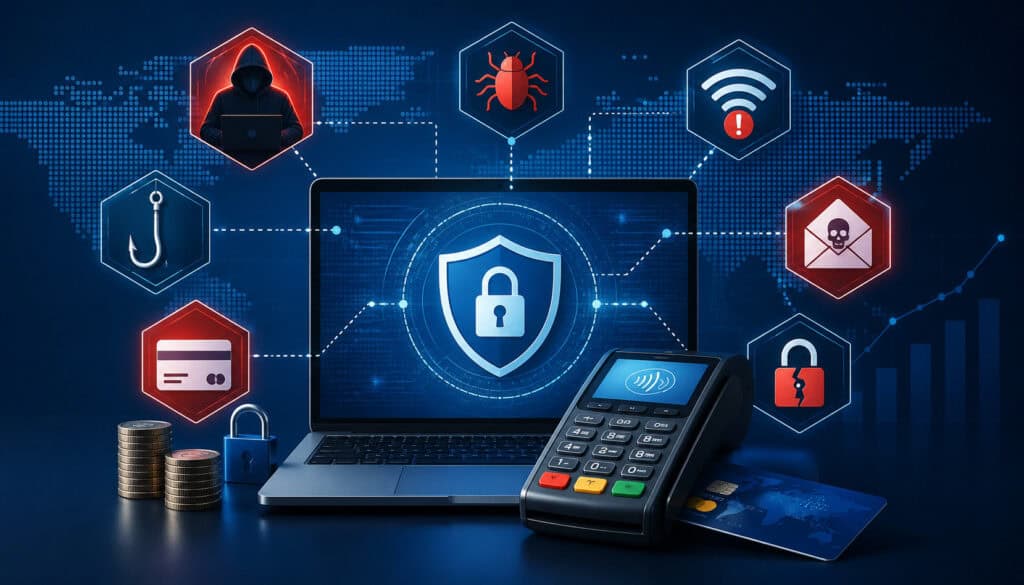
Payment gateway systems face a wide range of threats. Some target the checkout page directly. Others target APIs, staff accounts, customer accounts, plugins, scripts, webhooks, or backend systems. Understanding these threats helps businesses build better payment gateway protection.
Data breaches are among the most serious risks. A breach can happen when attackers access databases, logs, files, admin dashboards, cloud storage, or compromised applications that contain sensitive payment data. Even if raw card data is not stored, customer names, emails, billing addresses, tokens, and transaction histories still need data protection.
Card testing is another common problem. Attackers use automated bots to test stolen card numbers through checkout forms or donation pages. They may submit many small transactions to identify valid cards. Without velocity checks, rate limiting, AVS, CVV verification, fraud monitoring, and bot controls, card testing can create chargebacks and processor alerts.
API abuse can occur when payment endpoints are poorly protected. Attackers may attempt credential stuffing, parameter manipulation, replay attacks, excessive refund requests, fake transaction updates, or unauthorized data retrieval. The OWASP API security project is a helpful reference for common API risks and defensive concepts.
Webhook tampering is another issue. Webhooks notify merchant systems about events such as successful payments, failed charges, refunds, disputes, or subscription changes. If webhook security is weak, attackers may send fake payment confirmation events or replay old events to manipulate account access.
Other threats include phishing attacks against staff, stolen admin credentials, malware on websites, man-in-the-middle attacks, insecure plugins, poor input validation, and overly broad employee permissions. Many incidents are not caused by one dramatic failure. They result from small weaknesses that combine into a larger security gap.
Payment Gateway Security Guidelines and Standards
Payment gateway security guidelines help businesses understand what controls should be in place to protect payment data and transaction systems. These guidelines are not just for large companies. Small ecommerce stores, SaaS platforms, marketplaces, and service providers also benefit from following structured payment security best practices.
PCI DSS is the most recognized standard for payment account data security. It includes requirements related to network security, access control, vulnerability management, secure system configuration, monitoring, testing, and information security policies.
PCI compliance does not automatically make a business immune to fraud or breaches, but it provides a strong baseline for safer payment handling.
Encryption requirements are another key area. Businesses should enforce HTTPS security across checkout pages, account pages, payment forms, webhook endpoints, admin dashboards, and API connections. Outdated protocols, mixed content, expired certificates, and insecure redirects can weaken checkout security.
Secure API design is also essential. Payment gateway API security should include strong API authentication, authorization checks, rate limiting, input validation, error handling, logging, secret management, and monitoring.
Developers should follow secure coding practices and review guidance from sources such as the OWASP Top Ten when building payment-related applications.
Authentication protocols should be selected carefully. API keys may be suitable for server-to-server communication when stored securely and rotated regularly.
OAuth security and JWT authentication may be useful for scoped access and delegated authorization. HMAC signature verification is often used to prove that a message came from a trusted source and was not modified in transit.
Fraud monitoring standards are also part of a mature payment gateway security program. AVS, CVV verification, 3D Secure, velocity controls, transaction monitoring, device checks, risk scoring, and manual review workflows help detect suspicious behavior before it becomes costly.
Core Payment Gateway Security Best Practices
Core payment gateway security best practices are the everyday controls that reduce risk across checkout, APIs, admin accounts, data handling, and fraud management. These controls work best when they are combined rather than treated as separate tasks.
Start by enforcing HTTPS everywhere. Every checkout page, customer account page, admin login, API endpoint, and webhook endpoint should use SSL TLS encryption. Redirect all insecure traffic to secure URLs, fix mixed content warnings, and monitor certificate expiration.
Use tokenization wherever possible. Tokenization supports secure payment gateway operations by reducing the need to store sensitive card data. It is especially useful for recurring billing, saved cards, delayed charges, and repeat customer purchases.
Protect credentials carefully. API keys, signing secrets, OAuth client secrets, private keys, and webhook secrets should never be hardcoded in public repositories, frontend code, mobile apps, or shared documents. Store them in a secrets manager or secure environment configuration with strict access control.
Limit access by role. Staff should only have the permissions they need. A customer support user may need to look up transaction status, but not export customer data or issue large refunds. Developers may need sandbox access without production refund permissions.
Monitor payment activity continuously. Logging, alerts, dashboards, transaction monitoring, and fraud monitoring help detect unusual behavior. Look for abnormal refund volume, spikes in declined transactions, repeated small authorization attempts, unusual IP patterns, high-risk shipping changes, and webhook failures.
Schedule regular security audits. A security audit should review integration code, permissions, API credentials, fraud settings, logs, dependencies, plugins, hosting configuration, and incident response procedures. Vulnerability management should include patching, scanning, penetration testing where appropriate, and secure deployment practices.
Encryption and Secure Data Transmission
Encryption protects payment data by making it unreadable to unauthorized parties. In payment gateway security, encryption is most important when data is moving between a customer’s browser, a merchant server, a mobile app, a gateway API, and backend payment systems.
HTTPS security uses SSL TLS encryption to protect data in transit. A secure checkout should never collect payment details over an insecure connection. Browser warnings, mixed content, expired certificates, and insecure redirects can damage customer trust and create real security exposure.
Developers should also secure server-to-server communication. Payment APIs, webhook endpoints, refund endpoints, subscription billing endpoints, and customer vault endpoints should require encrypted communication. Internal services should avoid sending sensitive transaction data over unencrypted channels, even inside private networks.
Encryption at rest protects stored data such as transaction references, customer billing details, logs, reports, and backups. It is not a reason to store more data than necessary, but it reduces exposure if storage systems are accessed improperly.
Businesses should avoid placing sensitive payment data in URLs, query strings, browser storage, logs, analytics scripts, error messages, or email notifications. Even encrypted systems can leak data if developers send sensitive fields to the wrong place.
Tokenization and Data Minimization
Tokenization replaces sensitive card information with a token that can be safely referenced by the business. The original card data is stored by a secure payment provider, while the merchant uses the token for future payments, subscriptions, refunds, or account updates.
This improves sensitive payment data protection because the merchant system no longer needs to store raw card numbers. If the merchant database is compromised, tokens are generally less useful to attackers than full payment credentials, especially when tokens are restricted to a specific gateway or merchant account.
Data minimization supports tokenization by reducing what the business collects, stores, and shares. Teams should ask whether they truly need each payment-related field. If a system does not need full billing details, cardholder data, or complete transaction metadata, it should not store it.
Minimization also applies to logs and analytics. Developers sometimes log entire API payloads during testing and forget to remove that behavior in production. This can expose customer data in monitoring tools, support tickets, debugging platforms, or cloud logs.
A strong approach combines tokenization, hosted payment fields, limited data retention, masked displays, restricted exports, and clear deletion policies. This makes data breach prevention easier because there is less sensitive information to steal.
API Security for Payment Gateways
APIs are central to modern payment processing security. They connect websites, mobile apps, SaaS platforms, billing systems, dashboards, accounting tools, fraud platforms, and payment gateways.
Because APIs can initiate charges, issue refunds, update customers, retrieve transaction data, and receive event notifications, payment gateway API security must be treated as a priority.
Strong API authentication is the first layer. API keys should be unique, scoped, stored securely, and rotated on a schedule. Production keys should be separate from sandbox keys. A compromised test key should not provide access to live payment functions.
OAuth security can help when access needs to be delegated or limited to specific scopes. JWT authentication can support signed claims and session-based access when implemented correctly. HMAC signature verification can confirm that a request body has not been altered and that the sender has the shared secret.
Rate limiting reduces automated abuse. Payment APIs should limit repeated requests from the same IP address, account, device, token, or behavioral pattern. This helps defend against card testing, credential attacks, scraping, and denial-of-service attempts.
Endpoint design also matters. Payment endpoints should validate inputs strictly, use server-side authorization checks, avoid exposing internal IDs, and return safe error messages. A payment API should not reveal whether a card is valid, whether an account email exists, or whether a transaction ID belongs to another customer.
IP allowlisting may help for server-to-server integrations, but it should not be the only control. Cloud environments, mobile apps, remote teams, and third-party services can make IP rules harder to manage. Use allowlisting as one layer alongside strong authentication and monitoring.
Authentication and Access Control Best Practices
Secure authentication methods protect payment systems from unauthorized access. Attackers do not always break encryption or exploit complex vulnerabilities. Many payment incidents begin with stolen credentials, weak passwords, reused logins, exposed API keys, or staff accounts with too much access.
Multi-factor authentication should be required for admin dashboards, gateway portals, hosting panels, code repositories, cloud consoles, email accounts, and billing systems. It is especially important for users who can view transactions, change bank details, issue refunds, edit payment settings, export data, or manage API credentials.
Least privilege access means users receive only the permissions needed for their role. A support employee may need to confirm payment status but should not have access to developer keys.
A developer may need to configure webhooks but should not be able to change settlement bank details. A finance manager may need dispute reports but not production deployment access.
Role-based permissions make access easier to manage. Instead of assigning permissions one user at a time, create roles based on responsibilities. Review these roles regularly as teams change, vendors rotate, and business processes evolve.
Credential rotation is also important. API keys, webhook secrets, OAuth client secrets, private keys, and admin passwords should be changed when staff leave, vendors change, suspicious activity occurs, or secrets may have been exposed.
Secure storage is non-negotiable. Secrets should not be stored in spreadsheets, email threads, chat messages, project tickets, frontend code, mobile apps, or public repositories. Use secure secret management tools and limit who can retrieve production credentials.
Webhook Security Best Practices
Webhooks allow payment gateways to send event notifications to merchant systems. These events may confirm successful payments, failed payments, refunds, disputes, subscription renewals, chargebacks, customer updates, and payout changes. Because webhooks can trigger important business actions, webhook security is essential.
A common mistake is trusting a webhook just because it arrives at the correct endpoint. Attackers can send fake HTTP requests to public URLs. If the system accepts those requests without verification, it may mark unpaid orders as paid, activate subscriptions, change account status, or trigger fulfillment incorrectly.
Signature verification is the most important webhook control. Many gateways sign webhook payloads using a shared secret. The receiving system should calculate the expected signature and compare it with the signature in the request. HMAC signature verification helps confirm that the message came from the expected sender and was not modified.
Timestamp validation helps prevent replay attacks. A replay attack occurs when an old valid webhook is captured and sent again. By checking the timestamp and rejecting old events, businesses reduce the risk of duplicate or manipulated event handling.
Event idempotency is also important. The same webhook may be delivered more than once due to retries or network delays. The system should record processed event IDs and avoid performing the same action repeatedly.
Webhook endpoints should use HTTPS, require secure event parsing, reject unsupported event types, validate transaction status through the gateway API when needed, and log failures safely. Do not expose secrets in webhook error responses.
Fraud Prevention in Payment Gateway Security
Fraud prevention is a major part of payment gateway security because not every risky transaction involves stolen system access. Many attacks use valid-looking checkout behavior, stolen cards, synthetic identities, compromised customer accounts, or automated bots. Strong fraud prevention combines rules, signals, monitoring, and human review.
AVS checks compare billing address information with the card issuer’s records. CVV verification checks the security code provided by the customer. These tools do not stop all fraud, but they help identify transactions that deserve additional review.
3D Secure adds an authentication step for certain card-not-present transactions. Depending on the risk level and issuer response, the customer may be asked to complete additional verification. This can improve fraud prevention and may support chargeback protection in some scenarios.
Velocity checks detect repeated behavior over a short period. Examples include many failed payments from the same IP address, multiple cards used by one account, repeated attempts for small amounts, or many orders sent to one shipping address. Velocity rules are useful for ecommerce fraud prevention and card testing defense.
Risk scoring combines signals such as device fingerprinting, IP reputation, email age, order value, billing and shipping mismatch, failed payment history, geographic distance, and customer behavior. Higher-risk transactions can be blocked, challenged, or sent for manual review.
Fraud monitoring should be tuned over time. Rules that are too loose allow fraud through. Rules that are too strict block legitimate customers. Teams should review chargebacks, false positives, customer complaints, and authorization patterns to improve risk scoring.
Secure Checkout and Front-End Payment Protection
Secure checkout is where customers experience payment gateway security directly. Even if the backend is well protected, a poorly secured checkout page can expose customers to data theft, script injection, phishing, form manipulation, or confusing payment behavior.
Hosted checkout pages can reduce risk because the payment provider handles the most sensitive payment collection. This can simplify PCI compliance responsibilities and reduce the amount of card data touching the merchant environment.
Businesses comparing integration models may find this API versus hosted payment page guide useful for understanding control and security trade-offs.
Embedded secure fields offer another approach. Instead of collecting card data through ordinary website inputs, secure fields isolate payment entry areas so sensitive data goes directly to the gateway. This allows a branded checkout experience while reducing payment data exposure.
Front-end script protection matters. Checkout pages often include analytics tags, chat widgets, personalization tools, and marketing scripts. Each script can affect performance and security. Limit third-party scripts on checkout pages, load only what is necessary, and review script sources regularly.
Input validation should happen on both the client and server. Client-side validation improves user experience, but server-side validation is required for security. Never trust browser-submitted amounts, product IDs, discounts, customer IDs, or payment status.
Checkout security also includes clear error handling. Do not reveal sensitive decline reasons or internal system details. Give customers useful next steps without helping attackers test cards or discover account information.
Payment Gateway Security Checklist Table
A checklist helps teams turn payment gateway security from a vague goal into practical action. The table below summarizes important controls across checkout, APIs, fraud, compliance, monitoring, and long-term maintenance.
| Security Area | Best Practice | Why It Matters | Implementation Tip |
| HTTPS security | Enforce SSL TLS encryption across all payment pages and endpoints | Protects data in transit and supports secure checkout | Redirect insecure traffic and monitor certificate expiration |
| Tokenization | Replace sensitive card data with gateway tokens | Reduces exposure and supports data minimization | Use tokens for recurring billing and saved payment methods |
| API authentication | Use scoped API keys, OAuth, JWT, or signed requests | Prevents unauthorized payment actions | Separate sandbox and production credentials |
| Webhook security | Verify signatures and timestamps | Stops fake or replayed payment events | Use HMAC signature verification and store processed event IDs |
| Access control | Apply least privilege and role-based permissions | Reduces damage from compromised accounts | Review permissions regularly |
| Fraud prevention | Use AVS, CVV verification, 3D Secure, velocity checks, and risk scoring | Helps reduce fraud and chargebacks | Tune rules using real transaction data |
| Rate limiting | Limit repeated requests by account, IP, device, or token | Reduces bot abuse and card testing | Add stricter limits to payment and login endpoints |
| Logging | Log important events without storing sensitive payment data | Supports investigations and monitoring | Mask card data and protect log access |
| Vulnerability management | Patch systems, plugins, libraries, and dependencies | Reduces known exploit risk | Track updates and test before deployment |
| Security audit | Review payment flows, settings, credentials, and code | Finds gaps before attackers do | Include business and technical controls |
| Incident response | Prepare containment and communication steps | Reduces confusion during security events | Run tabletop exercises with key teams |
| Data protection | Minimize stored payment and customer data | Limits breach impact | Set retention rules and delete unneeded data |
This checklist should be adapted to the business model. A SaaS platform with recurring billing will have different priorities than a marketplace, donation form, mobile app, or ecommerce store. The purpose is not to create paperwork. It is to help teams identify which controls are working, which are missing, and which need improvement.
Common Payment Gateway Security Mistakes
Many payment gateway security problems come from avoidable mistakes. They often happen when teams move quickly, copy old integration code, rely too heavily on defaults, or assume that the payment gateway handles every security responsibility.
One common mistake is exposing API keys. Keys may appear in frontend JavaScript, mobile apps, public repositories, screenshots, documentation, or support tickets. Once exposed, they can be copied and abused. Production keys should be kept out of public code and rotated if exposure is suspected.
Another mistake is skipping webhook verification. Some teams receive a payment event and update an order immediately without checking the signature or confirming the payment through the gateway API. This can allow fake payment confirmations or replayed events to trigger fulfillment.
Weak authentication is also a major issue. Shared admin logins, missing multi-factor authentication, reused passwords, and inactive user accounts increase the risk of unauthorized access. Merchant account security depends heavily on strong identity controls.
Poor monitoring creates blind spots. If no one reviews failed payments, refund spikes, unusual API usage, login attempts, or fraud alerts, suspicious activity may continue for days or weeks. Data breach prevention depends on detection as well as prevention.
Insecure coding practices can create checkout vulnerabilities. Missing input validation, unsafe redirects, exposed error messages, outdated libraries, and poor session handling can weaken payment system hardening even when the gateway itself is secure.
Developer Security Mistakes
Developer mistakes can create serious payment gateway API security gaps. One of the most common is hardcoding secrets directly into source code. This may seem convenient during testing, but secrets can leak through repositories, build logs, shared snippets, or developer machines.
Another issue is missing HTTPS enforcement. A developer may assume the hosting platform handles HTTPS, but payment forms, API callbacks, redirects, and webhook URLs still need verification. Any insecure endpoint in the payment flow can become a weak link.
Poor input validation is also risky. Payment amounts, currency codes, customer IDs, order IDs, coupon values, and return URLs should be validated on the server. Attackers may modify browser requests to change transaction values, access another customer’s transaction, or trigger unintended actions.
Developers may also expose too much information in error messages. A payment API should not reveal internal stack traces, gateway credentials, fraud rule logic, or detailed card testing feedback. Safe error handling protects both customers and systems.
Missing idempotency can create duplicate charges or repeated fulfillment actions. Payment requests and webhook handlers should be designed to handle retries safely. This is especially important for mobile networks, subscription billing, and asynchronous payment flows.
Business-Level Security Mistakes
Business-level mistakes can weaken payment gateway security even when the technical integration is solid. One of the most common is giving too many users broad permissions. Staff may keep access after changing roles, vendors may retain credentials after projects end, and shared accounts may make accountability impossible.
Another mistake is ignoring fraud alerts. Fraud tools are only useful when someone reviews alerts, tunes rules, and investigates patterns. A business that never reviews chargebacks, dispute reasons, failed payments, or suspicious orders may miss preventable losses.
Vendor management is often overlooked. Payment systems may depend on ecommerce platforms, plugins, hosting providers, analytics tools, fraud platforms, subscription tools, and support software. Each vendor should be reviewed for security practices, data access, documentation quality, and support responsiveness.
Security training is also important. Staff should recognize phishing attempts, social engineering, suspicious refund requests, fake customer urgency, and risky data-sharing behavior. Payment processor security is not enough if employees can be tricked into changing account settings or revealing credentials.
Businesses sometimes lack a clear incident plan. When something goes wrong, confusion can delay containment. A basic response plan should identify who investigates, who contacts vendors, who reviews logs, who handles customer communication, and who approves recovery steps.
Security Monitoring and Threat Detection
Security monitoring helps businesses detect suspicious activity before it becomes a major incident. Payment gateway security is not complete without visibility into what is happening across checkout pages, APIs, admin accounts, webhooks, refunds, disputes, and transaction patterns.
Logging should capture important security events such as login attempts, failed authentication, API errors, webhook failures, refund actions, permission changes, key creation, risk score changes, and unusual transaction activity. Logs should be protected from tampering and should not contain full card numbers or sensitive authentication secrets.
Alerts should focus on meaningful signals. Too many alerts create fatigue, while too few alerts create blind spots. Useful alerts may include spikes in declined payments, repeated small transaction attempts, unusual refund volume, access from unfamiliar locations, disabled fraud rules, failed webhook verification, and sudden changes in chargeback activity.
Dashboards help teams see patterns over time. Transaction monitoring dashboards can show approval rates, decline codes, dispute trends, refund volume, fraud review queues, and API error rates. Technical dashboards can show latency, endpoint errors, rate-limit events, dependency issues, and webhook delivery failures.
Anomaly detection can identify behavior that does not match normal patterns. For example, a sudden increase in low-value authorizations may indicate card testing. A sharp increase in refund requests may indicate account compromise or internal misuse. A surge in failed login attempts may indicate credential stuffing.
Security monitoring should include both automated review and human judgment. Tools can flag suspicious events, but people still need to investigate, decide what to block, update rules, and communicate with customers or vendors when needed.
PCI Compliance and Payment Gateway Security
PCI compliance supports payment gateway security by setting baseline requirements for protecting payment account data. PCI DSS applies to organizations that store, process, or transmit cardholder data. The exact responsibilities depend on how the payment flow is designed, what systems touch card data, and which vendors are involved.
At a high level, PCI DSS focuses on secure networks, protected account data, vulnerability management, access control, monitoring, testing, and security policies. It encourages businesses to limit access, protect systems, encrypt data, maintain secure configurations, and regularly validate controls.
Businesses can often reduce PCI scope by using hosted payment pages, hosted fields, tokenization, and gateway-managed storage. Reducing scope does not remove all responsibility, but it can reduce the number of systems that handle sensitive payment data directly.
PCI compliance should be approached carefully. A business may need to complete self-assessment documentation, run vulnerability scans, maintain policies, or work with qualified professionals depending on its environment and transaction model. This guide is informational, so businesses should seek qualified compliance guidance for their specific situation.
Compliance and security are related but not identical. A business can pass a requirement at one point in time and still become vulnerable later if it stops patching systems, weakens access control, ignores logs, or changes its payment integration without review.
PCI DSS is best used as part of a broader security program that includes encryption, tokenization, fraud prevention, payment API security, secure checkout design, incident response, and continuous improvement.
Incident Response and Breach Prevention
Incident response is the plan for what a business does when something suspicious or harmful happens. Payment-related incidents may include exposed API keys, fake webhook events, suspicious refunds, card testing attacks, malware on checkout pages, compromised admin accounts, data exposure, or unusual transaction spikes.
Preparation is the first step. Businesses should define who is responsible for technical investigation, fraud review, customer communication, vendor coordination, legal or compliance consultation, and executive decisions. Contact details and escalation paths should be documented before a crisis.
Detection comes next. Monitoring tools, fraud alerts, customer reports, processor notifications, and staff observations may reveal a problem. Teams should investigate quickly while preserving logs and evidence. Avoid deleting data that may be needed to understand what happened.
Containment limits damage. This may involve disabling compromised credentials, rotating API keys, blocking suspicious IP addresses, pausing risky payment features, isolating affected systems, disabling vulnerable plugins, or temporarily increasing manual review thresholds.
Recovery restores safe operations. Teams may patch vulnerabilities, re-enable services, update fraud rules, notify affected parties when appropriate, review chargebacks, and confirm that the issue is no longer active. After recovery, a post-incident review should identify what failed and what needs improvement.
Breach prevention is ongoing. Vulnerability management, security audits, secure coding practices, staff training, access reviews, and payment system hardening all reduce the chance of incidents.
Businesses should also review guidance from trusted security sources such as the NIST Cybersecurity Framework, which offers a useful structure for managing cybersecurity risk.
How to Choose a Secure Payment Gateway
Choosing a secure payment gateway requires more than comparing transaction costs. Businesses should evaluate how well the gateway supports encryption, tokenization, PCI compliance, secure payment integration, fraud prevention, reporting, webhook security, developer documentation, and operational reliability.
Start with data protection features. A strong gateway should support HTTPS security, SSL TLS encryption, tokenization, secure storage of payment credentials, masked card display, and tools that help reduce PCI scope. For recurring billing or saved cards, tokenization is especially important.
Review API security features. Look for scoped API keys, secure authentication methods, OAuth security where appropriate, JWT authentication where relevant, HMAC signature verification for webhooks, rate limiting, idempotency support, sandbox environments, and clear error handling.
Fraud tools are also important. A secure payment gateway should support AVS, CVV verification, 3D Secure, fraud monitoring, risk scoring, velocity checks, transaction monitoring, and customizable review workflows. Businesses with higher-risk products, subscriptions, or high order values may need more advanced fraud controls.
Documentation quality matters. Developers need clear API references, webhook examples, testing tools, secure integration guidance, and implementation notes. The REST and GraphQL payment API comparison can help technical teams think through API architecture trade-offs before building payment workflows.
Support responsiveness should not be overlooked. During a payment outage, suspicious fraud spike, webhook failure, or settlement issue, slow support can create real business impact. Evaluate support channels, response expectations, status pages, and escalation options.
Payment Gateway Security for Ecommerce and Mobile Payments
Ecommerce and mobile payments introduce unique security considerations because customers interact with payment systems across browsers, devices, apps, networks, and checkout flows. Payment gateway security must protect both the backend transaction and the user-facing payment experience.
For ecommerce websites, secure checkout design is critical. Use HTTPS security, reduce third-party scripts on checkout pages, validate order totals server-side, protect customer accounts, monitor failed payment attempts, and secure plugins or extensions. Businesses using store platforms should keep themes, plugins, and dependencies updated.
For mobile apps, avoid storing sensitive payment data on the device. Use secure SDKs, tokenization, certificate validation, secure authentication methods, and careful session management. Mobile apps should not contain production secrets that can be extracted through reverse engineering.
Subscription platforms need extra controls around stored payment methods, billing updates, retries, upgrades, downgrades, cancellations, refunds, and account takeover risk. Customer account security is closely tied to payment security because a compromised account may allow changes to billing details or subscription access.
Marketplaces and platforms face additional complexity. They may need seller onboarding, split payments, payouts, refund workflows, identity verification, dispute handling, and transaction monitoring across multiple parties. Access control and audit trails are especially important in these environments.
Digital checkout flows should be tested across devices and browsers. A secure payment integration that fails on mobile may push customers to retry payments repeatedly, contact support, or abandon orders. Security and usability should work together.
For teams building commerce experiences, this Shopify marketplace integration guide may be useful for thinking about multi-channel payment and operational complexity.
Advanced Payment Gateway Security Techniques
Advanced payment gateway security techniques go beyond basic configuration. They help businesses detect subtle fraud, adapt authentication to risk, validate controls continuously, and respond faster to suspicious activity.
Machine learning fraud detection can analyze large volumes of transaction data and identify patterns that simple rules may miss. It may consider device behavior, purchase history, velocity, account age, checkout behavior, location signals, and transaction outcomes. These systems can improve risk scoring, but they should be monitored for false positives.
Adaptive authentication adjusts security requirements based on risk. A low-risk returning customer may complete checkout normally, while a high-risk transaction may require 3D Secure, additional verification, or manual review. This helps balance fraud prevention with customer experience.
Behavioral analytics can identify unusual user behavior. Examples include rapid form completion, copied-and-pasted payment data, repeated checkout retries, unusual navigation patterns, or behavior that differs from normal customer activity. These signals can support ecommerce fraud prevention.
Continuous security validation helps ensure controls keep working. This may include automated testing, vulnerability scanning, dependency checks, configuration review, secret scanning, webhook verification tests, and periodic payment flow audits. Security should be tested after code changes, plugin updates, gateway migrations, and checkout redesigns.
Payment system hardening includes reducing exposed services, applying secure headers, limiting admin access, disabling unused features, enforcing strong sessions, protecting logs, and segmenting critical systems. Hardening makes attacks more difficult even when one layer fails.
Best Practices for Long-Term Payment Security Maintenance
Payment gateway security is not a one-time project. Threats change, software changes, staff changes, vendors change, and business models evolve. Long-term maintenance keeps controls aligned with real risk.
Schedule regular security audits. Review payment flows, gateway settings, fraud rules, API credentials, webhook endpoints, admin users, plugins, dependencies, logging, and incident response procedures. Include both technical and operational stakeholders.
Update dependencies and platforms. Ecommerce plugins, payment SDKs, server frameworks, mobile libraries, and fraud tools should be patched regularly. Vulnerability management should include tracking known issues, testing updates, and removing unsupported software.
Rotate keys and secrets. API keys, webhook secrets, OAuth client secrets, signing keys, and admin passwords should be rotated after staff changes, vendor changes, suspected exposure, or policy-defined intervals. Keep an inventory of where each secret is used.
Review access permissions. Remove inactive users, reduce overly broad roles, disable shared accounts, and enforce multi-factor authentication. Merchant account security depends on knowing who can access payment settings and what they can do.
Update fraud rules over time. Fraud patterns change. Review chargeback data, dispute reasons, false declines, order patterns, and risk scores. Adjust AVS, CVV verification, 3D Secure, velocity limits, and manual review thresholds as needed.
Test payment systems regularly. Include successful payments, failed payments, refunds, disputes, subscription renewals, webhook retries, duplicate events, expired cards, and edge cases. Testing helps catch security and reliability issues before customers do.
What is payment gateway security?
Payment gateway security is the set of controls used to protect online payment transactions, customer payment data, payment APIs, webhooks, admin access, and fraud workflows. It includes encryption, tokenization, access control, secure authentication methods, PCI compliance, fraud monitoring, transaction monitoring, and secure checkout practices.
The goal is to keep sensitive payment data protected while allowing legitimate transactions to process smoothly. A secure payment gateway helps reduce fraud, prevent data exposure, protect merchant accounts, and support safer digital payment security.
Why is payment gateway security important?
Payment gateway security is important because payment systems handle sensitive data and valuable transaction activity. Weak security can lead to fraud, chargebacks, data breaches, account takeover, operational disruption, and customer trust problems.
It also helps businesses maintain safer checkout experiences and meet payment security expectations. Customers expect their payment details to be handled carefully, and businesses need reliable controls to protect revenue and reputation.
What are payment gateway security best practices?
Important payment gateway security best practices include enforcing HTTPS security, using SSL TLS encryption, implementing tokenization, securing API keys, verifying webhooks, applying rate limiting, using AVS and CVV verification, enabling 3D Secure where appropriate, monitoring transactions, and reviewing access permissions regularly.
Businesses should also run security audits, keep software updated, rotate credentials, follow PCI DSS requirements, and train staff to recognize fraud and phishing attempts.
How do payment gateways protect data?
Payment gateways protect data by using encryption, tokenization, secure API communication, authentication, authorization, fraud tools, and monitoring. Encryption helps protect data in transit and at rest. Tokenization replaces sensitive card information with a secure reference token.
Gateways may also support hosted checkout pages or secure fields that reduce how much cardholder data touches the merchant environment. This supports sensitive payment data protection and can reduce compliance scope.
What is PCI compliance in payment security?
PCI compliance refers to following PCI DSS requirements for protecting payment account data. These requirements cover areas such as secure networks, access control, vulnerability management, monitoring, testing, encryption, and security policies.
PCI compliance is not formal legal advice and requirements can vary based on the payment environment. Businesses should work with qualified professionals when they need specific compliance guidance.
What is tokenization in payment security?
Tokenization is the process of replacing sensitive payment information with a token. The token can be used for future payment actions, such as recurring billing or refunds, without the business storing the original card number.
This reduces the risk of exposing sensitive payment data. It is one of the most useful payment gateway protection methods for subscriptions, saved cards, customer accounts, and repeat purchases.
How do APIs affect payment gateway security?
APIs affect payment gateway security because they allow systems to create charges, issue refunds, update customers, retrieve transaction data, and manage payment events. If payment APIs are not secured, attackers may abuse them.
Strong payment gateway API security includes API authentication, scoped credentials, OAuth security, JWT authentication where appropriate, HMAC signature verification, rate limiting, input validation, secure error handling, and transaction monitoring.
What is webhook security?
Webhook security protects event notifications sent from a payment gateway to a merchant system. Webhooks may confirm payment success, refunds, disputes, subscription updates, or failed transactions.
Businesses should verify webhook signatures, validate timestamps, prevent replay attacks, use HTTPS, store processed event IDs, and confirm high-value events through the gateway API when needed.
Conclusion
Payment gateway security is essential for protecting online transactions, customer data, business revenue, and long-term trust. A secure payment gateway depends on multiple layers working together: encryption, tokenization, secure authentication, access control, payment API security, webhook security, fraud prevention, monitoring, PCI compliance, and continuous maintenance.
Businesses should avoid treating security as a one-time setup. Payment systems need regular testing, updates, access reviews, fraud rule tuning, security audits, and incident response planning. The safest payment environments are the ones that are actively maintained.
For business owners and technical teams, the best approach is practical and consistent. Map the payment flow, reduce stored data, secure every endpoint, verify every important event, monitor suspicious activity, and keep improving controls as payment risks evolve.