
Payment API integration gives businesses a programmable way to accept payments, manage transactions, automate billing, issue refunds, and keep payment activity synchronized with ecommerce, SaaS, marketplace, mobile, and internal business systems.
A well-designed integration can make these processes reliable and maintainable, but payments introduce responsibilities that ordinary API projects may not have.
Payment requests can involve sensitive credentials, customer information, financial records, asynchronous events, retries, fraud controls, and multiple systems that do not always respond at the same time. A seemingly simple checkout request therefore needs more than an API endpoint and a success message.
Reliable payment API integration starts with architecture. Teams must determine where payment information is collected, which systems are permitted to handle it, how credentials are protected, how transaction states are stored, and what happens when networks or downstream systems fail.
Security is equally important. Secret API keys should remain server-side, sensitive payment information should be tokenized when appropriate, transport connections should be encrypted, webhooks must be authenticated, logs need careful filtering, and production permissions should follow least-privilege principles.
Guidance on payment gateway security best practices provides additional background on these layered controls.
Operational resilience matters just as much. An ecommerce payment API may return an immediate authorization result while a later webhook reports a refund, dispute, failed capture, settlement adjustment, or subscription event.
Applications therefore need durable transaction records, idempotency, safe retry logic, monitoring, reconciliation, and clear incident-response procedures.
This guide explains the payment API best practices that help development and business teams build secure online payments without assuming that one architecture, security control, or payment workflow is appropriate for every organization.
It is educational rather than legal, cybersecurity, compliance, or professional engineering advice; organizations should evaluate requirements for their own systems and risk profile.
What Payment API Integration Is and How a Transaction Works
A payment API is an application programming interface that allows one software system to communicate with payment-processing infrastructure. Instead of an employee manually entering every transaction into a separate system, an application can send structured requests to an API endpoint and receive structured responses.
A payment processing API may support authorization, capture, tokenization, refunds, voids, recurring payments, transaction retrieval, payment-method management, reporting, disputes, and other functions.
Developers typically interact with the service through HTTP requests, often using a REST API, although payment architectures can use other approaches. For additional background, see this verified overview of what a payment API is.
The API becomes a bridge between the business application and the wider payment system. A website might create a payment after checkout, a SaaS platform might initiate recurring billing, a marketplace might associate transactions with individual orders, and an internal accounting application might retrieve captures and refunds for reconciliation.
A typical payment API transaction follows this sequence:
- The customer enters payment information: Depending on the architecture, those details may be entered on a hosted checkout page, into secure embedded payment fields, or through an application interface designed to minimize sensitive-data exposure.
- Sensitive information is securely captured: Payment details should travel over encrypted connections and should not be unnecessarily copied into merchant systems.
- The application creates a payment request: The server determines the authoritative order amount, currency, order identifier, customer reference, and other required parameters.
- API authentication is validated: The receiving service verifies the API key, access token, signed credential, OAuth authorization, or other authentication mechanism.
- Payment information may be tokenized: A token substitutes for sensitive payment credentials so the application can reference the payment method without routinely handling the original data.
- The transaction is submitted for authorization: The processing chain determines whether the requested amount can be authorized.
- A response is returned: It may represent success, a customer payment decline, a pending result, additional authentication, or a technical error.
- The payment is captured: Capture may happen together with authorization or later, depending on the transaction model.
- Webhooks communicate later events: Asynchronous notifications can report capture results, refunds, disputes, recurring billing events, or other status changes.
- The transaction proceeds to settlement and reconciliation: Internal records are compared with processor records, settlement information, deposits, fees, refunds, and accounting entries.
Four terms in this flow are often confused. Authorization is approval to reserve or make an amount available for a transaction. Capture is the action that tells the payment system to proceed with collecting an authorized amount.
Settlement is the subsequent process through which transaction obligations are calculated and transferred through the payment ecosystem. Funding describes the money ultimately reaching the merchant’s designated account.
These events may occur at different times. An order that is merely authorized should not automatically be treated as settled or funded.
Choosing the Right Payment Integration Architecture
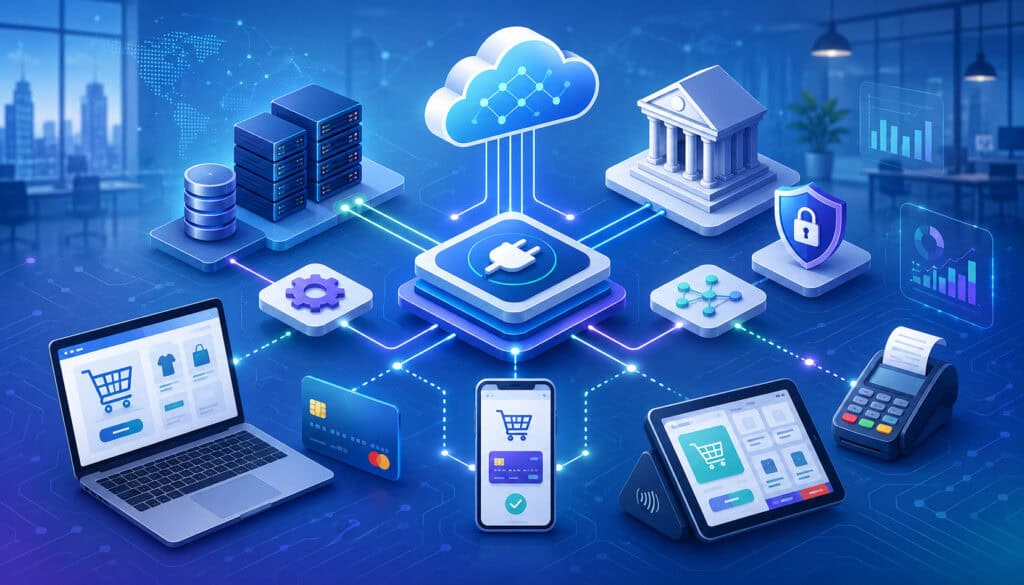
Architecture determines how much payment data enters your environment, how much checkout control developers receive, and how much responsibility the organization assumes for protecting payment-related systems. There is no universal architecture that is best for every online payment API integration.
A hosted checkout redirects the customer to, or presents, a checkout experience controlled outside the business’s primary application. Because sensitive payment entry can occur outside the merchant environment, hosted architectures can reduce the amount of payment information that merchant systems directly handle.
Embedded secure fields allow payment-entry components to appear inside the business’s checkout while sensitive fields are isolated from ordinary application inputs. This can provide more visual continuity than a full redirect while still reducing direct exposure to card information.
A direct API integration gives the development team extensive control over payment workflows. It can be appropriate for sophisticated ecommerce, SaaS, marketplace, or internal payment system integration, but additional flexibility usually means more security engineering, testing, maintenance, and operational responsibility.
A server-to-server integration places sensitive payment API operations in trusted backend systems. The browser or mobile application communicates with the business server, and that server performs authenticated payment operations. Secret credentials should normally remain in this trusted environment.
Mobile applications may also use payment-specific client components or SDK-style architectures that securely collect information before a server completes the transaction. A hybrid approach combines several methods, such as secure embedded collection for payment information with server-side API calls for orders, captures, subscriptions, or refunds.
| Architecture | Security responsibility | Checkout flexibility | Development complexity | Potential payment-data exposure |
| Hosted checkout | Lower merchant-side handling of sensitive entry data | Moderate | Lower | Generally reduced |
| Secure embedded fields | Shared responsibility | High | Moderate | Reduced when implemented correctly |
| Direct API | Higher | Very high | Higher | Depends heavily on design |
| Server-to-server | High for backend controls | High | Higher | Sensitive operations remain server-side |
| Hybrid | Varies by component | High | Moderate to high | Depends on data boundaries |
When comparing architectures, map the complete data flow. Identify where payment information originates, which application receives it, whether it enters browser storage or logs, which servers process it, where tokens are stored, and which employees can access the systems.
Architecture also affects PCI DSS scope. The applicable responsibilities depend on exactly how payment account data is stored, processed, or transmitted, and organizations should evaluate the official PCI DSS requirements rather than assuming that using a gateway removes every merchant responsibility.
Protect Authentication, Transport Security, Tokens, and PCI Scope
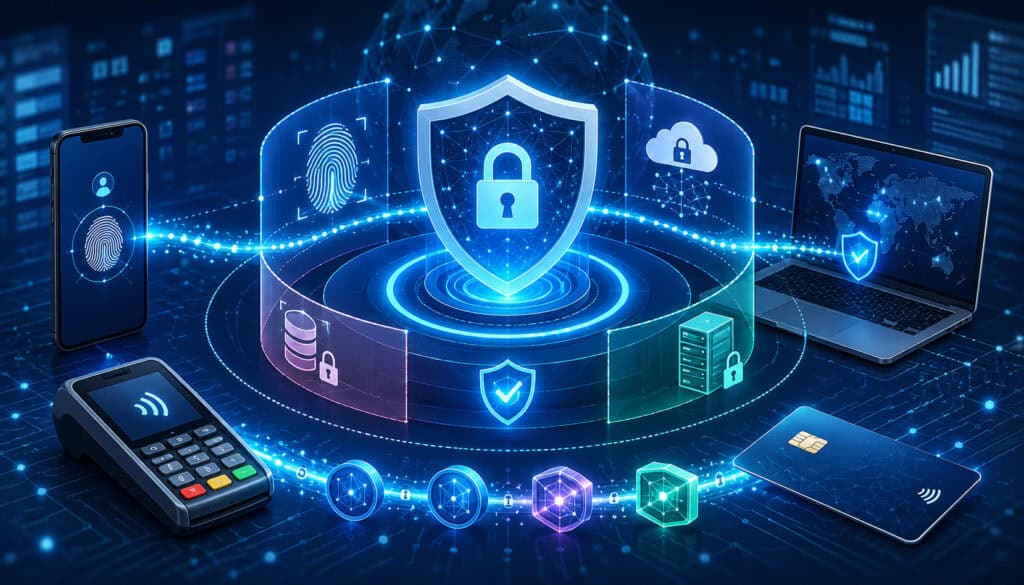
Secure payment API integration depends on layers. An encrypted connection cannot compensate for a leaked API credential, and tokenization cannot compensate for an application that accepts manipulated order totals.
Keep Secret API Credentials Server-Side
Secret API keys, private tokens, signing secrets, OAuth client secrets, and similar credentials should not be placed in browser JavaScript, public repositories, mobile application bundles, query strings, analytics events, screenshots, or client-side logs.
Anything delivered to a user’s browser or distributed inside a mobile package should generally be considered recoverable by that user.
Production secrets should instead be stored in protected server-side configuration or a dedicated secret-management system. Environment variables may be suitable in some deployments, provided access to the runtime environment is itself carefully controlled.
Secure secret-management guidance specifically treats API keys and similar credentials as secrets that need controlled storage and lifecycle management.
Use separate credentials for sandbox and production systems, restrict individual credentials to the permissions they actually need, rotate them according to the organization’s security process, and revoke them promptly when exposure is suspected.
Where scoped authorization is supported, OAuth can provide delegated or limited access instead of granting every integration unrestricted account authority. Teams implementing it should use current security guidance rather than relying solely on older examples. The underlying framework is designed to enable limited access to HTTP services.
For additional implementation context, this overview of API authentication methods for payments discusses credentials, tokens, signed requests, and related controls.
Use HTTPS and Tokenize Sensitive Payment Information
Every payment page, API request, webhook endpoint, account page, and administrative interface involved in the payment flow should use HTTPS. TLS provides mechanisms intended to protect client-server communications against eavesdropping, modification, and message forgery.
Applications should validate certificates normally rather than disabling certificate verification to work around development errors. Teams should also remove mixed-content dependencies from checkout pages and avoid insecure redirects that move customers or payment data between protected and unprotected connections.
Tokenization addresses a different problem. Rather than repeatedly storing or transmitting an original card number, the system receives a substitute token that references the underlying payment credential within an authorized payment environment.
Tokens can support saved payment methods, customer payment profiles, recurring billing, later captures, or other payment operations. However, a token is still valuable application data. It should be protected with authentication, authorization, tenant isolation, access controls, and appropriate retention policies.
Do not assume every token is universally reusable. Its usability may be limited by merchant context, customer profile, payment method, environment, or other conditions defined by the payment system.
Minimize PCI DSS Scope and Sensitive-Data Handling
PCI DSS establishes technical and operational requirements for protecting payment account data. Integration design directly affects which merchant systems participate in storing, processing, or transmitting that data.
Hosted payment pages, secure hosted fields, tokenization, and gateway-controlled vaulting can reduce direct payment-data exposure. They do not automatically eliminate every security or compliance obligation.
Developers should avoid collecting fields they do not need. Sensitive authentication information should not be copied into application databases, support tickets, analytics systems, internal chat, email, or unrestricted logs.
Employee access also matters. A technically sound integration can still create risk when administrators, support personnel, developers, or contractors have unnecessary access to customer payment information or production credentials.
This article should not be treated as a determination of PCI scope or compliance status. Organizations with questions about their specific environment should review the applicable requirements and obtain qualified assistance when appropriate.
Build Reliable Transaction Logic With Idempotency, Validation, IDs, Currency, and States
A production payment system must assume that requests can be repeated. A customer’s connection may drop after the payment service receives a request but before the application receives the response. The application now has an uncomfortable question: did the payment fail, or did only the response fail?
Idempotency solves an important part of that problem. An idempotency key identifies a logical operation so that repeating the same operation does not create an unintended second financial result.
Consider this sequence:
Order 4812 -> create payment -> network timeout
Application retries -> create payment again
Without duplicate protection, both requests could potentially be treated as separate payment attempts. With a stable idempotency key associated with the original order and operation, the server can recognize that the retry belongs to the same logical payment.
Idempotency keys should be unique enough to distinguish legitimate operations but stable across retries of the same operation. Do not generate a new key every time a timeout occurs, because that defeats the purpose.
Server-side validation is equally important. Never accept an amount solely because browser JavaScript says the cart total is 49.00. Retrieve trusted product prices, discounts, tax calculations, subscription terms, and order values from authoritative server-side data before creating the payment.
Validate currency, amount, customer identifier, order identifier, payment-method reference, supported fields, and expected response types. Treat unexpected fields or impossible status transitions as conditions that deserve investigation rather than silently accepting them.
Unique identifiers connect the payment lifecycle. Keep a merchant order ID, internal payment ID, external transaction reference, refund ID, webhook event ID, and reconciliation references as appropriate. These identifiers make duplicate detection, troubleshooting, refunds, dispute handling, and accounting substantially easier.
Currency requires particular care. Use recognized three-letter currency codes and understand each currency’s minor-unit rules; the relevant international standard defines alphabetic currency codes and decimal relationships for currencies with minor units.
Avoid binary floating-point arithmetic for monetary values because amounts such as decimal fractions may not be represented exactly. Many systems instead use integer minor units or decimal arithmetic designed for money.
A payment state machine provides another layer of protection. Useful states may include:
- Created
- Pending
- Authorized
- Captured
- Failed
- Declined
- Cancelled
- Refunded
- Partially refunded
- Disputed
Define which transitions are legal. For example, an authorized payment may become captured or cancelled, while a captured transaction may later become partially refunded, refunded, or disputed.
The application should also distinguish payment state from order state. A payment can be captured while fulfillment remains pending, or an order can be cancelled while a refund is still processing.
Handle Errors and Retries Without Creating New Payment Problems
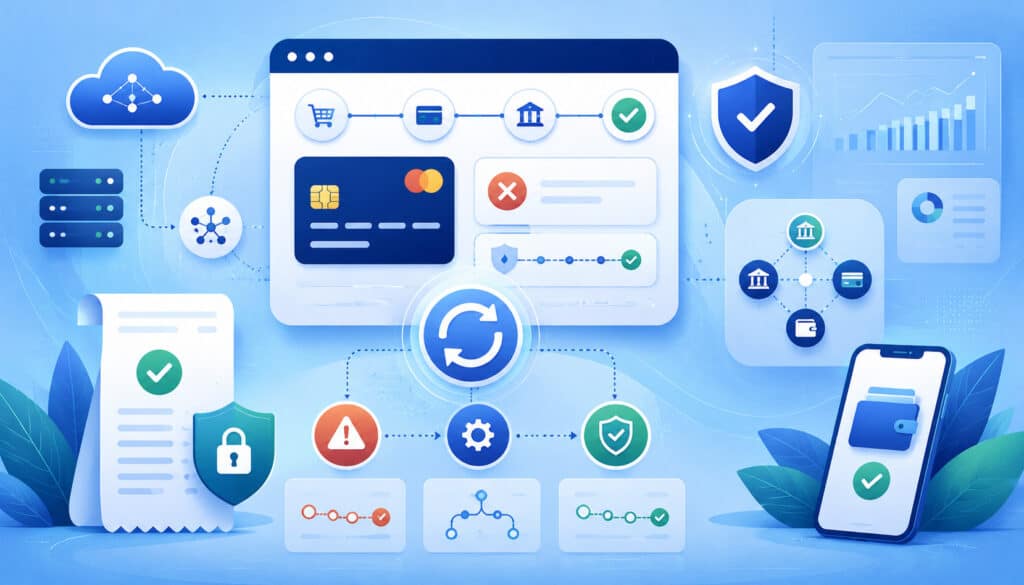
Payment errors do not all mean the same thing. A customer decline is fundamentally different from a network timeout, an invalid API credential, a malformed amount, or a temporary server failure.
Applications should classify errors before deciding what happens next.
Common Payment API Errors and Responses
| Error type | Possible cause | Recommended application response | Should it be retried? |
| Customer decline | Issuer or risk decision | Explain that payment was not completed and offer an appropriate next step | Usually not automatically |
| Validation error | Missing or invalid request data | Correct the request before resubmitting | No, until corrected |
| Authentication failure | Invalid, revoked, or expired credential | Stop the operation and investigate credentials | Not unchanged |
| Rate-limit response | Too many requests | Delay according to API guidance | Often, with backoff |
| Network timeout | Connectivity failure or uncertain response | Retrieve transaction state or retry idempotently | Sometimes |
| Server error | Temporary downstream problem | Preserve request context and retry cautiously | Sometimes |
| Duplicate request | Repeated logical operation | Return or retrieve the existing transaction | No new payment |
| Processor error | Downstream processing problem | Preserve state and follow documented recovery flow | Depends on error |
Customer-facing messages should be useful without revealing security-sensitive information. A customer may need to know that payment could not be completed, but they should not receive internal stack traces, API credentials, authentication details, fraud-rule configuration, database errors, or excessive information that could facilitate card testing.
Retries should be limited to conditions where repeating the operation is safe. Transient network failures, temporary service errors, and rate limiting may justify retrying. A customer decline normally does not justify repeatedly submitting the same payment automatically.
Use exponential backoff for suitable transient failures: increase the delay between subsequent attempts rather than immediately hammering the API. Add limits so a persistent outage does not create an endless retry loop.
Most importantly, combine retries with idempotency. Retrying a financial operation without a duplicate-prevention strategy can turn a resilience mechanism into a duplicate-charge mechanism.
A timeout also does not necessarily mean failure. The payment service might have completed the request while the response was lost. Before creating another payment, retrieve the existing transaction using the order reference, payment ID, or idempotency information where supported.
Implement Secure Webhooks and Server-Side Payment Confirmation
Payment processing is partly asynchronous. A customer may close the browser, lose connectivity, complete an authentication step later, receive a delayed capture result, or experience a refund or dispute well after checkout.
Webhooks allow a payment system to send event notifications to your application when those changes occur. Because a webhook endpoint is usually reachable from the internet, receiving a request at the expected URL is not evidence that the request is legitimate.
Verify webhook signatures according to the API’s documented signing process. Perform verification using the exact payload representation expected by that process, securely manage the signing secret, and reject events that fail verification.
Webhook guidance should be implemented alongside broader API security controls because broken authentication and authorization are common API risk categories.
Timestamp validation can help reduce replay risk when the signing scheme includes a trustworthy timestamp. Establish a reasonable acceptance window based on your architecture rather than accepting arbitrarily old signed requests.
Assume duplicate delivery is possible. Store a unique event identifier and make webhook processing idempotent so that receiving the same event twice does not ship two orders, issue two credits, or extend a subscription twice.
Also assume events may arrive out of order. A delayed event should not be able to overwrite a newer authoritative payment state simply because it was processed later.
A robust webhook handler commonly follows a pattern such as:
- Receive the request over HTTPS.
- Preserve the required raw request representation for signature validation.
- Verify the signature and timestamp.
- Validate the event type and essential identifiers.
- Check whether the event has already been processed.
- Store or enqueue the event durably.
- Return the required acknowledgement promptly.
- Process business actions idempotently.
- Retrieve the current payment object when stronger confirmation is needed.
- Log the result without storing sensitive credentials or payment data.
Applications should not blindly trust fields in a webhook payload merely because the signature is valid. Validate identifiers and expected state transitions, and use server-side transaction retrieval when the workflow requires confirmation of authoritative status.
The same principle applies to browser success screens. A customer being redirected to /payment-success does not prove that funds were authorized or captured. URLs and client-side state can be manipulated, and the browser may display stale or incomplete information.
The application should determine the final payment state on the server using verified transaction data and properly authenticated events. Fulfillment, account activation, digital delivery, and other financially significant actions should rely on that authoritative state.
Protect Logs, Access, Customer Data, and Fraud Controls
Logs are essential for troubleshooting online payment API integration, but careless logging can create another repository of sensitive information. Never intentionally record full card numbers, security codes, private API keys, bearer tokens, bank credentials, signing secrets, or authentication headers.
Mask or redact sensitive fields before log records leave the application. Protect log systems with role-based access, define retention periods, record administrative access where appropriate, and make sure production debugging does not silently capture entire request bodies.
Structured logs should focus on operational identifiers: internal order ID, payment ID, API operation, sanitized error category, latency, request correlation ID, webhook event ID, and status transition. These values generally provide more troubleshooting value than a raw payment payload.
Access control should follow the least-privilege principle. A support user who only needs transaction status does not need permission to create production API credentials. An application responsible for transaction retrieval may not need permission to issue refunds.
Use separate service accounts and credentials for distinct workloads when feasible. Separate test and production access, review permissions periodically, rotate credentials, and revoke access when employees, contractors, or vendors leave or change responsibilities.
Data retention should follow similar minimization principles. Keep customer and transaction information only when there is a legitimate operational, accounting, security, or other approved reason to retain it. Backups deserve the same protection as live databases.
Organizations should also define procedures for deletion and customer data requests based on their applicable obligations. The exact legal requirements depend on the organization and jurisdiction, so this discussion should not be treated as privacy or legal advice.
Fraud prevention adds another security layer. Useful controls can include:
- Address verification signals
- Payment security-code checks where appropriately handled
- Customer authentication
- Transaction velocity limits
- Device and session signals
- Account takeover detection
- Risk scoring
- Transaction monitoring
- Manual review workflows
API-based risk controls are explored further in this resource on API-based fraud prevention techniques.
Fraud controls should be calibrated rather than simply made maximally restrictive. Excessively aggressive rules may block legitimate customers, while weak rules may allow abusive activity. Review disputes, account takeover patterns, suspicious payment attempts, false positives, and manual-review outcomes together.
Support Recurring Payments, Refunds, Voids, and Other Lifecycle Events
Recurring payment API integration adds complexity because a customer’s first checkout is only the beginning of the payment relationship. Subscription systems may need to manage consent, stored credentials, billing schedules, renewals, payment-method changes, failed payments, cancellations, refunds, and customer notifications.
Store reusable payment tokens rather than unnecessary raw payment credentials. Associate the token with the correct customer and account context, restrict access, and maintain an audit trail of important billing changes.
Consent and billing terms should be captured through an appropriate business process before initiating recurring payments. The application should know what is being billed, the relevant schedule, which payment method is authorized for use, and what should happen when the subscription changes.
Failed renewal attempts need their own workflow. A temporary processing error may support a carefully controlled retry, while a definitive decline may require customer action. Automatic retry behavior should have explicit limits and should not endlessly submit the same unsuccessful payment.
Give customers or authorized staff a controlled method to update an expired or replaced payment method. Cancellation should prevent future billing according to the business rules without destroying historical transaction records needed for reconciliation or support.
Refunds, voids, and partial refunds should also be modeled distinctly. A void commonly cancels an eligible transaction before it progresses too far through settlement. A refund returns funds after a payment has progressed beyond the point where a void is appropriate.
For each refund or void request, validate the original transaction ID, refundable amount, currency, current payment state, and requesting user’s permission. Prevent duplicate refund submissions with idempotency or equivalent safeguards.
Partial refunds require accurate remaining-balance calculations. If a payment of 100 has already been refunded by 30, a later attempt to refund 80 should be rejected if it exceeds the remaining refundable amount.
Keep refund identifiers distinct from the original capture identifier. Reconciliation systems should be able to connect the original payment with each subsequent refund, dispute, fee, or adjustment without overwriting the original transaction.
Test the Payment API Beyond Successful Transactions
A sandbox environment is a controlled testing system where development teams can exercise payment workflows without intentionally creating real production transactions. Sandbox testing should demonstrate not only that payments work, but also that the application behaves safely when they do not.
Test successful authorizations and captures, but also create structured test cases for:
- Declined payments
- Insufficient-funds scenarios when available
- Invalid payment information
- Authentication failures
- Expired credentials
- Network timeouts
- Duplicate requests
- Rate-limit conditions
- Full refunds
- Partial refunds
- Voids
- Webhook retries
- Duplicate webhooks
- Delayed webhooks
- Recurring billing
- Expired stored payment methods
- Dispute or chargeback events where the test environment supports them
Successful payment testing alone proves very little about production resilience. Many of the most expensive integration defects appear only when two systems disagree about whether an operation is completed.
Test connectivity loss at awkward moments. For example, interrupt the network after submitting a payment but before the application receives the response. The system should be able to recover the transaction state without blindly creating another payment.
Test gateway or downstream downtime. Confirm that checkout presents an appropriate message, application threads do not hang indefinitely, request queues remain bounded, and staff receive useful operational alerts.
Test malformed and unexpected responses. Payment code should fail safely when required fields are absent, status values are unknown, response bodies are truncated, or an upstream dependency returns nonstandard content.
Simulate delayed, reordered, and duplicate webhook events. A robust application should eventually reach the correct state without duplicating fulfillment or corrupting payment records.
Partial system failures are especially valuable. What happens when the payment succeeds but the order database write fails? What happens when the database succeeds but a message queue is unavailable? These cases reveal where transaction boundaries and recovery mechanisms need improvement.
Test and production environments should be strongly separated. Use different credentials, endpoints, configuration, databases, webhooks, and preferably distinct access policies.
Never allow a production deployment to fall back silently to test credentials or vice versa. Deployment configuration should explicitly identify the environment and fail safely if required variables are missing.
Production credentials should not exist on developer laptops merely because sandbox credentials do. Similarly, production logs and customer data should not routinely be copied into development systems for debugging.
Before launch, execute a production-readiness test plan that covers payment creation, authorization, capture, refunds, failure recovery, webhook verification, permissions, monitoring, and reconciliation.
Plan for API Versioning, Rate Limits, Scalability, and Performance
Payment APIs evolve. Endpoints may be deprecated, response fields may change, new authentication requirements may appear, and previously optional fields may gain different behavior.
Pin API versions when the payment interface supports controlled versioning. Do not automatically adopt breaking production changes merely because a newer API release exists.
Track deprecation notices, migration documentation, field changes, authentication updates, and endpoint retirement schedules. Test upgrades in a nonproduction environment using realistic transaction workflows before deploying them.
The underlying API style also influences maintainability. This technical discussion of REST and alternative payment API approaches provides useful context for evaluating API architecture tradeoffs without assuming one approach fits every workload.
Rate limits restrict how frequently an application can call an API within defined conditions. Design for them before traffic grows.
Avoid repeatedly retrieving transaction objects when your own database already contains recent non-sensitive data that can safely serve the user interface. Cache only appropriate information; never use caching as an excuse to retain sensitive payment credentials unnecessarily.
Queues can smooth traffic spikes for operations that do not need synchronous completion. Webhook processing, reconciliation imports, nonurgent reporting, and some status synchronization tasks can often be handled asynchronously.
Use connection reuse where supported, configure sensible connection and read timeouts, and avoid an unnecessarily long chain of synchronous API calls inside customer checkout.
Database design matters as transaction volume grows. Index frequently queried identifiers such as order IDs, payment IDs, webhook event IDs, and reconciliation references. Keep historical financial records durable while avoiding contention around a single mutable order row.
Batch operations may be useful when an API explicitly supports them, particularly for reporting or reconciliation. Do not simulate batching by creating uncontrolled bursts of parallel requests.
Scalability planning should include traffic spikes, not just average volume. High transaction volume can expose database locks, exhausted connection pools, queue backlogs, insufficient API quotas, or slow webhook handlers that never appear in small sandbox tests.
Monitor Payment Operations and Reconcile Records Regularly
A production payment integration is not complete when deployment succeeds. Teams need visibility into technical performance and financial consistency.
Useful monitoring signals include:
- API latency
- API error rates
- Authentication failures
- Authorization failures
- Payment decline patterns
- Rate-limit responses
- Network timeouts
- Webhook verification failures
- Webhook-processing delays
- Duplicate requests
- Refund failures
- API availability
- Queue backlog
- Unexpected payment-state transitions
- Settlement discrepancies
Dashboards should separate technical failures from customer declines whenever possible. A spike in customer declines may indicate a risk or issuer pattern, while a spike in HTTP errors may indicate a software or infrastructure problem.
Alerts should focus on conditions that require action. Universal thresholds are rarely appropriate because transaction volume, business hours, payment methods, and system architecture vary substantially between organizations.
Monitoring tells you how the system is behaving. Reconciliation verifies that financial records agree across systems.
Compare API transaction records with orders, authorizations, captures, refunds, disputes, processing fees, settlement records, deposits, and accounting entries. Differences should enter a documented investigation workflow rather than being silently ignored.
A practical reconciliation cadence can look like this:
- Daily: Review new captures, refunds, failures, disputes, settlement activity, and unusual unmatched transactions. Confirm that high-value exceptions and payment-to-order mismatches are investigated.
- Weekly: Review recurring discrepancies, payment states that remain pending unexpectedly, failed refunds, webhook-delivery problems, duplicate activity, fee differences, and unresolved transaction exceptions.
- Monthly: Compare broader settlement and accounting totals, review aged reconciliation exceptions, analyze recurring root causes, verify access to reconciliation systems, and document corrections.
Reconciliation should operate by identifiers rather than descriptions alone. Match internal order IDs and payment IDs with capture, refund, dispute, settlement, and deposit references whenever those references are available.
Do not assume that a successful API response means every downstream financial record will automatically remain consistent forever. Refunds, disputes, operational corrections, delayed events, and settlement adjustments can change the financial picture after checkout.
Prepare an Incident-Response Process Before Production Problems Occur
Payment systems should have a documented response process for credential exposure, unauthorized transactions, suspected payment-data compromise, webhook outages, production downtime, and inconsistent payment records.
If API credentials may have been exposed, determine which credentials are affected, restrict or revoke them, rotate replacements through a controlled deployment process, and review relevant audit logs. Avoid deleting evidence that could help determine what happened.
For suspicious transactions, preserve identifiers, account activity, timestamps, access logs, API events, and fraud signals needed for investigation. Restrict affected permissions or accounts when necessary and involve appropriate internal security, compliance, legal, financial, or operational specialists based on the circumstances.
If webhooks fail, maintain a recovery path. That may include retrieving authoritative payment states, replaying securely stored internal events, or processing queued messages after the receiving system recovers.
If production payment systems go offline, checkout should fail predictably rather than leaving customers uncertain whether repeated clicks will create multiple transactions. Status communication, idempotency, queues, and transaction retrieval become especially valuable during recovery.
Inconsistent payment records require careful reconciliation. Identify which system contains the authoritative evidence for each part of the payment lifecycle and avoid bulk data corrections until the discrepancy’s cause is understood.
Incident plans should identify decision makers, technical owners, business contacts, escalation procedures, credential-rotation steps, communication responsibilities, and recovery validation tasks. Periodic exercises can expose missing permissions or undocumented dependencies before a real incident requires them.
No architecture can guarantee that incidents will never occur. The goal is to reduce their likelihood, contain their impact, preserve evidence, restore accurate service, and learn from the root cause.
Payment API Integration Best Practices
The following table summarizes core controls development and business teams should consider during payment gateway API integration.
Payment API Integration Best Practices
| Best practice | Why it matters | Common mistake | Recommended action |
| API authentication | Prevents unauthorized operations | Sharing or exposing secret credentials | Store secrets server-side and scope permissions |
| HTTPS | Protects data in transit | Allowing insecure endpoints or redirects | Require HTTPS throughout payment flows |
| Tokenization | Reduces unnecessary handling of payment credentials | Storing raw payment data for convenience | Use tokens where appropriate |
| Idempotency | Helps prevent duplicate financial operations | Generating a new request on every retry | Reuse a stable idempotency key for the same operation |
| Webhook verification | Prevents fake or replayed event handling | Trusting any POST to the webhook URL | Verify signatures, timestamps, IDs, and states |
| Error handling | Supports predictable recovery | Treating every failure identically | Classify declines, validation errors, outages, and timeouts |
| Retry logic | Improves resilience to temporary failures | Automatically retrying every decline | Retry only safe transient failures |
| Logging | Enables troubleshooting and investigations | Logging full request payloads | Redact sensitive data and restrict log access |
| Testing | Finds failure-path defects | Testing only successful payments | Test declines, outages, duplicates, refunds, and webhooks |
| Monitoring | Detects operational problems | Launching without alerts | Track payment and API health signals |
| Versioning | Prevents unexpected breaking changes | Automatically adopting API changes | Test and deploy upgrades deliberately |
| Reconciliation | Detects financial inconsistencies | Assuming API success equals accounting accuracy | Compare payments with settlements and accounting records |
Many integration failures come from ordinary shortcuts rather than unusual attacks. Common mistakes include exposing secrets in frontend code, storing sensitive card information unnecessarily, ignoring idempotency, blindly retrying payments, trusting browser-submitted totals, accepting unsigned webhooks, and using one unrestricted API credential everywhere.
Other recurring problems include logging authentication tokens, testing only successful transactions, hardcoding credentials, ignoring API version changes, failing to reconcile payments, processing duplicate webhook events, deploying without monitoring, and operating without an incident-response process.
These mistakes are interconnected. A network timeout is considerably more dangerous when idempotency is absent. A fake webhook is more dangerous when the application trusts client-facing payment states. A credential leak is more damaging when the credential has unrestricted permissions.
Good payment engineering therefore relies on multiple defensive layers instead of one “secure” feature.
Payment API Integration Checklist
Before moving an API payment processing integration into production, teams can use the following checklist as a structured review:
- Choose an appropriate integration architecture. Document whether payment information is hosted, embedded, tokenized, or handled directly and understand the resulting responsibilities.
- Keep secret credentials server-side. Prevent private keys and tokens from entering browser code, mobile bundles, URLs, logs, or public repositories.
- Use HTTPS. Protect checkout, API endpoints, webhooks, administration, and server-to-server communication.
- Tokenize payment information. Avoid storing sensitive payment credentials when an appropriate tokenized workflow is available.
- Minimize sensitive-data exposure. Collect and retain only information required for approved business processes.
- Implement idempotency. Protect payment creation, refunds, and other retryable financial operations against duplicates.
- Validate amounts server-side. Recalculate authoritative totals instead of trusting browser input.
- Build safe error and retry logic. Distinguish declines from transient technical failures.
- Verify webhooks. Validate signatures, timestamps, identifiers, duplicates, and expected state transitions.
- Test success and failure scenarios. Include timeouts, outages, duplicates, refunds, delayed events, and malformed responses.
- Separate sandbox and production. Use different credentials, endpoints, databases, data, and access controls.
- Restrict API permissions. Follow least privilege and separate service responsibilities where feasible.
- Monitor transactions and API health. Track latency, failures, webhook processing, refunds, duplicates, and availability.
- Reconcile payments regularly. Compare application records with captures, refunds, disputes, settlements, deposits, fees, and accounting.
- Plan for API updates and outages. Monitor deprecations and test controlled upgrades.
- Maintain incident-response procedures. Prepare for credential exposure, fraud, outages, event failures, and inconsistent records.
A checklist is only useful when it reflects the actual deployed architecture. Review it whenever payment flows, APIs, checkout components, infrastructure, vendors, permissions, or billing models change.
Frequently Asked Questions
What is payment API integration?
Payment API integration connects an application with payment-processing infrastructure through programmable API requests. The application may use those requests to create payments, authorize transactions, capture funds, issue refunds, manage tokens, retrieve transaction information, or support recurring billing.
A strong integration includes more than the basic payment request. Authentication, server-side validation, idempotency, webhooks, error handling, monitoring, reconciliation, and security controls are all part of a reliable production implementation.
How does a payment gateway API work?
A payment gateway API accepts authenticated transaction instructions from an application and communicates them through the payment-processing environment. The application typically submits information such as amount, currency, payment-method reference, order ID, and other required parameters.
The gateway returns an immediate result when possible, but later events may still change the transaction state. Applications should therefore support both synchronous API responses and asynchronous payment notifications.
How can developers securely store payment API keys?
Secret API credentials should remain in controlled server-side environments. Teams can use protected environment configuration or secret-management infrastructure with restricted permissions, auditing, and rotation procedures.
Do not place production secrets in frontend JavaScript, mobile application source, public repositories, documentation screenshots, URLs, analytics tools, or unrestricted logs. Separate credentials by environment and revoke them promptly when exposure is suspected.
What is idempotency in payment APIs?
Idempotency means repeating the same logical request does not create a second unintended financial operation. The application usually provides a unique key representing the operation, allowing the payment API to recognize retries.
It is particularly important after timeouts because the application may not know whether the original request completed. Idempotency allows cautious recovery without treating every uncertain response as permission to create another payment.
Why are webhooks important in payment processing?
Payment states can change after the customer’s immediate API request has finished. Captures, refunds, subscription renewals, disputes, payment authentication, and other events may happen asynchronously.
Webhooks allow the payment system to notify the application about those events. Receiving applications should verify signatures, handle duplicate delivery, account for event ordering, validate timestamps where supported, and process events idempotently.
Should payment information be stored directly?
Businesses should minimize sensitive payment-data storage whenever possible. Tokenization and hosted payment collection can reduce the need for merchant applications to store raw payment credentials.
If information does not have a clear approved purpose, avoid collecting it. Organizations that store, process, or transmit payment account data should evaluate the relevant security and compliance requirements for their environment.
How should payment API errors be handled?
Classify errors before responding. Customer declines, validation failures, authentication problems, timeouts, rate limits, duplicate requests, and server errors require different treatment.
Customer messages should explain the next step without exposing internal security information. Internal logs can contain correlation IDs and sanitized diagnostics, but should not contain full credentials or sensitive payment information.
When should failed payment API requests be retried?
Retries are appropriate mainly for clearly transient technical failures where repeating the request is safe. Examples may include temporary connectivity issues, selected server errors, or rate limiting.
Use idempotency, exponential backoff, and maximum retry limits. Do not automatically retry definitive customer declines or invalid requests without correcting the underlying condition.
How should developers test payment APIs?
Use the sandbox to test successful payments and deliberate failure conditions. Include declines, authentication failures, network timeouts, duplicate requests, refunds, voids, recurring payments, expired payment methods, webhook retries, and delayed events where supported.
Also test partial system failures. A payment system’s ability to recover after a lost response or unavailable database is often more important than another successful checkout test.
What is the difference between sandbox and production environments?
A sandbox is designed for development and testing without intentionally processing live customer transactions. Production is the live environment where real payment operations occur.
Credentials, endpoints, webhooks, databases, configuration, data, and access should remain separate. Deployment controls should make it difficult for test code to accidentally send transactions to live processing systems.
How can payment APIs be monitored?
Monitor both application performance and payment behavior. Useful signals include API latency, error rates, timeouts, authorization failures, webhook failures, refund errors, duplicate requests, rate limiting, queue delays, and availability.
Combine these signals with reconciliation. Technical monitoring can show whether software is functioning, while reconciliation verifies whether transaction, settlement, deposit, and accounting records remain financially consistent.
What are the most common payment API integration mistakes?
Frequent mistakes include exposing API secrets, storing unnecessary card information, failing to implement idempotency, retrying payments indiscriminately, trusting client-side totals, accepting unverified webhooks, and using overly broad credentials.
Other problems include logging sensitive data, testing only successful transactions, ignoring API version changes, failing to reconcile payment records, processing duplicate events, launching without monitoring, and lacking an incident-response plan.
Conclusion
Reliable payment API integration requires more than connecting a checkout form to an API endpoint. Teams need secure credential management, encrypted transport, tokenization, server-side validation, idempotency, verified webhooks, well-defined transaction states, thoughtful error handling, and controlled retry behavior.
Production reliability also depends on comprehensive testing, strict separation between sandbox and production environments, least-privilege access, safe logging, fraud controls, monitoring, reconciliation, API version management, and documented incident procedures.
The strongest payment integration is not necessarily the one developed fastest or the one with the most customized checkout. It is the one whose data flows are understood, whose failures are predictable, whose financial state can be verified, and whose security responsibilities are deliberately managed.
By prioritizing accuracy, customer protection, resilience, maintainability, and operational visibility, businesses and development teams can build payment systems that remain understandable and manageable as transaction volume, billing complexity, and application requirements grow.