
Real-time payments are changing what businesses expect from digital money movement. Instead of designing applications around long processing windows and periodic status checks, developers can increasingly build payment experiences in which an application submits a payment instruction, receives an immediate technical response, and follows transaction events as they move toward completion.
That capability depends on more than a fast payment rail. Successful real-time payment API integrations require secure authentication, precise transaction-state management, duplicate-payment prevention, verified notifications, fraud controls, resilient error handling, monitoring, and reconciliation.
The API may provide the connection, but the surrounding application architecture determines whether the payment workflow remains dependable when networks slow down, messages arrive twice, credentials expire, or transactions produce uncertain outcomes.
A real-time payment API is an application programming interface that allows software to communicate with payment infrastructure capable of processing fast electronic payment instructions.
Depending on the implementation, an application may use the API for payment initiation, transaction lookup, payment confirmation, account verification, request-for-payment messaging, returns, reporting, or reconciliation.
The broader concept of a payment API is explained in this guide to what a payment API does, including how APIs connect checkout, payment processing, reporting, and business systems.
Real-time payment integration should not be treated as a single API call followed by an assumption that everything succeeded.
It is better understood as a coordinated workflow connecting customer interfaces, application servers, security controls, payment endpoints, financial institutions, payment networks, databases, accounting systems, notification services, and operational monitoring.
This guide explains the workflow from initiation through reconciliation, including the technical and operational controls developers, ecommerce teams, SaaS companies, marketplaces, finance teams, and business owners should consider.
What Real-Time Payment API Integration Means
A real-time payment integration connects an application with payment infrastructure through programmable interfaces so the application can create, transmit, track, verify, and record fast account-to-account payment activity. The application usually communicates with one or more REST API endpoints using structured request and response payloads.
API-based payments can support several operations. An application might initiate a push payment to a supplier, retrieve the status of an account-to-account transfer, receive a webhook when a payment completes, send a request for payment to a customer, or retrieve completed transactions for reconciliation.
The API itself should not be confused with every other participant in the payment flow. A payment API is the software interface through which an application requests payment functions.
A payment gateway generally provides a technology layer for securely transmitting payment information, particularly in ecommerce environments. A processor performs or coordinates payment-processing functions, while a bank connection links payment activity to financial accounts.
A payment network or payment rail provides the rules and infrastructure used to exchange payment instructions between participating institutions. Depending on the integration model, several of these functions may be presented through a single technical interface even though different systems are involved underneath.
This distinction matters during troubleshooting. If an API call succeeds but a receiving institution rejects the payment, the API connection may be functioning correctly even though the payment itself did not complete.
Real-Time Payment Infrastructure and the API Layer
Real-time payments infrastructure provides the underlying capability for participating institutions to exchange payment instructions and related messages rapidly. The API layer makes that infrastructure usable by business software.
A typical payment processing API may expose endpoints such as:
- POST /payments to create a payment
- GET /payments/{payment_id} to retrieve transaction status
- POST /payment-requests to create a request for payment
- GET /transactions to retrieve transaction records
- POST /returns to initiate a supported return workflow
The exact endpoints, fields, permissions, statuses, limits, and supported operations vary. Developers should always treat the API specification and applicable payment-network rules as authoritative for the integration they are implementing.
The value of an instant payment API is therefore not simply speed. It is programmable control over the payment lifecycle. Applications can connect payment activity to orders, invoices, customer accounts, supplier records, treasury systems, notifications, and accounting entries.
How a Real-Time Payment API Transaction Works
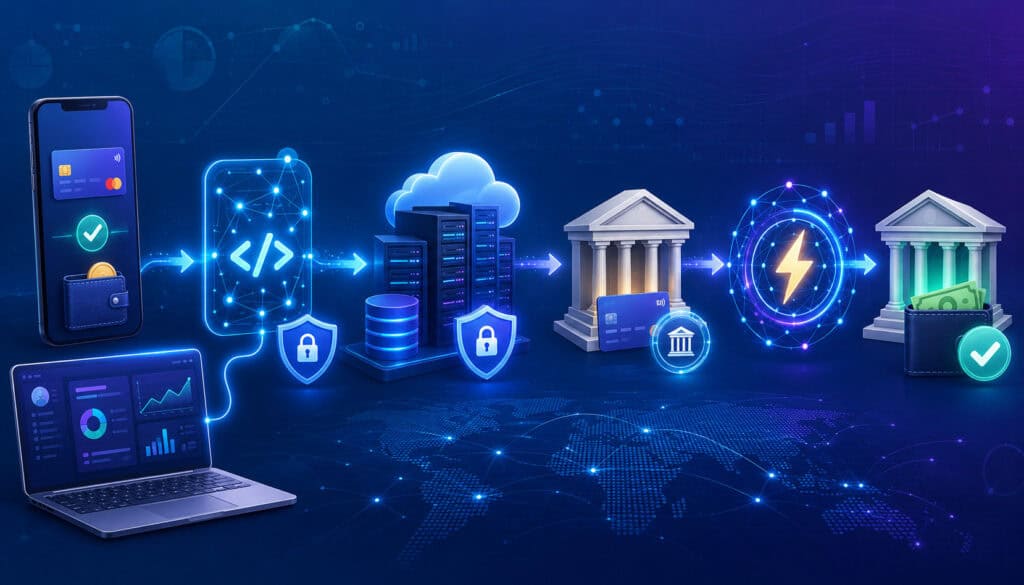
A real-time transaction usually moves through several systems before the business can treat it as complete. Even when each stage happens quickly, developers should model those stages separately.
A typical lifecycle looks like this:
- A customer or business initiates a payment.
- The application validates the amount, recipient, account information, and required references.
- Authentication and authorization controls determine whether the request may proceed.
- The application submits the payment instruction through an authenticated API endpoint.
- Fraud, account, transaction-limit, or risk controls evaluate the transaction.
- The payment instruction moves through the applicable financial infrastructure.
- A transaction status or acknowledgement is returned.
- Webhooks, callbacks, or subsequent API queries communicate additional status changes.
- The application updates the relevant order, account, invoice, or payout record.
- Transaction records are later reconciled with financial and accounting records.
The key architectural lesson is that real-time transaction processing can still contain asynchronous elements. An API response might confirm that a request was received without confirming that every downstream step is complete.
Payment Initiation and Validation
Payment initiation begins when the application collects or generates the information needed to construct a valid payment instruction. That normally includes an amount, currency or supported monetary unit, payer and payee information, account identifiers or tokens, a unique transaction reference, and any remittance information required by the workflow.
Validation should happen before the request reaches the payment API. The application should confirm that amounts are formatted correctly, required fields are present, account identifiers match expected formats, values are within applicable transaction limits, and the internal business record exists.
A simplified request might resemble:
POST /payments
Authorization: Bearer <access-token>
Idempotency-Key: <unique-request-key>
{
“amount”: “1250.00”,
“currency”: “XXX”,
“recipient”: {
“account_reference”: “recipient-token”
},
“reference”: “INV-4821”
}
The specific schema will vary. Developers should never assume that fields from one real-time transaction API are transferable to another.
Validation reduces unnecessary API errors, but it is not a substitute for server-side validation by the payment system. Both layers matter.
Authentication, Processing, and Payment Confirmation
Before accepting a payment instruction, the API must determine whether the calling application is authenticated and authorized to perform the requested operation. It may use API keys, access tokens, OAuth-based authorization, signed messages, certificates, or combinations of these controls.
After authentication, transaction risk controls may examine account information, transaction amount, payment history, velocity, device or session signals, and other permitted information. The instruction can then move into the underlying payment infrastructure.
A response may indicate that the payment was created, accepted, pending, processing, completed, rejected, or another defined state. These terms are not universal.
Applications therefore need to distinguish among:
- Request accepted by the API
- Payment instruction accepted for processing
- Payment currently processing
- Payment completed
- Funds reported as available
- Settlement reaching the state defined by the relevant payment rail
An HTTP success status alone should never be used as proof that every payment stage has finished.
Real-Time vs Traditional Payment Processing

Real-time payments sit alongside other payment methods rather than universally replacing them. Card payments, batch-oriented account transfers, bank payment methods, and real-time account-to-account payments have different operational characteristics.
A conventional card transaction, for example, may separate authorization from capture and settlement. Some bank-transfer systems process instructions in scheduled windows.
A real-time payment approach is generally designed to transmit and process payment instructions much sooner, but surrounding functions such as accounting, dispute handling, return processing, reporting, and customer support may still operate independently.
Real-Time vs Traditional Payment Processing
| Comparison factor | Real-time payment approach | Traditional processing approach | Why it matters |
| Processing speed | Designed for rapid processing | May involve batch or staged processing | Affects customer and treasury workflows |
| Availability | May support extended or continuous operating models | Operating windows vary by method | Applications must handle off-hours behavior correctly |
| Settlement characteristics | Can be closely connected to transaction processing | May involve separate clearing and settlement stages | Determines when finance teams recognize transactions |
| Reversibility | May be limited or governed by specific return procedures | Some methods provide established refund or dispute mechanisms | Changes error and fraud response planning |
| Confirmation | Can provide rapid transaction messaging | Confirmation may arrive through later stages | Applications need accurate state handling |
| Customer experience | Can support immediate feedback | Customers may see pending periods | Influences order and account design |
| Fraud exposure | Speed can reduce intervention time | Some methods provide longer review windows | Early controls become important |
| Operational complexity | Requires strong event and exception handling | Mature workflows may already exist | Technical speed does not remove operations |
| Reconciliation | Rich references may improve matching | Batch reports may drive reconciliation | Accounting architecture may differ |
No method is automatically superior. Businesses should evaluate the payment method according to transaction type, customer expectations, return rules, liquidity requirements, operational capacity, fraud exposure, accounting needs, and applicable network rules.
For example, a supplier payment may benefit from rapid account-to-account processing because the business wants quick confirmation. A different payment workflow might require authorization controls, delayed capture, or a dispute structure that fits another payment method more naturally.
Core Components of a Real-Time Payment API Integration
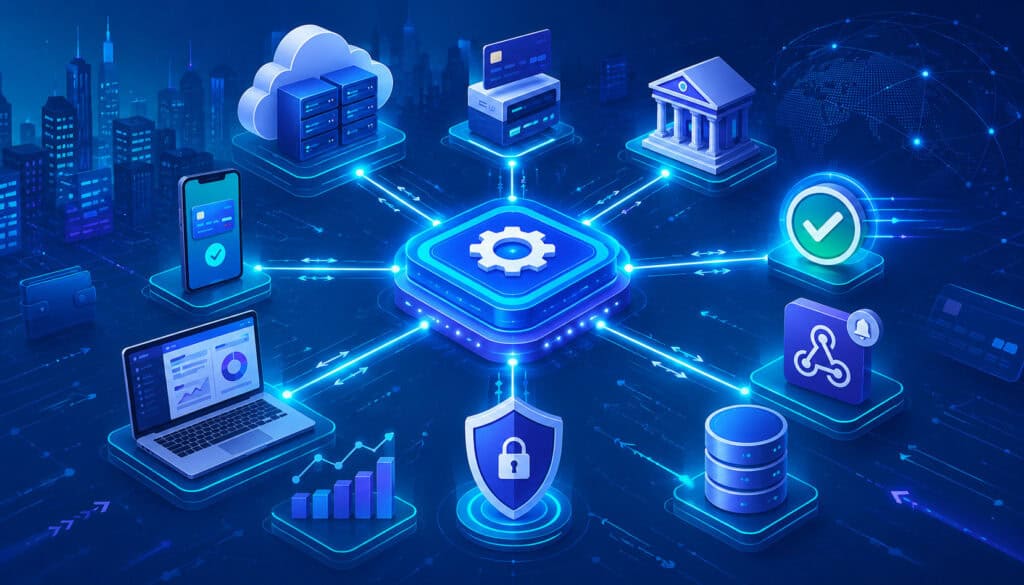
A reliable payment API integration depends on several components working together. The payment endpoint receives the most attention during development, but authentication, webhooks, idempotency, state storage, observability, and reconciliation often determine whether the production system remains dependable.
Real-Time Payment API Integration Components
| Component | Purpose | Key implementation concern | Recommended practice |
| Authentication | Identifies trusted applications | Credential theft or expiration | Store secrets securely and rotate them |
| Payment initiation | Creates payment instructions | Invalid or duplicated requests | Validate input and assign unique identifiers |
| Transaction status | Reports payment progress | Misinterpreting temporary states | Map external statuses to internal states |
| Webhooks | Delivers asynchronous events | Spoofing, duplicates, ordering | Verify signatures and process idempotently |
| Idempotency | Prevents duplicate operations | Repeated requests after timeouts | Reuse the same key for the same logical payment |
| Error handling | Classifies failures | Retrying permanent errors | Separate retryable and nonretryable failures |
| Monitoring | Detects abnormal behavior | Missing operational signals | Track API, payment, and webhook health |
| Reconciliation | Matches financial records | Missing or inconsistent identifiers | Preserve stable references end to end |
| Security | Protects systems and payment data | Excessive permissions or data exposure | Apply layered security controls |
API Endpoints, Payloads, Identifiers, and Statuses
An API endpoint is a defined network location that performs a specific operation. REST API integrations commonly use HTTP methods such as POST, GET, and occasionally PATCH or DELETE, depending on the operation.
Request payloads contain the information the API needs. Responses normally contain identifiers, status information, timestamps, validation results, and potentially error objects or related resource links.
Applications should preserve several identifiers separately. An internal order ID identifies the business transaction. An API request ID may identify one technical request. A payment ID identifies the payment resource. An idempotency key identifies the intended operation for duplicate-prevention purposes.
Collapsing those identifiers into one field makes troubleshooting and reconciliation unnecessarily difficult.
Transaction timestamps should also be recorded carefully. Useful timestamps may represent request creation, API receipt, acceptance, completion, return, or webhook delivery. Their meaning should be explicit rather than inferred from a generic created_at field.
Payment Status APIs and State Mapping
A payment status endpoint allows the application to retrieve the current state of a transaction. Common concepts include:
- Created: a payment object exists but may not have entered processing.
- Pending: additional processing or a decision remains outstanding.
- Processing: the instruction is actively progressing.
- Accepted: the instruction has passed a defined acceptance stage.
- Completed: the API reports its completion condition has been met.
- Rejected: the instruction was not accepted.
- Failed: processing could not complete.
- Cancelled: processing was stopped where supported.
- Returned: funds or a payment instruction moved through an applicable return process.
Exact terminology and semantics differ between APIs. Developers should create an internal mapping based on documented meanings rather than relying on the label alone.
Order state should also remain separate from payment state. A payment_completed event does not necessarily mean order_fulfilled, while a failed shipment does not mean the payment itself failed.
This separation prevents duplicate fulfillment, premature service activation, and accounting mismatches.
Webhooks, Idempotency, and Reliable Event Handling
Real-time payment systems frequently involve events that occur after the initiating API request has returned. Webhooks allow the payment system to notify the application when those events occur.
A webhook is an HTTP request sent to an application-controlled endpoint when a defined event happens. Instead of repeatedly polling the API, the application can receive payment updates as they are generated.
Webhooks are particularly useful for completion events, failed transactions, returns, payment-request responses, or other status changes.
Secure Webhook Handling
Webhook endpoints must be treated as security-sensitive infrastructure. An attacker should not be able to send an arbitrary request that causes an application to mark an invoice as paid or trigger fulfillment.
A robust webhook handler should:
- Require HTTPS.
- Verify the documented signature or authentication mechanism.
- Validate timestamps where replay protection is supported.
- Reject malformed events.
- Record the event identifier.
- Ignore already processed events.
- Handle events idempotently.
- Return appropriate HTTP responses.
- Log processing outcomes without exposing secrets.
- Route repeatedly failing events to recovery procedures.
Duplicate webhook events are normal enough that applications should expect them. The sender may retry because the original acknowledgement was lost even though the application processed the event successfully.
Event ordering can also vary. A later event may arrive before an earlier one because of queues, retries, or network paths. State transitions should therefore be validated instead of blindly applying events in arrival order.
The internal guide on payment API fundamentals also discusses webhook-driven payment updates and duplicate-event handling.
Idempotency and Duplicate Payment Prevention
Idempotency means that repeating the same logical operation does not create an unintended additional result. It is especially important in API payment processing because network uncertainty can make callers unsure whether a request succeeded.
Consider this scenario:
- An application sends a payment for an invoice.
- The payment server receives and processes the request.
- The network connection fails before the application receives the response.
- The application does not know whether the payment happened.
Blindly sending a new payment could create a duplicate. Instead, the application should reuse the original idempotency key or query the existing transaction using its known identifier.
A simplified strategy is:
idempotency_key = stable_unique_key_for_this_payment
send_payment(idempotency_key)
if response_is_unknown:
check_transaction_status()
do_not_create_new_payment_until_outcome_is_known()
The exact behavior of idempotency keys varies. Developers must understand their scope, retention period, request-matching rules, and conflict behavior.
API Authentication, Authorization, Credentials, and Encryption
Payment APIs expose financially sensitive capabilities. Authentication and authorization therefore need to be designed as core parts of the system rather than configuration details.
Common API authentication mechanisms include API keys, short-lived access tokens, OAuth-based flows, cryptographically signed requests, and certificates. Different mechanisms may be appropriate for server-to-server communication, delegated user authorization, administrative functions, or highly privileged endpoints.
A detailed overview of API authentication methods for payments provides additional context on credential types and access controls.
Authentication vs Authorization
Authentication establishes who or what is making a request. Authorization determines what that authenticated identity is permitted to do.
Suppose four internal services use the same payment environment:
- Checkout may create payments.
- Customer support may view transaction status.
- Finance may view reports.
- A restricted operations service may initiate permitted returns.
All four services may authenticate successfully, but they should not automatically receive identical permissions.
This is the principle of least privilege: each user, application, or service should receive only the capabilities required for its role. Independent security guidance similarly distinguishes identity verification from determining whether an authenticated entity may perform a particular operation.
Authorization should be enforced on the server side and, where possible, on every protected API endpoint. Permission boundaries should also be reviewed when staff roles, application architecture, or business requirements change.
Secure Credential Management
Secret API credentials should remain on controlled server-side systems. They should not appear in browser JavaScript, mobile application bundles, public repositories, URLs, screenshots, support tickets, or unprotected configuration files.
Production secrets should be stored using a dedicated secret-management mechanism or equivalently protected infrastructure. Access should be restricted to workloads and personnel that genuinely need it.
Credentials should have documented rotation procedures. Teams should know how to replace expiring credentials without disrupting payment traffic and how to revoke credentials quickly if compromise is suspected.
Separate credentials should be used for sandbox testing and production environments. Development systems should never require live payment credentials merely to exercise test workflows.
Administrative access also deserves strong protection, including appropriate multifactor authentication, controlled privileges, and auditability.
HTTPS, TLS, and Sensitive Data
API payment processing should use HTTPS so that TLS protects data while it moves between systems. TLS provides cryptographic mechanisms for protecting network communications, while certificates help clients authenticate the server they are connecting to. Primary technical guidance describes TLS as a mechanism for protecting information transmitted over networks.
Applications should validate certificates correctly rather than disabling verification to work around configuration errors. Certificate expiration and rotation should also be monitored because certificate-management failures can create outages as well as security exposure.
Tokenization can reduce direct handling of certain sensitive payment credentials where the integration supports it. Tokenization does not eliminate security responsibilities, however. Tokens, access credentials, account references, and transaction metadata can still be sensitive.
Broader API security planning should account for risks such as broken authentication, authorization weaknesses, excessive data exposure, resource abuse, and insecure configuration. The API security risk guidance provides a useful technical reference.
Errors, Retries, and Ambiguous Transaction Outcomes
Payment errors cannot all be handled the same way. Some indicate invalid input, some represent business decisions, some are temporary infrastructure conditions, and others leave the final payment outcome uncertain.
Common categories include:
- Validation failures
- Authentication errors
- Authorization failures
- Invalid recipient information
- Insufficient available funds
- Transaction-limit violations
- Duplicate requests
- Rate-limit responses
- Network timeouts
- Server errors
- Payment rejections
Applications should convert these external responses into documented internal error categories. That makes it easier to decide whether to correct the request, ask the user for information, wait, retry, escalate, or reconcile manually.
Safe Retry Strategies
A network timeout is not the same as a rejected payment. A server error is not necessarily evidence that the payment was never processed.
Retries should therefore be conditional. Useful mechanisms include:
- Exponential backoff: progressively increase the interval between attempts.
- Jitter: add variation so many clients do not retry simultaneously.
- Maximum attempts: prevent endless retry loops.
- Idempotency: ensure repeated attempts do not create duplicate transactions.
- Retry-after instructions: honor server-provided delay information where applicable.
- Queues: move retryable work into controlled asynchronous processing.
- Circuit breakers: temporarily reduce calls to an unhealthy dependency.
Financial transactions should never be blindly retried merely because the application did not receive a successful HTTP response.
Permanent errors such as invalid request fields usually need correction rather than retrying. Authentication errors may require credential renewal. Rate-limit responses generally call for delayed retry behavior. A transaction rejection may require the user or business to choose another permitted action.
Handling an Unknown Payment Result
One of the most important failure scenarios occurs when the application sends a payment but loses the connection before receiving the result.
The correct internal state is not automatically failed. It may be unknown or confirmation_pending.
The application should use the known transaction identifier, request identifier, or idempotency key to retrieve status. It should also process any verified webhook events associated with the transaction.
Only when the documented payment state is known should the application decide what happens next. Creating another payment before resolving the first payment’s outcome creates a serious duplicate-payment risk.
Fraud Prevention, Returns, and Request-for-Payment Workflows
Speed changes the timing of risk management. Where a payment becomes difficult to recover after completion, fraud prevention needs to happen before or during payment initiation rather than depending primarily on after-the-fact intervention.
Common controls include transaction monitoring, amount limits, velocity rules, account verification, behavioral analysis, device or session signals where appropriate, customer authentication, risk scoring, manual review for selected transactions, and account-takeover prevention.
An educational overview of API-based fraud prevention discusses how application-level controls can support payment-risk management.
Fraud Controls for Fast Payments
Risk controls should consider the transaction in context rather than judging every payment through a single rule. For example, an unusual recipient, rapid sequence of payouts, newly changed account credentials, unusually large amount, or abnormal account-access pattern may justify additional verification.
Velocity controls can restrict the number or value of transactions within defined periods. Amount limits can constrain exposure. Account verification can reduce recipient mistakes. Customer authentication can help confirm that a payment instruction came from the legitimate account user.
Manual review may still be appropriate for selected transactions even in a real-time payment environment. “Real-time” does not require every business decision to be automated.
Teams should also protect administrative and support workflows from account takeover. Attackers may target account changes, payout destinations, password recovery, or privileged support actions rather than the payment endpoint itself.
Reversals, Returns, and Refunds
Real-time payment methods do not necessarily behave like card refunds. Developers and business teams should avoid building user interfaces that imply every completed payment can simply be cancelled.
Depending on the payment rail and transaction circumstances, available mechanisms may include a return process, error-correction procedure, recipient cooperation, dispute mechanism, or another network-defined action. Some transactions may have strong finality characteristics that make proactive controls particularly important.
A customer-facing “refund” may also be implemented operationally as a new payment in the opposite direction rather than a reversal of the original transaction. That distinction affects identifiers, reconciliation, permissions, fraud controls, and accounting.
Applications should therefore model an original payment and any later return or reimbursement as related but distinct financial events unless the relevant specification says otherwise.
Operations teams should document who may initiate these actions and under what circumstances.
Request for Payment
A request for payment is a message asking another party to review and authorize a payment. Unlike automatically pulling funds, the workflow can present an electronic payment request that the payer evaluates before approving the corresponding transaction.
Potential uses include invoices, bills, marketplace obligations, service charges, or business receivables.
A request may include an amount, due information, invoice reference, payee identification, purpose, and other structured data supported by the system. Reminders can help with unpaid requests, but they should not be designed in ways that encourage duplicate payment.
Fraud controls remain important because fraudulent payment requests can attempt to persuade legitimate users to authorize payments to malicious recipients. Interfaces should make the payee, amount, reference, and authorization action clear before payment approval.
Business Use Cases, ISO 20022, and System Integration
Real-time payment APIs can support many business models because the underlying API can connect payment events to software workflows rather than treating payments as isolated financial records.
Business-to-business use cases may include supplier payments, invoice settlement, marketplace payouts, insurance disbursements, payroll-related transactions, contractor payments, treasury transfers, and account funding.
Consumer-oriented workflows may include bill payments, account funding, person-to-business payments, rapid disbursements, certain refund alternatives, and marketplace transactions.
The suitability of each use case depends on the applicable payment rail, participant capabilities, transaction rules, customer authorization model, limits, and operational requirements.
ISO 20022 and Structured Payment Data
ISO 20022 provides a standardized methodology and repository for financial messaging. The official ISO 20022 resource describes it as a common platform for developing financial messages.
For real-time payment infrastructure, structured messaging can support information such as debtor and creditor details, payment identifiers, purpose information, remittance references, and related transaction data where the applicable implementation allows them.
Richer structured data can improve automation. For example, an invoice number supplied in a structured field can help accounting software match a completed payment to the correct receivable without depending entirely on manual review.
That does not mean every real-time payment API exposes identical ISO 20022 fields. A financial institution, intermediary API, or payment application may expose only a subset, rename fields, or abstract the underlying message model.
Developers should therefore map API fields to internal business data deliberately rather than assuming a one-to-one representation of the full messaging standard.
Accounting, ERP, Treasury, and Order Systems
Payments become operationally useful when they connect cleanly to the systems around them.
A real-time payment integration may connect with:
- Accounting software
- Enterprise resource planning systems
- Invoice systems
- Treasury platforms
- Order management
- Customer management
- Marketplace ledgers
- Reporting systems
Stable payment references are essential for this integration. An invoice system might create reference INV-4821, the payment service might return PAY-9012, and the internal API gateway might record REQ-1188. Preserving all three creates traceability.
Event-driven integration can update downstream systems automatically. A completed payment may close a receivable, update a customer balance, or release an order for the next operational step.
Teams should still design controls around asynchronous failures. If payment completion succeeds but accounting synchronization fails, the correct response is usually to retry the accounting update—not the payment.
Reconciliation, Logging, Monitoring, and Scalability
Real-time payment processing does not eliminate reconciliation. In fact, faster transaction movement can make disciplined reconciliation more important because financial activity can occur outside traditional business-processing windows.
Reconciliation compares what the business believes happened with what payment and financial records show happened.
Useful records include:
- Payment requests
- Payment transaction IDs
- Completed payments
- Failed or rejected transactions
- Returns
- Applicable fees
- Internal orders or invoices
- Bank records
- Accounting entries
Practical Reconciliation Process
A daily reconciliation process can identify missing or inconsistent payment records quickly. Teams can compare completed API transactions against internal orders, confirm that returns are linked to original payments, investigate unresolved pending transactions, and verify that accounting entries were created.
Weekly review can focus on recurring exceptions. These might include transactions repeatedly requiring manual matching, webhook delivery failures, unexplained status mismatches, or recipient-validation problems.
Monthly reconciliation can support broader financial close activities. Teams may compare aggregate financial records, investigate remaining exceptions, confirm outstanding returns, and review reconciliation adjustments.
The goal is not simply for total amounts to match. Transaction-level traceability matters because two errors can accidentally offset one another while leaving customers or suppliers with incorrect individual balances.
The payment integration checklist provides additional implementation context for connecting payment operations, testing, and monitoring.
Logging and Audit Trails
Payment logs should help developers and operations teams reconstruct what happened without unnecessarily capturing sensitive information.
Useful fields include:
- Transaction identifier
- API request identifier
- Idempotency identifier where appropriate
- Timestamp
- API endpoint or operation
- Payment status
- Error category
- Internal order or invoice reference
- Webhook event identifier
Logs should not contain API secrets, private keys, access tokens, passwords, unnecessary account details, full sensitive credentials, or other financial information that is not required for troubleshooting.
Logging access should itself be controlled. An organization that carefully protects the payment database but exposes sensitive information through logs has simply moved the risk elsewhere.
Audit trails should also identify meaningful administrative actions such as privileged payment changes, permitted return requests, credential updates, or configuration modifications.
Monitoring and Observability
Observability means having enough telemetry to understand the internal behavior of the payment workflow from outputs such as metrics, logs, traces, and business events.
Teams may monitor:
- API latency
- Failed API requests
- Authentication errors
- Payment rejection patterns
- Webhook delivery failures
- Transaction delays
- Duplicate requests
- Unresolved pending payments
- Rate-limit responses
- API availability
- Queue depth
- Reconciliation exceptions
Thresholds should be based on the organization’s normal workload and risk tolerance rather than copied blindly from another system.
Technical metrics should be correlated with payment outcomes. A service can have normal HTTP latency while payments are accumulating in a pending state. Conversely, an elevated error rate may be caused by malformed client requests rather than payment-network failure.
Rate Limits and Scalability
Payment APIs commonly impose request limits to protect infrastructure and ensure fair use. High-volume applications should know how those limits are measured and how rate-limit responses are communicated.
Traffic spikes should be absorbed where appropriate through queues and asynchronous workers rather than creating uncontrolled bursts against payment endpoints. Connection pools, bounded concurrency, backpressure, and retry policies can help maintain stability.
Operations that do not require immediate synchronous results can often be decoupled. For example, payment initiation may occur in the foreground while reporting synchronization and some reconciliation work run asynchronously.
Capacity planning should include webhook traffic as well as outbound API requests. Large transaction volumes may create bursts of inbound events.
Circuit breakers can protect dependent systems during prolonged failures, while queues can preserve work until processing safely resumes.
Testing, Production Deployment, and API Change Management
A payment integration that has only been tested with successful transactions has not been adequately tested. Failure conditions are where duplicate payments, unresolved transactions, incorrect fulfillment, and reconciliation problems usually appear.
Sandbox testing should cover both expected business scenarios and hostile technical conditions.
At minimum, test:
- Successful transactions
- Invalid request fields
- Authentication failures
- Authorization failures
- Insufficient funds scenarios where simulation is supported
- Incorrect recipient data
- Duplicate requests
- Network timeouts
- Rate limits
- Delayed webhooks
- Duplicate webhooks
- Out-of-order events
- Failed payments
- Returns
- Service outages
A sandbox cannot perfectly reproduce production behavior, but it can validate application logic before real money is involved.
Production Deployment
A controlled production rollout should include the following steps:
- Separate test and production credentials. Never reuse sandbox secrets in production workflows.
- Protect production secrets. Store them in controlled systems with restricted access.
- Configure secure API and webhook endpoints. Enforce HTTPS and certificate validation.
- Verify webhook signatures. Test invalid signatures as well as valid ones.
- Enable monitoring. Ensure alerts cover technical and payment-state failures.
- Test transaction-state logic. Confirm that accepted, pending, completed, failed, returned, and unknown states are handled correctly.
- Confirm reconciliation procedures. Finance and engineering teams should know how exceptions are investigated.
- Define support escalation. Document responsibilities for payment, application, security, and accounting problems.
- Prepare incident-response procedures. Include credential compromise, payment duplication, API outage, webhook failure, and suspected fraud scenarios.
- Roll out carefully. Gradual exposure can reveal production-specific problems before they affect the full transaction volume.
A rollback plan should also distinguish code rollback from payment rollback. Reverting an application deployment does not undo financial transactions already initiated.
API Versioning and Change Management
Payment APIs evolve. Endpoints may be deprecated, schemas may change, fields may become required, new event types may appear, and authentication requirements may be updated.
Integrations should therefore avoid assuming that schemas will remain permanently unchanged.
Applications should tolerate documented optional fields they do not use. Webhook deserialization should be designed carefully so that the addition of a harmless field does not break event processing.
When upgrading API versions, teams should review release documentation, test changes in a nonproduction environment, rerun failure scenarios, verify webhook schemas, and monitor production closely after deployment.
Dependencies also require maintenance. SDK upgrades, certificate changes, runtime updates, and authentication libraries can affect payment integrations even when the payment API endpoint has not changed.
Ownership should be explicit. Someone needs responsibility for monitoring technical documentation, deprecation notices, integration health, and required upgrades.
Common Real-Time Payment API Integration Mistakes
Many production problems do not come from misunderstanding how to send an HTTP request. They come from assuming that a successful demonstration represents the full financial lifecycle.
One serious mistake is exposing API secrets in frontend code or public repositories. Secret credentials should remain within protected server-side infrastructure.
Another is trusting client-side payment status. A browser can be closed, manipulated, or disconnected. Financial state should be established through authenticated server-side API responses and verified events.
Retrying without idempotency can produce duplicate financial instructions. Likewise, ignoring webhooks can leave internal systems unaware of transactions that change state after the original request.
Other common failures include:
- Treating every successful API response as final payment confirmation.
- Logging sensitive payment or authentication information.
- Treating a timeout as proof that the transaction failed.
- Ignoring rate limits.
- Combining payment state with order or fulfillment state.
- Skipping reconciliation.
- Testing only successful requests.
- Failing to monitor production.
- Assuming every completed payment can be reversed.
- Ignoring API version changes.
- Operating without documented incident procedures.
- Granting every service the same payment permissions.
- Failing to test duplicate or delayed webhook events.
Legacy-system integration creates additional complications. Older accounting or order systems may expect batch files instead of event-driven updates. Data formats may be inconsistent, identifiers may be missing, or internal systems may not support intermediate payment states.
Employee training matters as well. Customer support, finance, engineering, fraud, and operations teams should understand what statuses such as pending, completed, failed, returned, and unknown mean within the organization’s specific implementation.
Real-Time Payment API Security Checklist
Security for real-time payment API integrations works best as a layered program rather than a single technical feature. Encryption cannot compensate for stolen credentials, and authentication cannot compensate for an application that blindly trusts forged webhook events.
A strong security architecture should address:
- HTTPS and appropriate TLS configuration
- Secure API authentication
- Least-privilege authorization
- Protected secret storage
- Credential rotation
- Tokenization where appropriate
- Server-side input validation
- Rate limiting
- Webhook signature verification
- Replay protection where supported
- Secure logging
- Multifactor authentication for privileged administrative access
- Transaction monitoring
- Fraud controls
- Audit trails
- Security monitoring
- Incident response
API security guidance highlights authentication and authorization failures among important API risk categories, reinforcing why payment APIs should be designed with explicit access controls rather than relying only on network location or possession of a generic key.
Security also needs operational ownership. Teams should know who can rotate compromised credentials, block suspicious payment activity, investigate webhook anomalies, communicate with affected users, review transaction logs, and reconcile questionable payments.
The specific legal, regulatory, banking, cybersecurity, and accounting obligations applicable to an organization can depend on its role, payment methods, data handling, contracts, and operating environment. Technical guidance should therefore be combined with appropriate professional review when those obligations are being determined.
Real-Time Payment API Integration Checklist
Before launching an instant payment integration, teams can use the following checklist to confirm that payment speed has not overshadowed reliability.
- Define payment use cases. Document who pays whom, why, and what business event follows each payment state.
- Choose the appropriate API architecture. Decide which operations require synchronous requests, webhooks, queues, or scheduled reconciliation.
- Secure credentials. Keep sensitive keys and tokens on protected server-side systems.
- Validate payment requests. Confirm amounts, recipients, references, formats, and required data before submission.
- Use unique transaction identifiers. Preserve internal and external references throughout the payment lifecycle.
- Implement idempotency. Prevent timeouts, retries, and repeated clicks from creating duplicate payments.
- Verify webhooks. Authenticate events before allowing them to change financial or fulfillment state.
- Build safe retry logic. Classify errors, apply backoff, and never blindly recreate uncertain transactions.
- Maintain clear payment states. Distinguish created, pending, processing, accepted, completed, failed, returned, and unknown states as appropriate.
- Protect logs. Record operational context without recording unnecessary sensitive information.
- Apply fraud controls. Use risk monitoring, limits, account verification, and authentication appropriate to the use case.
- Test failure scenarios. Exercise duplicate requests, timeouts, delayed events, rejected payments, returns, rate limits, and outages.
- Monitor production activity. Observe API health, transaction state, webhook delivery, authentication failures, and anomalies.
- Reconcile payments. Compare API records, orders, bank records, returns, and accounting entries.
- Plan for API outages. Use queues, controlled retries, circuit breakers, and operational escalation.
- Maintain incident-response procedures. Document actions for fraud, credential compromise, duplicate payments, data exposure, and processing disruption.
A good implementation checklist should be revisited whenever the payment workflow, payment rail, application architecture, or API version changes.
Frequently Asked Questions
What is a real-time payment API?
A real-time payment API is a programmable interface through which software can interact with payment infrastructure designed for rapid transaction processing. Depending on its capabilities, the API can allow an application to initiate a payment, retrieve transaction status, receive event notifications, send payment requests, retrieve transaction history, or manage supported return operations.
It is important to separate the API from the payment rail underneath it. The API provides the software interface; the financial infrastructure performs the payment functions according to its own rules.
A real-time payment API may use REST endpoints, JSON payloads, access tokens, idempotency keys, transaction identifiers, and webhooks, but those implementation details vary.
Businesses should evaluate the complete lifecycle rather than assuming that any API described as “real-time” guarantees identical processing, settlement, finality, availability, or return behavior.
How do real-time payment API integrations work?
The application first collects or generates the information needed for the payment. It validates the amount, recipient, reference information, and other required fields before submitting an authenticated API request.
The payment system validates and processes the instruction and returns an acknowledgement or transaction status. Additional status changes may arrive asynchronously through webhooks or may be retrieved through a transaction-status endpoint.
The application maps those external events to its internal payment state. It can then update an invoice, customer account, marketplace ledger, supplier balance, or other relevant business record.
Finally, finance and operations teams reconcile API transaction records against internal and financial records. This last stage is important because a successful API call alone is not the complete payment workflow.
How are real-time payment APIs different from traditional payment APIs?
The largest architectural difference is usually the expectation of faster transaction-state progression and faster event communication. Real-time payment APIs often support workflows where the application receives payment information rapidly enough to update customer or operational systems soon after initiation.
Traditional payment APIs may represent card authorization and capture, batch-oriented account transfers, or other methods where different processing stages operate according to different schedules.
However, both types of integrations still require authentication, validation, error handling, fraud prevention, monitoring, secure transport, reporting, and reconciliation.
The better choice depends on the use case. Transaction speed is one consideration among return behavior, customer experience, payment acceptance, operational requirements, security, accounting, and financial-network rules.
What is idempotency in real-time payment processing?
Idempotency is a mechanism that helps ensure repeated requests for the same intended payment do not unintentionally create multiple payments. Suppose an application submits a payment and then experiences a network timeout. The payment may already have been processed even though the application never received the response.
If the application creates a completely new request, it could send the payment twice. With an idempotency mechanism, the retry can retain the identity of the original operation.
Developers should understand exactly how their API implements idempotency, including how long keys remain valid, whether request parameters must match, and which endpoints support them.
Idempotency complements transaction lookup and reconciliation. It does not eliminate the need to investigate uncertain payment outcomes.
Why are webhooks important for instant payments?
Webhooks communicate asynchronous events. They allow a payment system to tell an application that something changed without requiring the application to continuously poll for status. For example, the initial payment API call might return processing. A later webhook may indicate that the payment completed, failed, or entered another documented state.
Webhook handlers should verify signatures or the API’s equivalent authentication mechanism before trusting the event. They should also support duplicate events, retries, replay protection where available, and potentially out-of-order delivery.
The payment system and the application’s internal state should remain reconcilable even if a webhook is temporarily unavailable. That is why transaction-status APIs and recovery jobs remain useful alongside webhooks.
How should payment API credentials be protected?
Secret credentials should be stored in protected server-side infrastructure rather than browser code, mobile binaries, URLs, public repositories, or loosely protected configuration files.
A dedicated secrets-management system can provide controlled storage, access restrictions, rotation support, and auditing. Permissions should follow least privilege so that a reporting workload cannot initiate payments simply because another application needs that capability.
Short-lived credentials can reduce exposure in systems that support them. Long-lived credentials should be rotated according to documented procedures and immediately replaced if compromise is suspected.
Production and sandbox credentials should remain separate. Administrative access to credential-management systems should also receive strong authentication and auditing.
What happens if a real-time payment request times out?
A timeout means the caller did not receive a response within the expected period. It does not necessarily mean that the payment failed. The server may have processed the request before the connection broke. The application should therefore avoid creating a second payment until it determines the state of the first one.
Use the original transaction identifier, request identifier, or idempotency key to query status when the API supports that workflow. Verified webhook events may also establish what happened.
If the transaction remains unresolved, move it to an explicit exception state and investigate according to documented operational procedures. “Unknown” is safer than incorrectly marking a potentially successful payment as failed.
Can real-time payments be reversed?
Not necessarily. Return and correction capabilities depend on the payment network, transaction state, financial institutions involved, reason for the request, and applicable operating rules.
Some payments may support defined return messages or correction procedures. Other situations may require recipient cooperation or a separate payment in the opposite direction. Applications should not present a generic “undo” capability unless the underlying infrastructure actually supports that action.
Finance and customer-service teams also need to understand the distinction between reversing an original payment and creating a separate reimbursement transaction. Those events may require different identifiers, permissions, accounting treatment, reconciliation logic, and fraud controls.
How should real-time payment transactions be reconciled?
Reconciliation should connect the payment API record with the business transaction that created it. Useful identifiers include the internal order or invoice number, payment ID, request ID, return ID, remittance reference, and accounting reference. Keeping those identifiers throughout the workflow makes automated matching more reliable.
Teams should compare completed payments, failed transactions, returns, applicable fees, internal orders, bank records, and accounting entries. Daily review can surface new exceptions, while periodic broader reviews can identify recurring problems.
Unresolved pending payments should receive special attention. Reconciliation should identify individual mismatches rather than relying exclusively on aggregate totals.
What security controls should a real-time payment API use?
Security should combine transport protection, strong authentication, authorization, secure secret storage, input validation, controlled permissions, rate limiting, verified webhooks, logging, monitoring, and incident response.
TLS protects network communication, but endpoint security remains important. An encrypted request can still be malicious if the calling account has been compromised.
Least-privilege authorization reduces the consequences of credential theft. Idempotency and transaction controls reduce operational payment risk. Fraud monitoring can identify suspicious financial behavior.
Administrative systems should receive strong access controls and appropriate multifactor authentication. Logs should contain enough context for investigation without exposing secrets or unnecessary sensitive financial data.
How should developers test instant payment APIs?
Developers should test both expected and unexpected paths. Successful payment initiation is only the beginning.
A useful test plan includes invalid payloads, expired or invalid credentials, unauthorized operations, incorrect recipient information, duplicate submissions, simulated insufficient funds where supported, timeouts, rate limits, delayed webhooks, duplicate events, out-of-order events, failed payments, returns, and service outages.
The application should also be tested for recovery. If a webhook fails repeatedly, can the system retrieve the transaction later? If an accounting update fails after payment completion, can that update be retried without recreating the payment?
Production monitoring should verify that assumptions made during sandbox testing remain valid under real workloads.
What are the biggest challenges when integrating real-time payments?
The difficult part is usually not constructing the initial API request. It is managing everything that can happen around the transaction.
Common challenges include legacy-system integration, inconsistent identifiers, ambiguous outcomes, delayed events, duplicate requests, API downtime, rate limits, secret management, fraud prevention, transaction limits, reconciliation complexity, API changes, and employee training.
State management is particularly important because payment, order, accounting, and fulfillment systems may each update at different times.
Organizations also need operational procedures for incidents and exceptions. Fast payment infrastructure increases the value of automation, but automation without verification, monitoring, and recovery procedures can propagate errors just as quickly.
Conclusion
Successful real-time payment API integrations are built around reliability rather than speed alone. The real-time payment API may initiate a transaction quickly, but the surrounding application still needs to determine who may create payments, validate each instruction, prevent duplicates, interpret transaction states correctly, verify asynchronous events, and recover safely from failures.
Idempotency is essential when retries or network timeouts create uncertainty. Verified webhooks allow applications to process asynchronous payment updates without trusting arbitrary inbound requests. Clear state models prevent a payment acknowledgement from being mistaken for completion or an order event from being mistaken for a financial event.
Secure authentication, authorization, TLS, secret management, and least-privilege access protect the API layer. Fraud controls help evaluate transactions before speed reduces the opportunity for intervention.
Logging and observability allow teams to investigate failures, while disciplined reconciliation confirms that payment records, internal business systems, financial records, and accounting entries remain aligned.
Businesses should also expect change. APIs evolve, credentials rotate, transaction behavior varies by payment rail, and operational requirements change as transaction volumes and use cases grow.
Sandbox testing, controlled deployments, documented incident procedures, API version management, and ongoing production monitoring should therefore remain part of the integration lifecycle.
The strongest real-time payment integration is not the one that merely produces the fastest response. It is the one that maintains security, accurate financial state, operational resilience, traceability, and a clear customer experience when transactions succeed—and when they do not.