
API-based fraud prevention helps businesses screen digital activity before a bad transaction becomes a loss. Instead of relying only on manual checks after a payment fails, businesses can use APIs to evaluate transactions, logins, customer accounts, billing events, refunds, and dispute patterns while those events are happening.
For ecommerce teams, SaaS companies, payment teams, developers, product managers, and service providers, the value is practical: APIs make fraud controls part of the workflow. A checkout page can call a fraud detection API before authorizing a card.
A subscription platform can monitor unusual payment retries. A marketplace can delay risky payouts. A support team can review flagged activity before approving a refund.
API-based fraud prevention is not one tool or one setting. It is a layered approach that combines payment fraud detection API data, transaction risk scoring, device fingerprinting, IP reputation, geolocation checks, velocity checks, behavioral analytics, AVS, CVV verification, 3D Secure, tokenization, encryption, webhook security, API authentication, API rate limiting, bot detection, fraud monitoring, and manual review.
The goal is not to block every unusual transaction. The goal is to make better decisions. Strong fraud controls should reduce payment fraud prevention losses while keeping secure checkout smooth for legitimate customers.
What Is API-Based Fraud Prevention?
API-based fraud prevention is the use of application programming interfaces to detect, score, block, review, or monitor suspicious activity across digital systems. An API allows one system to securely exchange data with another.
In fraud prevention, this often means sending transaction, customer, payment, device, account, and behavioral details to a fraud prevention API and receiving a response that helps the business decide what to do next.
For example, an ecommerce checkout might send a customer’s order amount, billing address, shipping address, IP address, device data, email address, payment attempt history, and card verification results to a fraud scoring API. The API may return a risk score, a recommendation, or a rule outcome such as approve, decline, challenge, or review.
API fraud prevention can also work outside checkout. A SaaS company may use APIs to monitor account logins, recurring billing events, trial abuse, failed payment retries, password reset attempts, or unusual account changes. A marketplace may use APIs to review seller onboarding, buyer behavior, refund patterns, and payout risk.
This approach works well because fraud rarely appears in one signal. A single transaction may look normal, but the combination of a new account, high order value, mismatched location, repeated failed card attempts, suspicious device behavior, and fast shipping request can suggest greater risk.
For teams comparing payment integration models, reviewing API architecture choices for payment workflows can help clarify how transaction data moves between systems.
Why API Fraud Prevention Matters for Businesses
API fraud prevention matters because digital fraud can affect revenue, operations, customer trust, and payment reliability.
A fraudulent order may cause the business to lose inventory, shipping costs, transaction fees, labor, and the original payment amount. A pattern of chargebacks can also damage payment performance and increase scrutiny from payment providers.
Payment fraud prevention is especially important for businesses that accept online card payments, offer subscriptions, provide instant access to digital goods, sell high-value products, ship quickly, or manage user accounts.
These workflows give fraudsters opportunities to test stolen cards, take over accounts, abuse refunds, exploit promotions, or file dishonest disputes.
The challenge is balance. Blocking too little creates fraud losses. Blocking too much creates false positives, where legitimate customers are declined, challenged, delayed, or sent to manual review unnecessarily. False positives can hurt customer experience, reduce approval rates, and create support tickets.
API-based fraud prevention helps businesses make more precise decisions. Instead of applying one broad rule to every customer, a business can use transaction monitoring, risk-based authentication, device intelligence, and payment API security controls to apply friction only when risk is higher.
A low-risk returning customer may complete checkout normally. A suspicious login from a new device and unusual location may trigger step-up authentication. A high-risk transaction with mismatched details may go to manual review. A bot-driven card testing attack may be stopped by velocity checks, rate limits, and IP controls.
How Fraud Prevention APIs Work

A fraud prevention API works by receiving data from a business system, analyzing that data, and returning a decision or risk signal. The API does not need to control the entire payment flow. It can sit inside the checkout, login, order review, refund, subscription, or back-office process.
A typical request may include customer information, transaction amount, payment method details, billing and shipping information, IP address, device fingerprint, account age, email signals, prior order history, failed payment attempts, refund history, and behavioral analytics.
The fraud detection API then compares those details against rules, models, historical patterns, known risk indicators, and business-specific controls.
The response may include:
- A numeric risk score
- A low, medium, or high risk label
- A recommendation to approve, decline, challenge, or review
- Triggered fraud rules
- Device, IP, or identity risk signals
- A manual review queue status
- A reason code explaining the decision
The business then decides how to use the response. Some businesses automatically approve low-risk transactions, decline clearly high-risk attempts, and send uncertain cases to review. Others use fraud scores as one factor within a larger payment gateway API or payment processing API workflow.
Good integrations also record the result. Logging risk decisions, payment outcomes, chargebacks, refunds, and dispute results helps teams tune rules over time. Without feedback, even a strong fraud prevention API may become less effective as fraud patterns change.
Key Participants in API-Based Fraud Prevention
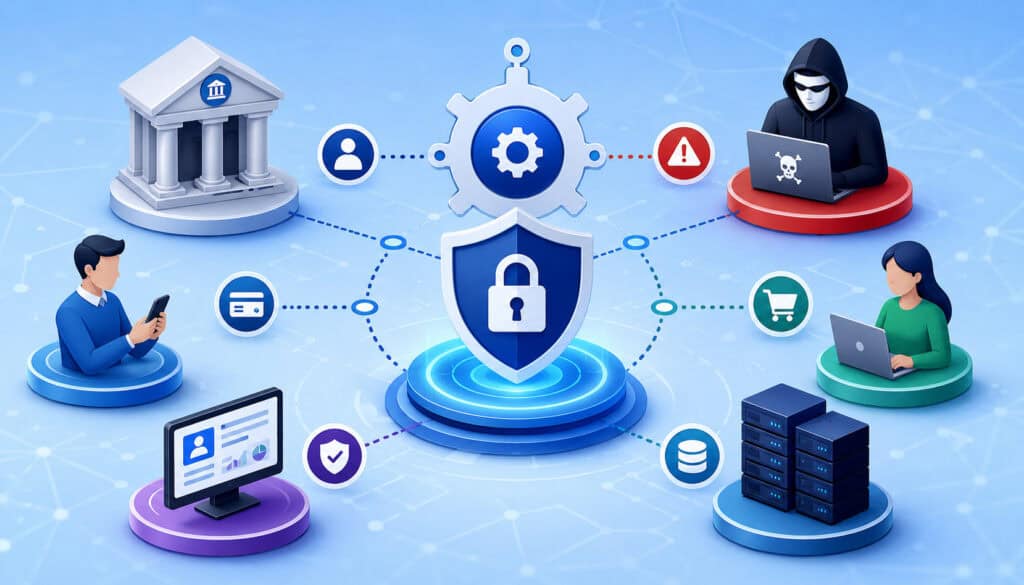
API-based fraud prevention usually involves more than one system and more than one team. A business may have a website or app, an ecommerce platform, a payment gateway API, a payment processor API, a fraud prevention API, authentication tools, customer support software, order management tools, and internal reporting dashboards.
The customer starts the activity by logging in, placing an order, updating a payment method, requesting a refund, or changing account details. The business system captures the event and passes relevant data to fraud tools.
The payment gateway or processor handles authorization and payment routing. The fraud prevention API provides risk insight. The risk, support, finance, or operations team reviews exceptions and monitors outcomes.
Other participants may include the merchant account, card network, issuing bank, and dispute process. These parties may not be directly visible to the customer, but they affect authorization decisions, 3D Secure flows, chargeback outcomes, and fraud liability rules.
The Business, Developer, and Risk Team
Business owners define risk tolerance. Developers integrate APIs securely. Product managers decide where fraud checks fit into the customer journey. Fraud analysts review alerts and tune rules.
Finance teams track chargebacks, refunds, and dispute losses. Support teams communicate with customers when orders are held or accounts need verification.
These groups need shared rules and clear ownership. For example, who decides whether a high-value order should ship? Who reviews a customer locked out after suspicious login attempts? Who updates velocity checks after a card testing spike? Who monitors false positives?
A healthy workflow defines what gets approved automatically, what gets declined automatically, and what requires manual review. It also defines what evidence should be stored for dispute prevention, such as transaction details, delivery confirmation, customer communication, authentication results, and fraud scoring outcomes.
The Payment API, Gateway, Processor, and Fraud Tools
Payment APIs, gateways, processors, fraud APIs, authentication systems, and security controls work together during payment authorization and post-payment monitoring. The checkout system may tokenize card data, validate AVS and CVV signals, call a payment fraud detection API, and then submit the transaction through the payment gateway API.
Some fraud checks happen before authorization, such as bot detection, device fingerprinting, velocity checks, and risk scoring. Some happen during authorization, such as CVV verification, AVS checks, and 3D Secure. Others happen after authorization, such as refund monitoring, dispute alerts, subscription behavior analysis, and chargeback trend review.
This layered design supports better payment API fraud prevention because no single signal is expected to carry the entire decision.
Common Types of Fraud APIs Can Help Detect

Fraud APIs can help detect many types of online payment and account abuse. The exact coverage depends on the provider, integration depth, business model, and quality of data sent to the API.
Stolen card fraud occurs when someone uses payment credentials without authorization. APIs can flag mismatched billing details, risky IP addresses, unusual devices, high-risk transaction patterns, and failed verification attempts.
Card testing happens when bots or fraudsters run small or repeated transactions to check whether stolen card details work. Velocity checks, API rate limiting, bot detection, device intelligence, and excessive failed authorization monitoring are useful here.
Account takeover prevention focuses on suspicious logins, password resets, new devices, impossible travel, email changes, shipping address changes, and saved payment method misuse. Risk-based authentication can add extra verification when account risk rises.
Refund abuse, friendly fraud, promo abuse, subscription abuse, and chargeback fraud require more operational context. APIs can help by connecting payment data, customer history, refund frequency, dispute history, promotion use, and behavioral analytics.
Marketplaces may also face fake sellers, buyer-seller collusion, payout fraud, identity mismatch, fake tracking details, and refund manipulation. A fraud rules engine can help route suspicious accounts, transactions, and payouts to review.
Real-Time Transaction Risk Scoring
Real-time transaction risk scoring assigns a risk level to a transaction while the customer is still in the payment flow. The score may be numeric, such as zero to one hundred, or categorical, such as low, medium, or high. The score is usually based on multiple signals rather than one data point.
Common signals include order amount, transaction velocity, card type, billing and shipping mismatch, IP location, email age, device fingerprint, customer history, failed payment attempts, past refunds, chargeback history, and unusual checkout behavior.
A high order amount may not be suspicious by itself. A high order amount from a new account using a new device, mismatched address, rush shipping, and repeated failed card attempts is more concerning.
Transaction risk scoring helps businesses apply different actions based on risk. Low-risk payments may be approved automatically. Medium-risk payments may trigger 3D Secure, email verification, phone verification, or manual review. High-risk attempts may be blocked or declined before fulfillment.
Risk scoring is also useful for reporting. Teams can compare fraud rates, approval rates, false positives, review outcomes, and chargeback patterns by score band. This helps refine rules and determine whether the fraud prevention API is supporting both security and customer experience.
Device Fingerprinting and Identity Signals
Device fingerprinting helps identify the device or browser used during login, checkout, account updates, or payment attempts.
It may evaluate browser settings, operating system details, screen characteristics, plugins, time zone, language, device identifiers, and other technical signals. The goal is to recognize patterns that may not be obvious from customer-entered information alone.
Device fingerprinting can help detect repeat fraud attempts even when a fraudster changes names, email addresses, cards, or shipping details. It can also flag suspicious device changes, emulator activity, browser inconsistencies, automation tools, proxy use, and abnormal checkout behavior.
Device signals are helpful for account takeover prevention. A returning customer who logs in from a familiar device may need less friction. A login from a new device, new location, and unusual behavior may require risk-based authentication before allowing payment method changes or high-value purchases.
Device Data and Repeat Fraud Patterns
Fraudsters often rotate visible details. They may use different email addresses, cards, names, or shipping addresses across attempts. Device data can reveal that several attempts are still connected by the same browser, emulator, device cluster, or automation pattern.
This is especially useful for card testing prevention, promo abuse, refund abuse, and account creation abuse. If many accounts are created from similar device environments and quickly attempt payments, the fraud rules engine can flag the pattern for review.
However, device fingerprinting should not be the only decision factor. Devices can be shared, reset, blocked by privacy tools, or misidentified. Use device signals alongside payment verification, IP reputation, customer history, velocity checks, and transaction risk scoring.
Privacy and Responsible Data Use
Device fingerprinting and behavioral analytics require careful data handling. Businesses should collect only necessary data, protect it appropriately, and disclose relevant data practices in customer-facing policies. Fraud prevention should not become unlimited surveillance.
Responsible use also means avoiding unsupported decisions. A suspicious device signal may justify additional verification, but it may not always justify an automatic decline. Teams should monitor false positives and review whether fraud rules affect legitimate customers unfairly.
Security, privacy, and compliance obligations vary by business model and data type. Businesses should get qualified guidance when designing fraud systems that collect device, identity, payment, or behavioral data.
Velocity Checks and Transaction Limits
Velocity checks measure how many times an activity occurs within a defined period. They are one of the most practical API fraud prevention controls because many fraud attacks rely on speed and repetition.
Examples include repeated payment attempts, multiple cards from one IP address, many failed transactions from one device, rapid account creation, repeated refunds, unusual order frequency, excessive password reset requests, and sudden spikes in checkout volume.
Velocity rules can help stop card testing. For example, if one IP address attempts many low-dollar transactions with different card numbers in a short time, the system can block further attempts, require CAPTCHA, rate limit the endpoint, or route the traffic to a stronger review process.
Velocity checks are also useful for account takeover prevention. Multiple failed logins, repeated password reset attempts, or many payment method changes may signal credential stuffing or account abuse.
Good velocity rules are specific. A business may use separate thresholds for new customers, returning customers, digital goods, high-value products, subscription retries, gift cards, and refund requests. Rules that are too strict can block legitimate customers, especially during sales, product launches, or seasonal spikes.
IP Reputation, Geolocation, and Proxy Detection
IP reputation checks evaluate whether an IP address is associated with suspicious activity, bot traffic, proxies, VPNs, hosting providers, data centers, or previous abuse. Geolocation checks compare location signals against billing details, shipping details, device time zone, account history, and expected customer behavior.
These signals can be useful for real-time fraud screening. For example, a login from a new location followed by a password change and a high-value order may require step-up authentication. A checkout attempt from an anonymized proxy with mismatched billing and shipping details may deserve review.
Geolocation checks can also detect impossible travel. If an account logs in from two distant locations within a short period, the system may flag the account for account takeover prevention.
However, location data should be used carefully. People travel, use mobile networks, share connections, and rely on privacy tools. An IP mismatch alone should rarely be the only reason to block an order. It is better treated as one signal in a larger risk model.
IP reputation is most powerful when combined with device fingerprinting, transaction monitoring, payment verification, and customer history. Together, those signals help distinguish suspicious activity from normal customer behavior.
AVS, CVV, and Card Verification Signals
AVS and CVV verification are common payment API fraud prevention signals. AVS, or Address Verification Service, checks whether the billing address provided by the customer matches the address associated with the card. CVV verification checks the security code printed on the card or provided through a secure card entry flow.
These checks help confirm that the customer has more than just a card number. A correct CVV can indicate possession of card details beyond the primary card number. An AVS match can support confidence that the customer knows the billing information.
But AVS and CVV are not perfect fraud indicators. A legitimate customer may mistype an address, use an old billing ZIP code, or have a partial AVS response. A fraudster may have stolen full card details, including billing information and CVV. Some card types and payment flows may also return limited verification data.
For this reason, AVS and CVV verification should be part of a broader payment fraud detection API strategy. A failed CVV on repeated attempts may be highly suspicious. A partial AVS mismatch on a long-time customer with strong device history may be less concerning.
3D Secure and Risk-Based Authentication
3D Secure adds an extra authentication layer for certain online card transactions. When triggered, the customer may be asked to verify the purchase through the issuing bank or authentication flow. This can include a one-time passcode, banking app confirmation, biometric check, or other verification method.
Risk-based authentication decides when extra verification is needed. Low-risk transactions may go through without extra steps. Higher-risk transactions may require a challenge. This helps balance fraud prevention with customer experience.
3D Secure is especially useful for higher-risk transactions, unusual customer behavior, new devices, high-value orders, and situations where additional issuer involvement may reduce fraud exposure. It can also support dispute prevention by creating stronger authentication evidence.
However, 3D Secure should be used thoughtfully. Triggering challenges too often can create checkout friction. Not triggering them when risk is high may leave the business exposed. Many payment systems allow businesses to configure rules based on amount, risk score, region, card type, or customer history.
Developers working with ecommerce checkout flows may find 3D Secure integration steps useful when thinking about how authentication fits into payment workflows.
For broader identity design, digital identity guidance offers helpful context around authentication assurance, risk assessment, and identity-related controls.
Bot Detection and Card Testing Prevention
Bot detection helps identify automated traffic that attempts logins, account creation, checkout submissions, coupon abuse, or card testing. Card testing prevention is especially important for businesses with low-friction payment forms, donation forms, trial signups, or checkout pages that allow repeated attempts.
Common warning signs include excessive failed authorization attempts, many cards from one IP address, repeated small transactions, suspicious user agents, abnormal request timing, scripted form submissions, repeated checkout errors, and device or browser inconsistencies.
APIs can support bot detection by analyzing request patterns, device signals, IP reputation, behavioral analytics, and velocity checks. They can also help enforce controls such as API rate limiting, temporary blocks, CAPTCHA where appropriate, device challenges, and transaction limits.
Practical prevention techniques include:
- Limiting payment attempts per account, IP, device, and session
- Blocking known abusive IP ranges or data center traffic when appropriate
- Monitoring spikes in failed authorizations
- Using device intelligence to identify repeat attempts
- Requiring authentication before allowing repeated payment attempts
- Adding CAPTCHA only when risk signals justify extra friction
- Alerting teams when card testing patterns emerge
API Rate Limiting and Abuse Prevention
API rate limiting controls how many requests a user, device, IP address, API key, or account can make during a defined period. It protects payment APIs, checkout systems, login endpoints, refund workflows, and account management tools from excessive requests.
Rate limits help reduce credential stuffing, bot traffic, repeated card attempts, scraping, denial-of-service-style abuse, and accidental overload from poorly designed integrations. In payment workflows, rate limits can slow down attacks before they become expensive authorization traffic.
Rate limiting should be designed carefully. A hard limit that blocks legitimate customers during high traffic may hurt revenue. A limit that is too loose may allow bots to continue testing cards or credentials. Businesses often need different limits for checkout attempts, login attempts, refund requests, account creation, payment method updates, and administrative API calls.
Good rate limiting also includes clear error handling. Developers should return safe, generic messages to users while logging detailed internal data for investigation. Retry headers, backoff logic, and monitoring dashboards can help teams distinguish legitimate spikes from abuse.
API security fraud prevention should also consider API key limits. A compromised API key should not have unlimited access to payment, refund, customer, or reporting endpoints.
The API security project is a useful resource for understanding common API risks and mitigation concepts.
Machine Learning Fraud Detection
Machine learning fraud detection uses algorithms to identify patterns across transaction data, customer behavior, device history, payment attempts, and past fraud outcomes. Instead of relying only on fixed rules, machine learning tools can evaluate many signals at once and identify combinations that may suggest risk.
For example, a model may learn that certain combinations of new account activity, shipping distance, email characteristics, transaction amount, device history, failed attempts, and product type are more likely to result in fraud or chargebacks. The model can then produce a risk score or recommendation.
Machine learning is useful because fraud patterns change. Static rules may miss new tactics or become too strict over time. Machine learning tools can adapt as more data becomes available, especially when businesses feed back outcomes such as approved orders, confirmed fraud, refunds, chargebacks, and manual review decisions.
Benefits of Machine Learning Fraud Tools
Machine learning fraud tools can process large amounts of data quickly. They can find patterns that would be difficult for a person to manually identify, especially across thousands of transactions, logins, refunds, and payment attempts.
They can also reduce manual review volume by prioritizing the riskiest cases. Instead of asking a team to review every unusual order, the system can score transactions and route only uncertain or high-value cases to analysts.
Another benefit is adaptive screening. A machine learning fraud detection system may recognize shifts in behavior earlier than a static rule set, especially when fraudsters change IP ranges, devices, card sources, or checkout patterns.
Limitations and False Positives
Machine learning is not perfect. It depends on data quality, feedback loops, model design, and business context. A model trained on incomplete or biased data may produce weak recommendations. A model that is not monitored may drift as customer behavior or fraud tactics change.
False positives remain a real concern. A model may flag a legitimate customer because their behavior looks unusual compared with historical patterns. For this reason, machine learning should be paired with business rules, review workflows, transparent reason codes where available, and regular performance checks.
Fraud Rules Engines and Custom Controls
A fraud rules engine allows businesses to create custom rules based on their specific risk patterns. Rules may consider order value, location, device risk, transaction count, customer history, payment method, shipping method, product type, refund history, or account age.
For example, a business may create a rule that sends high-value orders from new customers to manual review when the billing and shipping addresses do not match. Another rule may block repeated failed payments from the same device. A subscription company may review accounts that create multiple trials using similar payment or device signals.
Rules engines are useful because every business has different fraud exposure. A one-size-fits-all fraud model may not know that certain products are frequently targeted, that certain shipping methods carry more risk, or that specific refund patterns are suspicious.
Rules should be tested before enforcement. A rule that appears sensible may block too many legitimate customers. Testing rules in monitor-only mode allows teams to see what would have been flagged without affecting customers. After review, the business can decide whether to approve, challenge, review, or decline based on the rule.
Good rules also need maintenance. Fraud patterns change, product lines change, and customer behavior changes. Rules that are not reviewed may become noisy, ineffective, or too aggressive.
Webhook Security for Fraud Prevention
Webhooks notify business systems when important events happen. In payment and fraud workflows, webhooks may report payment approvals, failed payments, disputes, refunds, suspicious activity, account updates, subscription changes, risk decisions, or chargeback alerts.
Webhook security is essential because webhooks can trigger important actions. A webhook may update an order status, release digital access, start fulfillment, pause a subscription, or open a dispute workflow. If a webhook is forged, replayed, or accepted without verification, attackers may manipulate business systems.
Secure webhook handling should include signature verification, timestamp checks, replay protection, HTTPS endpoints, secret rotation, endpoint authentication where supported, and logging. The receiving system should verify that the webhook truly came from the expected source before trusting its contents.
Businesses should also design webhook processing carefully. Webhooks can arrive late, arrive more than once, or arrive out of order. Systems should be idempotent, meaning processing the same event twice should not create duplicate refunds, duplicate shipments, or duplicate account changes.
API Authentication and Access Control
API authentication confirms that the system or user making a request is allowed to access the API. Strong API authentication supports fraud prevention by reducing unauthorized access to payment, customer, refund, subscription, and reporting functions.
Common methods include API keys, OAuth, bearer tokens, HMAC signatures, signed requests, and session-based controls. The right method depends on the use case, sensitivity of the endpoint, and architecture.
Access control is just as important as authentication. A key that only needs to read transaction status should not be able to issue refunds. A support role should not have unrestricted access to payment credentials. A sandbox key should not work in production. Least privilege limits the damage if credentials are misused.
Credential rotation, secure storage, environment separation, audit logs, and monitoring are essential. API keys should not be hard-coded into frontend code, stored in public repositories, shared in chat messages, or reused across unrelated services.
Payment API security also requires good operational habits. Teams should know who owns API credentials, when they were last rotated, which systems use them, and how to revoke them during an incident.
Tokenization and Encryption in Fraud Prevention
Tokenization replaces sensitive payment data with a token that can be used for future transactions without exposing the original card data to every system. Encryption protects data by making it unreadable without the correct cryptographic keys. Both are important for secure payment workflows.
Tokenization can reduce exposure to sensitive card data. For example, a subscription platform may store a payment token rather than storing raw card details. If the subscription system is compromised, the attacker does not automatically gain usable card numbers from that system.
Encryption protects data in transit and at rest. Payment API requests should use secure transport, and sensitive stored data should be protected according to applicable security requirements.
Tokenization and encryption do not stop every type of fraud. A fraudster may still use a stolen card at checkout. An attacker may still take over an account that has a tokenized payment method. But these controls reduce data exposure and limit the impact of credential or system compromise.
Businesses handling payment card data should review payment data security standards and work with qualified professionals to understand their obligations. Tokenization may reduce certain risks, but it does not remove the need for secure design, monitoring, access control, and compliance review.
API-Based Fraud Prevention Techniques Table
The table below summarizes common API-based fraud prevention techniques and how they support payment fraud prevention, ecommerce fraud prevention, and account protection.
| Technique | What It Checks | Fraud It Can Help Reduce | Important Consideration |
| Transaction risk scoring | Order, customer, payment, device, and behavior signals | Stolen card use, risky orders, chargebacks | Scores should be tuned against real outcomes |
| Device fingerprinting | Device, browser, emulator, and repeat-use signals | Account abuse, promo abuse, repeat fraud | Use as one signal, not the only decision factor |
| Velocity checks | Frequency of attempts by account, IP, device, or card | Card testing, bot abuse, refund abuse | Thresholds should vary by workflow |
| IP reputation | Risky IPs, proxies, VPNs, data centers, prior abuse | Bot traffic, account takeover, suspicious checkout | Location alone should not drive automatic declines |
| Geolocation checks | Billing, shipping, IP, device time zone, account history | Identity mismatch, impossible travel | Legitimate customers travel and use mobile networks |
| AVS | Billing address match | Stolen card attempts | Partial mismatches can happen with good customers |
| CVV verification | Card security code result | Unauthorized card use | Stolen full card data may still pass |
| 3D Secure | Step-up cardholder authentication | Unauthorized card transactions, disputes | Too much friction can reduce completed checkouts |
| Bot detection | Automation, suspicious agents, scripted behavior | Card testing, credential stuffing | Use adaptive challenges where possible |
| API rate limiting | Request volume and retry patterns | Endpoint abuse, repeated card attempts | Avoid blocking legitimate traffic spikes |
| Webhook verification | Event signatures, timestamps, replay attempts | Forged payment or dispute events | Always validate before changing order status |
| Tokenization | Exposure of stored payment data | Data compromise impact | Does not prevent all transaction fraud |
| Encryption | Data protection in transit and storage | Data theft and leakage | Key management matters |
| Manual review | Human evaluation of uncertain cases | False positives, edge-case fraud | Review teams need clear procedures |
Fraud Prevention API Workflow Example
A simple API-based fraud prevention workflow begins when a customer starts checkout. The website or app collects order information, customer details, device signals, and payment-related data. Sensitive payment information should be handled through secure payment flows, tokenization, and appropriate payment API security controls.
Before authorization, the system sends relevant transaction data to a fraud prevention API. The API returns a risk score, recommendation, triggered rules, and supporting signals. The business then applies its decision logic.
A low-risk transaction may continue directly to payment authorization. A medium-risk transaction may trigger 3D Secure, email verification, or manual review. A high-risk transaction may be declined, blocked, or held before fulfillment.
After authorization, the system stores the fraud decision, payment result, order details, and any verification evidence. If the order later becomes a chargeback, refund request, or confirmed fraud case, that outcome should be fed back into reporting and rule tuning.
This same workflow can apply beyond checkout. A login event can be scored for account takeover risk. A refund request can be scored for abuse. A subscription retry can be monitored for stolen card use. A marketplace payout can be delayed pending review.
Manual Review and Human Oversight
Manual review remains important because automated systems do not understand every business detail. A transaction may look risky but be legitimate. Another transaction may look ordinary but involve a suspicious support interaction, unusual delivery request, or known dispute pattern.
Manual review is especially useful for high-value orders, unusual customer behavior, mismatched details, repeated attempts, chargeback history, risky product categories, address changes, and edge cases where automated systems are uncertain. A review team can evaluate context that rules and models may miss.
Good manual review requires clear procedures. Reviewers should know which signals matter, what evidence to check, how to contact customers, when to approve, when to cancel, and how to document decisions. They should also avoid asking for sensitive information through insecure channels.
Manual review should not become a bottleneck. If too many transactions are sent to review, teams may delay legitimate orders and frustrate customers. If too few are reviewed, risky transactions may pass unchecked. Reporting should track review volume, approval rates, decline rates, fraud outcomes, and false positives.
Human feedback also improves automation. When reviewers mark transactions as safe, suspicious, or fraudulent, those outcomes can help tune rules and improve future scoring.
Chargeback Prevention Through APIs
Chargeback prevention starts before the dispute occurs. API-based fraud tools can help reduce chargebacks by flagging suspicious transactions, verifying customer identity, monitoring risky behavior, recording transaction evidence, and supporting clear communication.
A fraud prevention API may detect stolen card use before authorization. A payment fraud detection API may recommend 3D Secure for higher-risk orders. Transaction monitoring may flag customers with unusual refund or dispute patterns. Webhooks may notify the business when a dispute is opened, allowing teams to respond quickly.
APIs can also organize evidence. Useful records may include order details, IP address, device signals, AVS and CVV results, risk score, authentication results, delivery confirmation, refund history, customer messages, and acceptance of terms. Organized records can support dispute prevention and response workflows.
Chargeback prevention is not only about fraud. Confusing billing descriptors, unclear refund policies, delayed support responses, poor shipping communication, and subscription cancellation friction can all lead to disputes.
APIs can help by syncing order status, sending receipts, tracking subscription events, and alerting teams to customer issues before they become disputes.
Fraud Prevention for Recurring Billing and Subscriptions
Recurring billing creates different fraud risks than one-time checkout. A customer may sign up with a stolen card, abuse a free trial, take over an account with saved payment tokens, dispute recurring charges, or repeatedly request refunds after using a service.
API-based fraud prevention can monitor subscription events across the customer lifecycle. During signup, APIs can evaluate device data, email signals, IP reputation, payment verification, and trial velocity. During billing, APIs can monitor failed payment retries, payment method changes, login behavior, account sharing patterns, and cancellation behavior.
Tokenized payment methods help reduce exposure of card data, but they do not remove account takeover risk. If an attacker gains account access, they may use saved payment methods, change account details, or access paid services.
Risk-based authentication can help protect sensitive account actions such as password changes, email changes, payout updates, and payment method changes.
Subscription teams should also monitor refund abuse and dispute trends. A pattern of customers subscribing, consuming services, requesting refunds, and repeating the process may require stronger rules, clearer policies, or manual review.
For businesses exploring alternative payment methods, bank-based payment concepts may help teams think about payment method risk, settlement behavior, and customer authorization flows.
Fraud Prevention for Marketplaces and Platforms
Marketplaces and platforms face risks on both sides of a transaction. Buyer fraud can include stolen cards, refund abuse, false item-not-received claims, promo abuse, and chargeback fraud. Seller fraud can include fake sellers, counterfeit listings, identity mismatch, seller collusion, payout fraud, and account takeover.
API-based fraud prevention helps marketplaces monitor onboarding, transactions, refunds, disputes, and payouts. During onboarding, APIs can support identity checks, account risk scoring, device review, and duplicate account detection.
During transactions, APIs can evaluate buyer behavior, payment risk, order patterns, and seller history. Before payouts, APIs can delay or review funds when risk signals are high.
Marketplaces should pay special attention to payout timing. Fraud may not be obvious at payment authorization. A transaction may later become a dispute, refund claim, or fulfillment issue. If funds are paid out too quickly, the platform may carry the loss.
Rules engines can help define payout controls based on seller age, transaction volume, dispute rate, refund rate, product type, delivery confirmation, and risk score. Manual review can help with edge cases, high-value sellers, unusual spikes, and suspected collusion.
Common API-Based Fraud Prevention Mistakes
A common mistake is relying on one fraud signal. AVS alone is not enough. CVV alone is not enough. IP location alone is not enough. Even machine learning fraud detection should not operate without monitoring, feedback, and business context.
Another mistake is blocking too aggressively. A high decline rate may look safe, but it can hide lost revenue from legitimate customers. False positives should be tracked just as carefully as confirmed fraud.
Some teams ignore webhook security. If payment or fraud webhooks are not verified, attackers may try to forge events, replay old events, or manipulate order status.
Other mistakes include exposing API keys, skipping rate limits, failing to review chargeback data, not updating fraud rules, ignoring failed payment spikes, and not testing fraud workflows before launch.
Technical Mistakes
Technical mistakes often start with weak API authentication. API keys may be stored in frontend code, shared across systems, or never rotated. Webhook signature checks may be missing. Logs may capture sensitive data unnecessarily. Retry logic may accidentally duplicate payments or refunds.
Insufficient sandbox testing is another issue. Developers should test approval, decline, challenge, review, timeout, duplicate webhook, failed webhook, and retry scenarios. Fraud workflows should fail safely, not silently approve risky transactions because an API call timed out.
Timeout handling matters. If a fraud prevention API is unavailable, the business should have a defined fallback policy based on risk tolerance. High-risk workflows may pause. Low-risk workflows may proceed with monitoring.
Business and Operational Mistakes
Operational mistakes include unclear refund policies, weak customer support workflows, no manual review process, ignored dispute trends, poorly trained staff, and lack of ownership over fraud decisions.
A business may have strong technical controls but still create disputes through confusing billing descriptors, slow support responses, or unclear subscription cancellation steps. Fraud prevention should include customer communication and operational discipline.
Teams should also avoid “set it and forget it” fraud rules. Fraud patterns change. Products change. Customer behavior changes. Rules, thresholds, review queues, and reporting should be reviewed regularly.
Security and Compliance Considerations
Security and compliance are central to API-based fraud prevention. Businesses that handle payment data must consider PCI compliance, secure API design, encryption, tokenization, access control, audit logs, privacy obligations, fraud monitoring, and incident response.
API security should include strong authentication, least-privilege access, secure credential storage, rate limiting, input validation, logging, monitoring, and vulnerability management. Webhook endpoints should verify signatures and reject untrusted events. Production and sandbox credentials should be separated.
Data minimization is important. Fraud tools work best with relevant data, but businesses should avoid collecting unnecessary sensitive information. Device, identity, location, and behavioral data should be handled carefully and disclosed appropriately.
Audit logs help teams understand what happened during a fraud incident or dispute. Logs should record key events without exposing sensitive payment data. Access to logs should be limited to people who need them.
This article is informational and should not be treated as formal legal, security, or compliance advice. Businesses should work with qualified professionals when designing payment systems, compliance programs, privacy practices, and incident response plans.
For secure development concepts, the API security project and payment data security standards are useful educational resources.
How to Choose a Fraud Prevention API
Choosing a fraud prevention API requires more than comparing price. Businesses should evaluate the fraud signals supported, integration effort, payment gateway compatibility, documentation quality, rule customization, reporting tools, webhook support, manual review tools, privacy practices, scalability, and support options.
Start with business risk. What types of fraud are most likely? Stolen card use? Card testing? Account takeover? Refund abuse? Subscription disputes? Marketplace payout fraud? The right fraud prevention API should match the risk profile.
Next, review data requirements. Some tools need transaction, device, IP, email, customer, and payment data to work well. Make sure your systems can collect and send the required data securely.
Documentation matters. Developers need clear API references, sandbox environments, sample requests, test scenarios, webhook documentation, authentication instructions, and error handling guidance. Poor documentation can create security gaps and delayed launches.
Also review decision controls. Can the API return risk scores and reason codes? Can rules be customized? Can thresholds vary by product or customer type? Can uncertain transactions be routed to manual review?
Finally, consider operational fit. A strong fraud API should support monitoring, reporting, feedback loops, dispute review, and team workflows. Fraud prevention is not just an integration; it is an ongoing process.
API Fraud Prevention Checklist for Businesses
Use this checklist to evaluate whether your payment and account workflows are ready for API-based fraud prevention.
- Fraud risks identified.
- Payment flow mapped.
- Key fraud signals selected.
- API authentication secured.
- Webhooks verified.
- Rate limits configured.
- AVS and CVV checks reviewed.
- Device and IP signals tested.
- Risk scoring rules configured.
- Manual review process defined.
- Chargeback monitoring enabled.
- Sandbox testing completed.
- Staff trained.
- Ongoing review schedule created.
This checklist works best when paired with real data. Review failed payments, chargebacks, refunds, customer complaints, support tickets, account takeover reports, and suspicious order patterns. These records show where fraud controls should be strongest.
Best Practices for API Security Fraud Prevention
Strong API security fraud prevention starts with protecting credentials. Store API keys and tokens securely, rotate them periodically, limit permissions, and revoke unused credentials. Never expose secret keys in browser code, public repositories, mobile apps, or support notes.
Use least-privilege access. Refund endpoints, customer data endpoints, payout endpoints, and reporting endpoints should have separate permissions where possible. Limit administrative access and monitor sensitive actions.
Verify webhooks before acting on them. Check signatures, timestamps, event IDs, and replay protections. Important state changes should be confirmed through trusted API calls when needed.
Apply rate limits to checkout, login, payment attempts, account creation, password reset, refund requests, and administrative APIs. Monitor failed attempts and set alerts for unusual spikes.
Use tokenization and encryption to reduce payment data exposure. Review PCI compliance responsibilities and avoid storing sensitive card data unless absolutely necessary and properly protected.
Tune fraud rules over time. Review chargebacks, false positives, manual review outcomes, and customer support feedback. Test edge cases before enforcing new rules.
Balance fraud prevention with customer experience. Secure checkout should not feel unpredictable or overly restrictive for legitimate customers. Add friction only when risk signals justify it.
Common Misconceptions About API Fraud Prevention
One misconception is that a fraud prevention API stops all fraud. No tool can prevent every bad transaction. Fraud prevention works best when layered with secure APIs, risk scoring, verification, monitoring, and manual review.
Another misconception is that more declines always mean better protection. Excessive declines may reduce fraud losses while also blocking good customers. Approval quality matters more than raw decline volume.
Some businesses believe AVS and CVV are enough. They are useful signals, but they do not detect every stolen card attempt, account takeover, bot attack, or refund abuse pattern.
Another misconception is that machine learning eliminates manual review. Machine learning can improve screening, but it still requires feedback, monitoring, and human judgment for uncertain cases.
Some teams assume webhooks are automatically trustworthy. Webhooks must be verified. A forged or replayed webhook can create serious order, refund, or account errors.
Finally, fraud prevention is not only a developer responsibility. Developers secure the integration, but business owners, risk teams, finance teams, support teams, and product managers all shape the fraud strategy.
What is API-based fraud prevention?
API-based fraud prevention is the use of APIs to detect, score, monitor, challenge, review, or block suspicious activity in digital transactions and account workflows. It can help screen online payments, logins, refunds, subscriptions, account changes, and marketplace payouts.
The API receives relevant data such as transaction amount, customer details, device information, IP address, payment verification results, and behavioral signals. It then returns a risk score, recommendation, rule result, or review status that the business can use to make a decision.
What is a fraud prevention API?
A fraud prevention API is a software interface that helps a business connect its systems to fraud detection and risk screening tools. It may provide transaction risk scoring, device fingerprinting, IP reputation, velocity checks, bot detection, fraud rules, machine learning fraud detection, and manual review support.
A fraud prevention API can be integrated into checkout pages, payment gateway API workflows, account systems, order management tools, subscription platforms, and back-office processes.
How does payment API fraud prevention work?
Payment API fraud prevention works by evaluating risk signals before, during, and after a payment attempt. Before authorization, the system may check device data, IP reputation, transaction velocity, account history, and behavioral analytics.
During authorization, it may use AVS, CVV verification, and 3D Secure. After authorization, it may monitor refunds, disputes, chargebacks, and account activity.
The goal is to approve legitimate payments, block clearly risky attempts, and route uncertain cases to manual review or step-up authentication.
What fraud signals do APIs check?
Fraud APIs may check order amount, customer history, account age, email signals, IP reputation, geolocation, device fingerprint, failed payment attempts, billing and shipping mismatch, AVS response, CVV result, card type, refund history, chargeback history, and unusual behavior.
The exact signals depend on the API, integration, payment method, and business model. Stronger results usually come from combining multiple signals.
Can APIs prevent card testing?
APIs can help reduce card testing by detecting repeated payment attempts, many cards from one IP address, excessive failed authorizations, suspicious user agents, bot patterns, and abnormal checkout behavior.
Controls such as velocity checks, API rate limiting, device intelligence, CAPTCHA when appropriate, and bot detection can slow or block automated card testing. No system can guarantee complete prevention, so businesses should also monitor failed payment spikes and update rules as attacks change.
What is transaction risk scoring?
Transaction risk scoring is the process of assigning a risk level to a payment or order based on multiple signals. A fraud scoring API may evaluate transaction amount, customer behavior, device data, location, payment verification results, previous attempts, and historical outcomes.
The score helps the business decide whether to approve, decline, challenge, or review the transaction. Risk scores should be monitored against fraud results and false positives.
How do velocity checks reduce payment fraud?
Velocity checks reduce payment fraud by limiting or flagging repeated activity within a short period. They can detect many failed payment attempts, multiple cards from one device, repeated refunds, rapid account creation, excessive password resets, or unusual order frequency.
Velocity checks are especially helpful for card testing prevention, bot abuse, account takeover prevention, and refund abuse detection.
Is machine learning fraud detection reliable?
Machine learning fraud detection can be useful, but it should not be treated as perfect. It can analyze many signals at once, identify patterns, adapt to changing fraud behavior, and reduce manual review volume.
However, it depends on data quality, feedback, monitoring, and proper configuration. It can still create false positives or miss new fraud patterns. Businesses should use machine learning alongside rules, review workflows, and human judgment.
What is webhook security in fraud prevention?
Webhook security means verifying that event notifications sent to your system are authentic, current, and safe to process. In fraud prevention, webhooks may notify systems about payments, refunds, disputes, failed payments, suspicious activity, or risk decisions.
Businesses should verify webhook signatures, check timestamps, prevent replay attacks, validate event IDs, secure endpoints, and avoid trusting webhook data without verification.
How does API authentication help prevent fraud?
API authentication helps ensure that only authorized systems can access payment, customer, refund, subscription, or reporting APIs. Strong authentication reduces the risk of unauthorized requests, credential misuse, and system abuse.
Good practices include secure API keys, OAuth where appropriate, bearer tokens, HMAC signatures, least-privilege access, credential rotation, secure storage, and separate sandbox and production credentials.
Final Thoughts
API-based fraud prevention helps businesses protect transactions, reduce chargebacks, detect suspicious behavior, secure payment workflows, and improve payment reliability. It works by connecting fraud controls directly into checkout, payment authorization, account activity, recurring billing, refunds, disputes, and operational review.
The strongest approach is layered. Transaction risk scoring, velocity checks, device intelligence, IP reputation, geolocation checks, AVS, CVV verification, 3D Secure, webhook verification, API rate limiting, tokenization, encryption, bot detection, fraud rules engines, machine learning fraud detection, and manual review all play different roles.
No single signal should decide every outcome. A suspicious IP may be harmless. A billing mismatch may be a typo. A device change may be normal travel. But when multiple signals point in the same direction, a fraud prevention API can help teams respond quickly and consistently.
Businesses should secure API access, test fraud rules, monitor results, review false positives, train staff, and keep strategies updated as fraud patterns change. Effective API fraud prevention is not a one-time setup. It is an ongoing discipline that combines technology, process, security, and sound judgment.