
By Joseph Bryson August 23, 2026
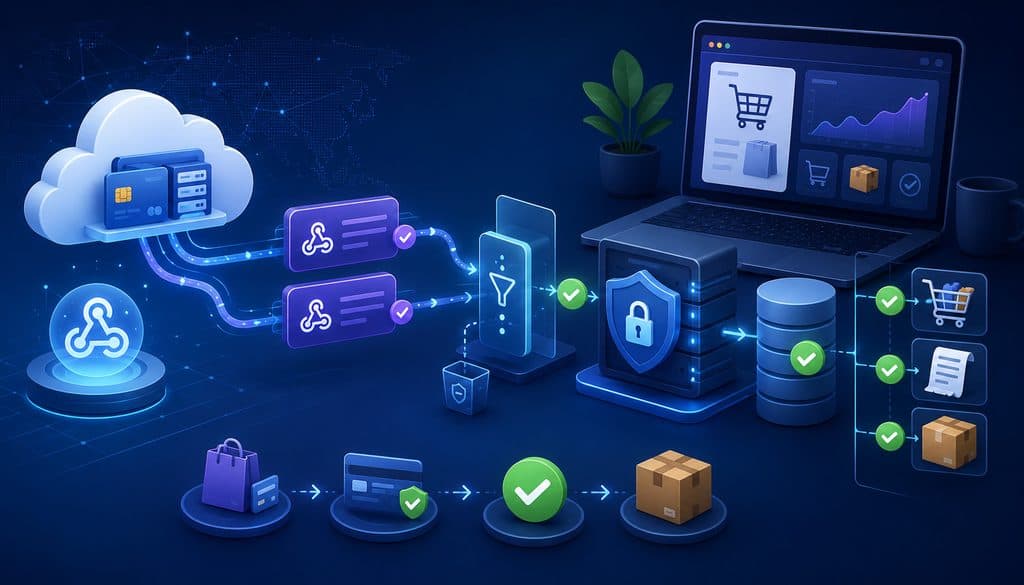
The payment succeeds at the processor, but the webhook never reaches the merchant. The customer sees a confirmation, the processor has captured the money, and the merchant’s order remains “pending.” Reliable payment systems must be designed so one missed callback cannot permanently separate order state from payment state.
That failure scenario captures the central challenge of webhook reliability for payment events. Payment processing is distributed across browsers, merchant applications, payment APIs, provider infrastructure, databases, queues, networks, and downstream fulfillment services. Any connection between those components can fail temporarily.
A resilient architecture treats payment webhooks as an important notification channel, but not as the only source of payment truth:
Payment API Request → Provider Processes Payment → Provider Stores Authoritative State → Webhook Event → Merchant Endpoint → Durable Event Record → Idempotent Business Logic → Order State Update → Reconciliation Job
In a practical workflow, that becomes:
Payment Attempt → Provider State → Webhook Delivery → Local Processing → Order Update → Reconciliation
Payment webhook reliability therefore depends on several controls working together: authenticated webhook delivery, durable event storage, duplicate detection, idempotent business operations, bounded retries, valid payment state transitions, observability, event replay, and independent order payment reconciliation.
No individual database flag, HTTP response, or webhook signature creates exactly-once processing by itself. The objective is to make failures recoverable and repeated delivery harmless enough that payment systems produce effectively-once business outcomes even when the underlying network behaves unpredictably.
This guide provides general technical and security information. Payment-provider behavior, PCI DSS responsibilities, API semantics, and webhook guarantees vary by implementation, so teams should validate their architecture against the documentation for their actual providers and systems.
What Is a Payment Webhook and Why Can Delivery Fail?
A payment webhook is an asynchronous server-to-server notification sent by a payment provider when something relevant happens to a payment, refund, dispute, subscription, payout, or related resource.
Instead of an application repeatedly asking whether a payment changed, the provider sends an HTTP request to a webhook endpoint controlled by the merchant or platform.
A typical payment event webhook may include a provider event ID, payment identifier, event type, event creation time, payment or order reference, resource data, and cryptographic signature information. The exact schema varies considerably between providers.
The webhook should be treated as notification of provider-side state, rather than the provider’s only record of that state. Adyen, for example, describes webhooks as a mechanism for keeping systems synchronized and recommends securing, storing, acknowledging, and then processing received messages.
A useful distinction is:
| Mechanism | Primary Purpose | Main Reliability Limitation |
| Synchronous API response | Tells the caller what happened during an API request | Later payment state can still change |
| Browser redirect | Returns the shopper to a merchant page | Browser can close, lose connectivity, or be manipulated |
| Webhook | Sends asynchronous server-side event notifications | Can be delayed, duplicated, retried, or missed |
| Status API lookup | Retrieves provider-side resource state | Requires an explicit request |
| Durable message queue | Moves events between merchant-controlled services | Does not by itself recover an event never received from the provider |
| Reconciliation job | Compares merchant state with provider state | Usually operates after the initial payment flow |
A browser success page is particularly unsuitable as the sole trigger for fulfillment. A customer’s browser can close before returning, a redirect can fail, and client-side state should not be trusted as authoritative confirmation that funds were captured.
The broader design principles behind secure integrations—including server-side status verification, API authentication, webhook validation, and minimizing client trust—are also covered in this payment API security guide.
Common Causes of Webhook Delivery Failure
A webhook delivery failure can occur even when the payment itself completed successfully. The payment operation and the webhook transport are separate activities, often running on different infrastructure and timelines.
Failures may result from:
- DNS resolution problems.
- TLS or certificate failures.
- Merchant server downtime.
- Load-balancer or reverse-proxy problems.
- Firewall or WAF rules blocking legitimate traffic.
- A deployment that breaks the endpoint.
- Application exceptions.
- Database or dependency outages.
- Queue failures.
- Signature-validation bugs.
- Malformed or unsupported event payloads.
- Slow processing that exceeds provider expectations.
- Incorrect HTTP responses.
- Temporary internet routing problems.
- Payment-provider delivery outages.
The merchant should therefore assume that a callback can be delayed or absent temporarily even when the provider has already stored a final payment result.
Provider retry behavior can reduce the impact of temporary failures, but it cannot replace reconciliation. PayPal, for example, currently documents retries for unsuccessful webhook deliveries, while Adyen documents its own retry queue and timing behavior.
Those exact schedules are provider-specific and should never be copied into an architecture as if they were universal rules.
Webhooks Are Usually At-Least-Once: Design for Duplicate Delivery
One of the most important ideas in payment webhook reliability is that receiving an event once does not mean receiving it only once. Distributed delivery systems commonly favor reliable redelivery over the risk of silently losing an event.
With at-most-once delivery, an event is sent no more than once, which avoids duplicates but can lose information when delivery fails. With at-least-once delivery, the sender retries uncertain or unsuccessful deliveries, improving the chance that the event arrives but making duplicates possible.
True exactly-once delivery across independent distributed systems is a much stronger guarantee. Application developers should not claim they have achieved it simply because they added a processed=true field.
Payment providers explicitly warn developers about duplicates. Stripe states that webhook endpoints might receive the same event more than once and recommends tracking processed event identifiers. PayPal documentation for certain webhook integrations similarly identifies at-least-once delivery behavior.
Consider this sequence:
payment.succeeded → merchant handler processes payment → handler times out before acknowledgement → provider cannot confirm receipt → provider sends the event again
Nothing necessarily went wrong at the provider. The retry exists precisely because the provider could not know whether the first attempt completed.
A duplicate-safe architecture should make the second delivery harmless.
Event ID Deduplication
The webhook receiver should normally maintain durable records that allow it to determine whether a provider event has already been accepted or processed. Useful fields include:
| Event Ledger Field | Purpose |
| Provider event ID | Detect repeated delivery of the same provider event |
| Provider | Separates identifiers across payment systems |
| Payment ID | Associates the event with the provider payment |
| Order ID | Associates payment activity with business state |
| Event type | Identifies the event’s meaning |
| Received time | Supports auditing and latency analysis |
| Signature verified | Records authenticity-check result |
| Processing status | Tracks received, processing, completed, or failed |
| Retry count | Reveals repeated internal processing attempts |
| Last error | Supports troubleshooting |
| Completion time | Measures processing duration |
The basic flow is:
Check Event ID → Already Processed? → Skip Safely / Continue
The check needs durable concurrency protection. An in-memory cache can improve performance but is not a sufficient critical deduplication store because restarts, multiple application instances, cache eviction, or regional failures can erase or bypass it.
A database uniqueness constraint on a provider/event-ID combination is often more robust than a read-then-write pattern that can race under concurrency.
Stripe also notes that two distinct Event objects can sometimes represent related duplicate business activity, in which case object identifiers and event type can matter in addition to the event ID. This illustrates why deduplication rules must follow each provider’s event model rather than assuming every platform behaves identically.
Idempotent Business Logic and Duplicate Fulfillment Prevention
Deduplicating event IDs is useful, but business logic should also be idempotent. Idempotency means that processing the same logical operation multiple times leaves the business in the same final state as processing it once.
Suppose a paid event causes four operations:
- Mark the order paid.
- Decrement inventory.
- create a fulfillment request.
- Grant loyalty points.
If the handler runs twice, simply preventing the second order.status = paid write is not enough. Inventory, fulfillment, loyalty, accounting, email delivery, and downstream integrations can still repeat.
Critical business effects should therefore have their own transactional guards. For fulfillment, a simplified model could be:
Fulfillment Status = Not Fulfilled → Atomic Transition → Fulfilled
Only the process that successfully obtains that transition should create the irreversible fulfillment effect.
Database techniques can include unique constraints, atomic conditional updates, compare-and-set operations, transactions, and row-level locking where appropriate. The correct mechanism depends on the datastore and workload.
The objective is not to pretend duplicate messages never occur. It is to make duplicate payment events safe.
Payment Idempotency Keys Are Different From Webhook Event IDs
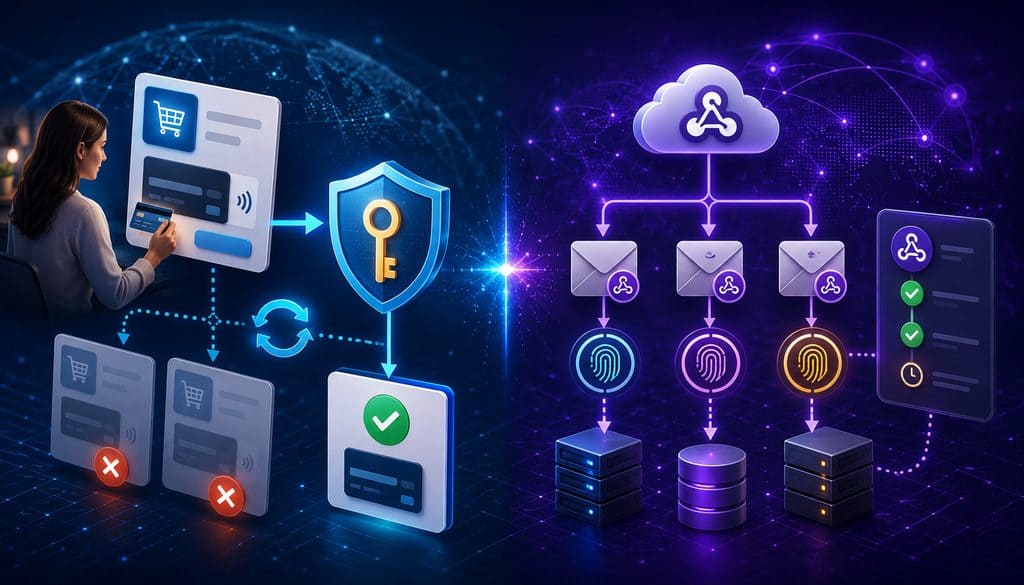
Payment idempotency keys and webhook event IDs solve related duplication problems at different points in the architecture.
An outbound API idempotency key is normally supplied by your application when making a payment API request. It helps the provider recognize that a retry represents the same logical operation rather than a new one.
An inbound webhook event ID is generated or supplied by the event producer and helps your webhook consumer recognize a repeated notification.
These concepts should not be collapsed into one mechanism.
Imagine an ecommerce application creates a payment:
Create Payment API Call + Idempotency Key → Network Timeout → Retry Same Request With Same Key
Outbound API idempotency solves a different failure mode. Stripe’s idempotent request documentation, for example, describes how an idempotency key can make eligible API retries safer when the result of an earlier request is uncertain.
Without idempotency, the application might not know whether the original request reached the provider. A naive retry could accidentally create a second charge.
Stripe’s API documentation, for example, supports idempotency keys for safely retrying applicable requests and documents provider-specific retention and parameter-handling semantics. Adyen likewise documents an idempotency-key header for supported POST requests and explains how the same key can be used after uncertain responses.
These are examples, not a universal API standard. Providers may differ in key length, retention, request types covered, conflict handling, and whether failed responses are persisted.
Designing Payment Idempotency Keys
A payment idempotency key should represent one stable logical operation. It should not be randomly regenerated every time the same operation is retried, because doing so defeats the purpose.
A useful conceptual design might associate a key with:
Order 8421 → Payment Attempt 1 → Create Payment
If the request times out, the application can retrieve the stored key and retry the same logical request. A later, intentionally separate payment attempt should receive a separate key.
Important properties include:
- Stable across retries of the same operation.
- Unique enough to avoid collision with unrelated operations.
- Stored alongside the order or payment attempt.
- Generated server-side or under trusted application control.
- Reused only according to the payment provider’s documented rules.
- Protected from accidental use for different request parameters.
- Safe when multiple workers retry concurrently.
Do not embed sensitive information in keys merely for debugging convenience. A key should function as an operation identifier, not as a container for credentials or customer payment data.
For additional implementation context, the payment API integration best practices guide discusses broader payment API design concerns such as retries, state handling, and secure integration architecture.
Outbound idempotency still does not make inbound webhook processing duplicate-safe. A successful API request can produce multiple event delivery attempts, so both controls remain necessary.
Building a Safe Webhook Retry and Queue Architecture
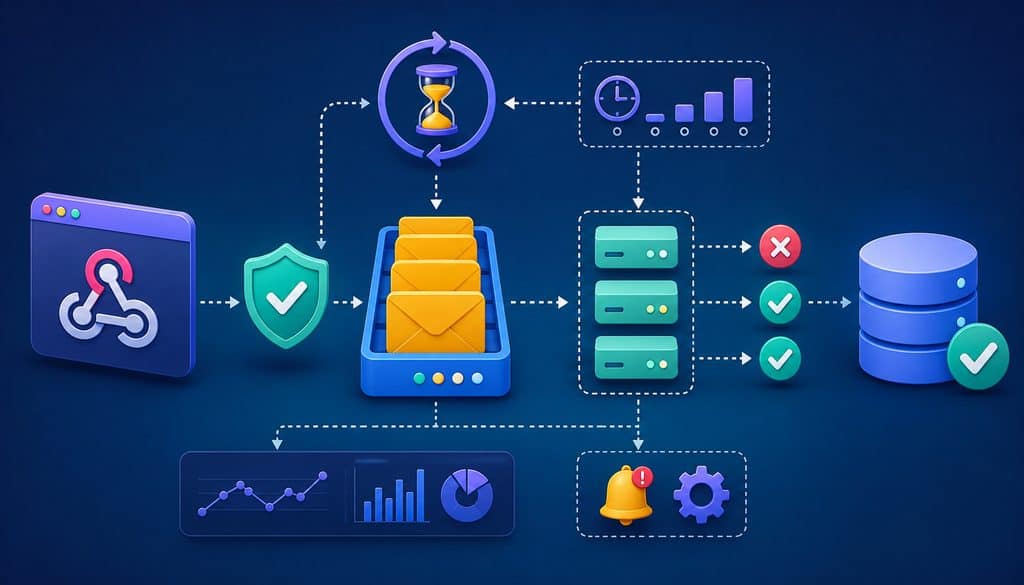
A robust webhook retry policy exists at several layers. The payment provider may retry delivery to the merchant. The merchant may retry event processing. A queue may redeliver failed jobs. A downstream fulfillment or accounting service may have its own retry mechanism.
All of these retries can interact.
That is why retry behavior should be designed around idempotent operations and failure classification, not simply “retry everything.”
A practical webhook architecture is:
Receive → Verify Signature → Persist Event Durably → Return Success → Process Asynchronously
A common resilient approach is to verify the event, persist it durably, acknowledge receipt, and then perform business processing asynchronously. Adyen’s webhook handling documentation specifically recommends storing the webhook in a database or queue before acknowledging it and applying business logic afterward.
This pattern separates provider delivery from business processing. Adyen explicitly recommends securing and storing a webhook before acknowledging it and applying business logic afterward. Stripe recommends asynchronous processing of webhook events.
The acknowledgment says that the merchant has durably accepted responsibility for the event. It does not necessarily mean inventory has been updated, an email has been sent, or fulfillment has completed.
That distinction is crucial.
Retryable and Non-Retryable Failures
Retry logic should distinguish transient infrastructure failures from permanent input or security failures.
| Failure | Retry Internal Processing? | Why |
| Temporary database outage | Usually | Dependency may recover |
| Network timeout | Usually | Remote service may become reachable |
| Temporary 5xx response | Often | Server-side condition may be transient |
| Queue worker crash | Usually | Work can resume elsewhere |
| Invalid webhook signature | No normal business retry | Event has not been authenticated |
| Permanently malformed event | Usually no blind retry | Reprocessing unchanged input will likely fail again |
| Missing temporary dependency | Often | Dependency might become available |
| Unsupported event type | Depends | May require deployment or routing correction |
“Usually” and “often” matter because context changes the answer. A retryable HTTP code for one API may represent a permanent business outcome for another.
Exponential backoff can reduce pressure on a struggling dependency:
Retry Delay = Increasing Delay After Each Failure
The implementation should generally use bounded retries, backoff, and jitter where appropriate, but there is no universal webhook retry schedule suitable for every payment provider or merchant.
The payment API error handling strategies guide provides additional context for distinguishing ambiguous network failures, business declines, and retryable API errors.
Durable Queues, Dead-Letter Handling, and Backpressure
A durable queue creates a useful boundary:
Webhook Endpoint → Durable Queue → Worker → Database → Order State
The endpoint can perform the minimum synchronous steps required to authenticate and durably accept an event, while workers handle slower processing.
Benefits include:
- Absorbing traffic bursts.
- Isolating webhook availability from downstream latency.
- Supporting controlled retries.
- Allowing multiple workers to process events.
- Providing queue-depth visibility.
- Reducing provider redelivery caused by slow business logic.
- Buffering during downstream maintenance.
- Supporting backpressure when dependencies are overloaded.
Repeatedly failing events should not cycle forever without visibility. A dead-letter queue or equivalent failed-event store can isolate messages that exceeded an internal retry policy.
Operations staff can then inspect the failure, fix the cause, and replay the message deliberately.
A dead-letter queue is not a trash bin. Events involving money can represent unresolved accounting or order state, so DLQ depth and message age should be monitored as operational risk.
Webhook Signature Verification and Secure Endpoints
Webhook reliability answers, “Can the system eventually process the event correctly?” Webhook security answers, “Can the system trust that this event came from the expected sender and was not improperly modified?”
Both are essential.
A highly reliable endpoint that accepts forged payment.succeeded requests is unsafe. A perfectly authenticated endpoint that loses legitimate events is also inadequate.
Cryptographic signature verification should normally occur before webhook data is trusted for payment decisions. Providers differ in their signing algorithms, headers, payload construction, timestamps, certificate schemes, and secret management, so implementation should follow the provider’s current documentation.
Adyen strongly recommends HMAC verification for supported webhook types. PayPal documents its own webhook verification mechanisms. Stripe signs webhook deliveries and requires verification against the appropriate endpoint secret.
Raw Request Body and Replay Protection
Some webhook signature systems authenticate the exact bytes transmitted by the provider. Parsing JSON and then serializing it again can alter whitespace, encoding, key order, or other details.
Stripe specifically warns that signature verification requires the raw request body and that framework transformations can cause validation to fail. Adyen likewise documents webhook variants where the body must remain unchanged for HMAC calculation.
The safe sequence is provider-specific, but conceptually:
Receive Bytes → Preserve Required Raw Representation → Verify Signature → Parse Authenticated Content → Persist/Process
Replay protection is related but different. A valid signed webhook captured earlier could still carry a legitimate signature.
Where the provider protocol supports them, defensive controls can include:
- Signed timestamps.
- Provider-recommended freshness validation.
- Durable event-ID deduplication.
- Nonce or sequence handling where defined.
- Current provider-state verification for sensitive actions.
Never invent a freshness interval independently of the provider’s signing protocol.
Secure Webhook Endpoint Controls
A secure webhook endpoint should generally include:
- HTTPS with appropriately configured TLS.
- Provider-supported signature or message-authentication verification.
- Secure storage and rotation of signing secrets.
- Least-privilege service permissions.
- Controlled database and queue access.
- Input-size and schema validation.
- Careful rate limiting that does not unintentionally block legitimate provider retries.
- Monitoring for authentication failures.
- Regular patching.
- Redacted logs.
- Separation between test and production credentials and endpoints.
A difficult-to-guess webhook URL is not authentication.
IP or domain allowlisting can sometimes provide supplementary protection, but it should not replace cryptographic verification where signatures are available. Adyen, for example, notes that IP addresses can change and discusses domain/network controls as additional security measures while separately recommending HMAC verification.
Payment State Machines, Out-of-Order Events, and Exactly-Once Business Effects
Payment state is rarely a simple Boolean value. A payment may pass through several stages before becoming final, and later operations such as refunds can create additional states.
A generic model might look like:
Created → Pending → Authorized → Captured/Paid → Partially Refunded/Refunded
Alternative transitions can include:
Pending → Failed
or:
Authorized → Cancelled
Actual payment states vary by provider, payment method, settlement model, asynchronous authentication flow, and capture configuration. The application should map provider-specific state into a carefully defined internal model rather than assuming one universal lifecycle.
This state machine protects the order from stale or inappropriate events.
Suppose an order is already recorded as paid, but a delayed webhook representing an earlier pending state arrives afterward. A naive “last webhook wins” implementation might incorrectly move the order backward.
Stripe explicitly states that event delivery order is not guaranteed and advises applications to retrieve missing objects through the API where needed.
Other providers have their own ordering behavior, timestamps, or sequence mechanisms. Only rely on an ordering guarantee when the provider explicitly documents it for the relevant event stream.
Payment Status Synchronization
A healthy payment architecture usually tracks three related records:
Local Order Status ↔ Local Payment Record ↔ Provider Payment Status
The order represents the commercial transaction. The local payment record represents the merchant’s knowledge of payment attempts and provider identifiers. The provider resource represents payment state maintained by the payment service.
Webhook handlers should validate whether an incoming event represents a permitted transition.
For example:
- pending → paid may be valid.
- paid → refunded may be valid when a refund occurred.
- paid → pending may require rejection or provider-state verification.
- An event referring to an unknown payment may require lookup before order mutation.
Timestamps can help, but blindly comparing timestamps may still be unsafe if different event types describe different resources or provider semantics.
When ambiguity matters, query the current provider payment object using an authenticated server-to-server API.
Effectively-Once Outcomes Under Concurrency
At-least-once delivery does not mean customers must experience duplicate business effects. Reliable systems can combine durable deduplication, transactional state transitions, and idempotent downstream operations to achieve effectively-once outcomes.
Consider two workers processing the same paid event concurrently. Both check that the order is unfulfilled before either updates it.
Without atomicity:
- Worker A sees Not Fulfilled
- Worker B sees Not Fulfilled
- Worker A ships
- Worker B ships
The solution is not another ordinary read. The transition itself should be atomic so only one worker obtains authorization to trigger the one-time effect.
Similar protections can be applied to:
- Inventory decrements.
- Gift-card activation.
- Digital download grants.
- Subscription provisioning.
- Loyalty credits.
- Accounting postings.
- Refund initiation.
- Merchant payout actions.
This distinction between network-level exactly-once delivery and business-level effectively-once outcomes is one of the most useful concepts in payment event engineering.
When the Callback Never Arrives: Reconciliation Is the Safety Net
The most dangerous webhook architecture is one that has no recovery path for an event that never arrives.
Consider the sequence:
- The customer submits payment.
- The provider processes and records the payment successfully.
- The merchant’s initial API response is delayed, ambiguous, or confirms only an intermediate state.
- Webhook delivery fails.
- The merchant order remains pending.
- The customer believes payment failed and tries again.
- The merchant risks duplicate charging, duplicate fulfillment, support disputes, or accounting mismatch.
Retry delivery helps, but a retry mechanism still depends on an event eventually reaching the merchant.
Reconciliation solves a different problem: it compares merchant state against payment-provider state independently of webhook transport.
The core principle is:
A missing webhook must not leave an order permanently stuck.
Order Payment Reconciliation Workflow
A practical reconciliation process can follow these steps:
- Find unresolved local payments: Identify orders or payment attempts that remain pending, unknown, or inconsistent longer than expected for their payment method.
- Locate the provider reference: Retrieve the stored provider payment ID, transaction ID, checkout session reference, merchant reference, or other documented lookup key.
- Query the payment provider: Use the provider’s authenticated API to retrieve current authoritative payment state.
- Compare states: Determine whether local order status matches the provider’s current payment status.
- Validate the transition: Apply the same payment state-machine rules used for webhook processing.
- Correct local state: If the provider reports a confirmed payment, update the local payment record and order atomically.
- Trigger missing downstream effects once: Fulfill, notify, account, or provision only through duplicate-safe guards.
- Record reconciliation activity: Capture the previous state, provider state, correction, time, and relevant identifiers.
- Investigate recurring discrepancies: A growing mismatch rate may indicate webhook failures, deployments, signature-validation errors, or provider connectivity problems.
The query cadence should reflect the business’s payment methods, customer expectations, volume, provider rate limits, and operational risk. There is no universal interval that every merchant should use.
Scheduled Reconciliation, Polling, and Provider APIs
Scheduled reconciliation can catch more than missing success notifications. Depending on the payment integration, it can reveal:
- Orders that remain pending despite successful provider payments.
- Refunds not reflected locally.
- Payment failures not propagated to order systems.
- Internally failed webhook jobs.
- Events trapped in a dead-letter queue.
- Settlement or payout discrepancies.
- Duplicate local payment attempts.
- Provider status changes that occurred during an outage.
Payment status polling can also be used selectively for transactions whose state is time-sensitive. Polling should usually complement rather than replace event-driven webhooks because constant status queries can increase API traffic and still require careful state handling.
Every payment attempt should therefore retain enough provider identifiers to retrieve its state later. If the only relationship between an order and a provider payment existed temporarily in browser memory, reconciliation becomes unnecessarily difficult.
Webhook Replay, Redirects, Fulfillment, and Recovery Procedures
Many payment providers provide dashboards, APIs, event logs, or replay mechanisms for investigating failed webhook delivery. Replay is useful after a merchant endpoint has been repaired, but replay itself can create duplicates.
Stripe documents manual resend functionality and also describes a workflow for processing undelivered webhook events while avoiding duplicate processing. PayPal currently documents manual resend capabilities for failed webhook deliveries.
A safe replay workflow is:
Identify Event → Confirm Current State → Replay → Deduplicate → Process → Verify Order
The “confirm current state” step matters when the original event is old. A historical payment.pending notification may no longer describe the payment’s current state.
Do not blindly replay a large event range into production without understanding how deduplication, downstream fulfillment, refunds, subscription actions, emails, and accounting integrations will react.
Browser Redirect vs. Webhook
The customer-facing redirect and server-facing webhook serve different purposes.
| Signal | Browser Redirect | Webhook |
| Initiated through customer browser | Yes | No |
| Customer can close the path | Yes | No |
| Server-to-server | No | Yes |
| Suitable as sole payment truth | No | No—provider state must remain independently queryable |
| Useful for customer experience | Yes | Indirectly |
| Subject to duplicate delivery | Usually different semantics | Yes, often possible |
The success page is valuable for telling the shopper what happens next. It can also trigger a server-side status lookup so the page shows the most current order state.
It should not independently authorize shipping or digital access based only on a query string such as ?success=true.
The merchant’s fulfillment rule should instead specify which verified provider payment state permits an irreversible action.
Synchronous Response vs. Asynchronous Events
The initial payment API response may report a final outcome for some transactions but an intermediate state for others. Certain payment methods involve authentication, delayed confirmation, settlement updates, asynchronous risk checks, or later refund activity.
That makes the payment state machine more useful than generic assumptions such as:
success=true
An application should know whether it requires:
- Authorization.
- Capture.
- Confirmed payment.
- Cleared or settled funds.
- Another provider-specific state.
The answer can differ by product and risk model.
For architectural and testing considerations surrounding payment integrations, the payment API testing checklist provides additional scenarios for validating transaction behavior before production deployment.
Webhook Observability, Logging, Deployment Safety, and Availability
Reliable systems need to reveal when reliability is degrading. A webhook pipeline that silently accumulates failed events is only superficially healthy.
Webhook observability should cover delivery, processing, queues, reconciliation, and security.
Useful metrics include:
| Metric | Why It Matters |
| Webhook receipt rate | Reveals changes in incoming activity |
| Processing failure rate | Detects application or dependency problems |
| Duplicate event count | Shows provider retries or acknowledgment issues |
| Processing latency | Reveals slowing workers or dependencies |
| Queue depth | Shows accumulating work |
| Oldest unprocessed event | Highlights prolonged backlog |
| Dead-letter count | Identifies events requiring investigation |
| Reconciliation mismatch count | Detects divergence between provider and merchant state |
| Signature failures | Reveals configuration issues or suspicious traffic |
| Pending orders over threshold | Finds transactions that may have missed callbacks |
Targets and alert thresholds should be based on the merchant’s normal transaction patterns and risk tolerance rather than arbitrary universal numbers.
Logging and Correlation Without Exposing Payment Data
A transaction should be traceable across systems using non-sensitive identifiers such as:
Order ID → Internal Payment Attempt ID → Provider Payment ID → Provider Event ID → Internal Correlation ID
These identifiers make it possible to connect API logs, webhook receipts, queue jobs, reconciliation records, and fulfillment actions.
Logs should not become an uncontrolled copy of payment data.
Avoid writing:
- Full primary account numbers.
- Card verification values.
- Webhook signing secrets.
- API credentials.
- Bearer tokens.
- Private keys.
- Unnecessary customer data.
- Entire request bodies when they contain sensitive information.
PCI DSS applicability depends on the actual data stored, processed, transmitted, and systems involved. Webhook payloads often use tokens or resource identifiers, but a merchant should inspect the real provider schema rather than assuming every webhook falls outside PCI scope.
Alerts, Deployments, and Schema Changes
Operational alerts should focus on conditions requiring action, including:
- Sudden webhook failure increases.
- Growing queue backlog.
- Abnormally old events.
- Reconciliation mismatch spikes.
- Signature-verification failures.
- Provider outages.
- Repeated dead-letter events.
- Increasing payment-processing latency.
- Excessive stuck orders.
Deployments are a common source of webhook failures. A new release may change routing, body parsing, schemas, credentials, database structure, or queue consumers.
Reduce deployment risk through:
- Backward-compatible webhook handlers.
- Queue buffering.
- Staged rollouts.
- Contract and integration tests.
- Schema compatibility testing.
- Version-aware parsing where required.
- Rapid rollback capability.
- Separate test and production webhook configurations.
Webhook parsers should generally tolerate provider-added fields where the API contract allows extensibility. Do not depend on JSON object field order, and avoid rejecting harmless unknown fields unless the provider schema specifically requires strict rejection.
Required fields should still be validated before they affect financial state.
Endpoint and Provider Availability
The webhook endpoint itself should be treated as production payment infrastructure.
Depending on scale and risk, availability controls can include:
- Redundant application instances.
- Load balancing.
- Autoscaling.
- Queue buffering.
- Health checks.
- DNS monitoring.
- TLS-certificate monitoring.
- Dependency isolation.
- Graceful overload handling.
A merchant outage should not permanently corrupt payment state if the provider later retries delivery or reconciliation retrieves current state.
Likewise, a provider outage should not require manual order repair if delayed events and later reconciliation can close the gap after service returns.
Testing Webhook Reliability and Failure Recovery
Webhook integrations should be tested for failure modes, not merely for the happy path where one successful event arrives once and processes instantly.
Use provider sandboxes, test environments, synthetic payment data, and staging infrastructure. Avoid destructive chaos experiments against production payment systems.
A useful test matrix includes:
| Test | Expected Outcome |
| Same event delivered twice | One business effect |
| Event arrives late | Valid state is applied without corrupting newer state |
| Events arrive out of order | State machine prevents invalid regression |
| Handler crashes | Durable event remains retryable |
| Provider retries delivery | Duplicate is handled safely |
| Database unavailable | Event is retained or retried according to architecture |
| Queue unavailable | Endpoint avoids falsely acknowledging undurable work |
| Callback never arrives | Reconciliation discovers provider state |
| Invalid signature | Event is rejected and not trusted |
| Event replay | Already-completed effects are not repeated |
| Worker processes same job twice | Transactional guard prevents duplicate fulfillment |
| New unknown JSON field | Compatible handler continues where provider contract permits |
Failure testing can safely simulate dropped network requests, worker restarts, delayed queue processing, temporary database failures, duplicate event injection, stale events, and reordered events in staging.
Common Webhook Reliability Mistakes
The most damaging mistakes are often architectural rather than syntax errors.
Watch for:
- Assuming every webhook arrives exactly once.
- Treating the browser success page as payment authorization.
- Failing to store provider event IDs.
- Depending only on an in-memory deduplication cache.
- Returning success before durable persistence.
- Performing long business workflows synchronously inside the webhook request.
- Retrying every failure indefinitely.
- Having no dead-letter or failed-event procedure.
- Assuming webhook events always arrive in chronological order.
- Using “last webhook wins” payment logic.
- Skipping a formal payment state machine.
- Having no order payment reconciliation process.
- Losing provider payment identifiers needed for lookup.
- Replaying historical events without deduplication.
- Logging secrets or payment data.
- Skipping cryptographic signature verification.
- Using IP allowlisting as the sole authenticity control.
- Failing to monitor stuck orders.
- Treating an HTTP 200 acknowledgment as proof that fulfillment completed.
Testing these scenarios provides far more confidence than validating only successful checkout behavior.
Reference Architecture and Webhook Reliability Checklist
A dependable payment event pipeline separates provider state, transport, merchant processing, and reconciliation.
A reference architecture is:
Payment Provider
↓
Webhook Endpoint
↓
Signature Verification
↓
Durable Event Store / Queue
↓
Idempotent Worker
↓
Payment State Machine
↓
Order / Fulfillment
↕
Scheduled Provider Reconciliation
The provider keeps the authoritative payment resource. The webhook tells the merchant that something changed. Durable storage protects an accepted event from worker failure. Idempotent processing prevents duplicate business effects.
The state machine prevents stale or out-of-order messages from blindly overwriting newer information. Reconciliation closes the loop when the webhook channel fails entirely.
A production-readiness checklist can include:
| Control | Implemented? |
| Signature verification | ☐ |
| Durable event persistence | ☐ |
| Event-ID deduplication | ☐ |
| Idempotent business logic | ☐ |
| Outbound API idempotency | ☐ |
| Bounded retry policy | ☐ |
| Dead-letter handling | ☐ |
| State transition validation | ☐ |
| Out-of-order protection | ☐ |
| Reconciliation job | ☐ |
| Provider API status lookup | ☐ |
| Event replay procedure | ☐ |
| Logging and metrics | ☐ |
| Stuck-order alerts | ☐ |
| Secure secret management | ☐ |
| Deployment compatibility testing | ☐ |
Questions to Ask Your Payment Provider
Provider documentation should be reviewed before finalizing any webhook design. Useful questions include:
- Is webhook delivery described as at-least-once or another model?
- How are duplicate events identified?
- Which identifiers remain stable across retries?
- How long are failed deliveries retried?
- Which HTTP responses trigger redelivery?
- What delivery timeout applies?
- Can events arrive out of order?
- Are event timestamps or sequence numbers available?
- How long can historical events be retrieved?
- Can failed or historical events be replayed?
- How are webhook messages authenticated?
- Does signature verification require the raw request body?
- Is a signed timestamp available for replay protection?
- How are signing secrets rotated?
- Which API retrieves authoritative payment status?
- Are webhook delivery logs available?
- How are webhook versions and schema changes handled?
- Are retry schedules different between webhook products or event types?
Do not assume an answer from one payment provider applies to another. For example, PayPal publishes a specific retry policy for its REST webhook integration, while Adyen publishes a different retry-queue design. Stripe publishes separate behavior for retries, manual resending, event ordering, duplicate handling, and historical event processing.
Frequently Asked Questions
What is a payment webhook?
A payment webhook is a server-to-server HTTP notification sent when a payment provider records an event such as a successful payment, failure, refund, dispute, subscription update, or other payment-state change. It lets applications react asynchronously instead of continuously polling the provider.
The webhook normally contains provider-defined identifiers and event data that the receiving application can associate with a local payment or order.
Because webhooks travel across networks and may be delayed, duplicated, or unavailable temporarily, they should be combined with signature verification, durable storage, idempotent processing, a payment state machine, and independent provider-state reconciliation.
Are payment webhooks guaranteed to arrive?
Developers should not design orders around an assumption that every webhook will arrive immediately or exactly once. Providers commonly retry failed delivery, but retry schedules, retention periods, replay mechanisms, and guarantees vary.
A payment can succeed while the merchant endpoint is offline, TLS fails, a proxy blocks traffic, or the application returns an unsuccessful response. Reliable architecture therefore stores provider payment identifiers and uses reconciliation or API status lookup to detect orders whose local state differs from provider state.
Provider-specific delivery guarantees should always be taken from current documentation rather than inferred from another payment platform.
Why do webhook events arrive more than once?
Duplicate webhook delivery commonly occurs because the provider does not receive a successful acknowledgment or cannot determine whether the merchant successfully accepted the first delivery. A timeout can happen after the merchant has already processed the event, causing a retry of the same notification.
Other merchant-side systems can also redeliver messages, including queues and failed-job processors. Applications should therefore record provider event identifiers and make business operations idempotent.
Repeated delivery should not cause duplicate shipments, inventory reductions, loyalty credits, account activations, emails, refunds, or accounting entries.
What is webhook idempotency?
Webhook idempotency means that processing the same logical payment event repeatedly produces the same intended business outcome as processing it once. It is one of the central safeguards for duplicate-safe payment events.
Idempotency typically requires more than one control. The receiver may deduplicate a provider event ID, while the order service separately protects fulfillment with an atomic state change or unique business constraint.
This layered approach matters because duplicate processing can occur through provider retries, queue redelivery, worker concurrency, manual event replay, or operational recovery. Idempotency makes those repeated attempts recoverable without multiplying financial or fulfillment effects.
What is the difference between an idempotency key and a webhook event ID?
An idempotency key normally protects an outbound API operation. The merchant sends a stable key with a request so a retry of the same logical operation does not unintentionally create another financial action.
A webhook event ID protects a different boundary. It is normally a provider-supplied identifier used by the merchant to recognize an inbound event it has already received or processed.
For example, retrying Create Payment after a network timeout may reuse an outbound payment idempotency key. Later, the provider may deliver the resulting webhook twice. The receiving system then uses inbound event deduplication and idempotent business logic to prevent repeated order effects.
How should duplicate payment webhooks be handled?
First verify the webhook using the payment provider’s documented authentication or signature mechanism. Then create or check a durable event record using the provider event identifier and other necessary provider-specific fields.
If the event has already completed processing, the handler should generally avoid repeating its business effects while returning the response required by the provider’s protocol. If it is new, persist it and process it through idempotent application logic.
Critical one-time actions should have independent atomic guards. The goal is not merely to discard repeated HTTP requests but to guarantee that repeated delivery cannot create repeated financial or fulfillment consequences.
What retry policy should a webhook endpoint use?
There is no universal retry interval appropriate for every payment system. Provider-to-merchant retries follow the payment provider’s documented schedule, while merchant-side queue or worker retries should be designed around the merchant’s own dependencies and failure types.
Transient failures such as temporary database unavailability or network timeouts may justify bounded retries with increasing delays. Invalid signatures and permanently malformed payloads should not simply be retried forever.
Every retryable operation with potential side effects should be idempotent. Repeated failures should eventually move into a visible failed-event or dead-letter workflow instead of creating unlimited operational noise.
Should a webhook handler return 200 before processing finishes?
A common resilient pattern is to verify the message, durably persist or enqueue it, return the provider-defined successful acknowledgment, and then perform longer business processing asynchronously. This reduces webhook timeout risk and separates provider delivery from downstream application availability.
However, the endpoint should not acknowledge work that exists only in volatile memory. If it returns success and crashes before durable persistence, the provider may reasonably consider the event delivered even though the merchant lost it.
Also verify which successful HTTP status codes and timing rules the provider accepts. Different providers document different requirements, so “always return exactly 200” is not a universal rule.
How do you verify a payment webhook signature?
Follow the exact verification procedure documented by the payment provider. This may involve a shared HMAC secret, public-key verification, provider verification API, timestamp, message ID, specific headers, or provider SDK.
Some signing schemes require the exact raw request body. Parsing JSON before verification can change the byte representation and cause valid signatures to fail.
Signing secrets should be stored in a secure secret-management mechanism and rotated according to provider guidance. Successful cryptographic verification establishes authenticity and integrity under the provider’s protocol, but it does not replace event deduplication, payment state validation, or replay protection.
What happens if the payment succeeds but the webhook never arrives?
The order should eventually be discovered by a payment reconciliation process. The merchant finds unresolved orders, uses the stored provider payment reference to query authoritative payment state, compares it with local state, and applies a valid correction.
If the provider reports the payment as successfully completed, the system can update the order and trigger any missing fulfillment through duplicate-safe transactional guards.
This is why a webhook cannot be the only source of payment truth. Reconciliation ensures that an endpoint outage, provider delivery problem, signature bug, or other missing callback does not leave a successfully paid order permanently stuck.
How do you reconcile missing payment events?
Start with orders or payment attempts in unresolved states. For each one, retrieve the provider payment identifier stored when the attempt was created and query the provider’s authenticated API for current status.
Compare that status with the local payment record and order. Apply only valid payment state transitions, then trigger any previously missed downstream action once.
Record that the correction came from reconciliation rather than ordinary webhook processing. This creates an audit trail and allows teams to monitor how often webhook delivery or internal processing creates discrepancies. Recurring mismatches should be treated as an integration reliability signal rather than routine housekeeping.
Can webhook events arrive out of order?
Yes, unless the payment provider explicitly guarantees ordering for the relevant event stream. Network delays, retry queues, concurrent processing, partitioned systems, and multiple event destinations can all affect arrival order.
Applications should not assume that the most recently received webhook always represents the newest payment state. Instead, use provider-specific timestamps or sequence information carefully, enforce valid internal state transitions, and query the provider’s current payment resource when the correct state is uncertain.
A delayed older event should not automatically move an order backward from a confirmed state such as paid to an earlier pending state.
Should payment fulfillment depend on the success-page redirect?
No. The success page is part of the customer experience, not a sufficient server-side payment authorization mechanism.
The customer may close the browser, lose connectivity, manipulate client-side parameters, or return through an unexpected path. Conversely, a provider could successfully process payment while the redirect never completes.
Fulfillment should depend on a verified provider payment state obtained from an authenticated server-side source such as an appropriately validated API response, verified webhook, or later reconciliation.
The success page can query the merchant backend for current order status and display confirmation without itself controlling shipping, downloads, service activation, or other irreversible actions.
How do you replay missed webhook events safely?
Identify the affected provider event and first determine whether its business effect may already have happened through another delivery, reconciliation, or manual intervention. Confirm current provider and local payment states before replaying an old event.
Send or request replay using the provider’s supported mechanism, then pass the event through the same signature validation, durable event ledger, deduplication, state-transition rules, and idempotent business logic used for normal deliveries.
Avoid bulk replay without safeguards. Historical events may be stale, and large replays can trigger unexpected downstream actions if the merchant’s handlers were not designed for duplicate or out-of-order processing.
What webhook reliability metrics should be monitored?
Monitor both the webhook transport and the business consequences of payment events. Useful measures include receipt rate, processing failures, duplicate counts, retry counts, queue depth, oldest unprocessed event, processing latency, dead-letter volume, signature failures, pending-order age, and reconciliation mismatches.
Correlation identifiers should make it possible to trace an individual order from the payment API request through provider payment ID, webhook event, queue job, order transition, and fulfillment.
There is no universal acceptable threshold for these metrics. Alerting should be based on normal merchant volume, business risk, payment methods, provider behavior, and the customer impact of delayed payment synchronization.
Conclusion
Payment callback reliability is not achieved by hoping every webhook arrives once, in order, immediately after payment. Reliable payment systems assume networks fail, callbacks are duplicated, events may arrive late, and processing can crash after partial progress.
The strongest design separates several concerns:
Provider authoritative state → authenticated webhook notification → durable event storage → duplicate-safe processing → validated payment state → protected business effect → independent reconciliation
Inbound event IDs prevent repeated webhook processing, while outbound payment idempotency keys protect retried API operations. They solve different problems and both are important.
A queue isolates webhook receipt from downstream work. A dead-letter process exposes events that cannot complete. A payment state machine prevents stale messages from overwriting newer truth. Signature verification establishes trust in incoming events, while transactional guards prevent duplicate fulfillment.
Most importantly, reconciliation ensures the architecture does not depend on the callback arriving at all.
When a payment provider records success but the webhook never reaches the merchant, the order should not remain pending indefinitely. Stored provider references, scheduled payment status synchronization, authenticated API lookup, event replay where supported, stuck-order alerts, and durable reconciliation can bring the two systems back into agreement.
That is the practical goal of webhook reliability: not a claim of perfect delivery, but a payment system that remains correct when delivery is imperfect.